Home
Class 11
PHYSICS
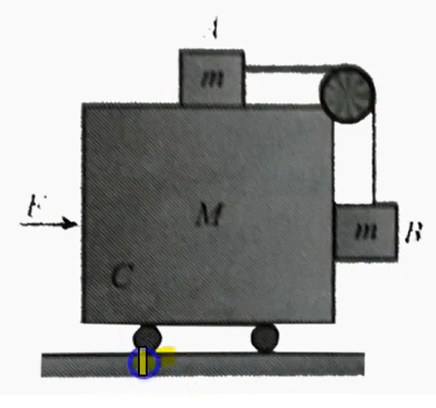
Consider the situation shown in figure. ...

Consider the situation shown in figure. The horizontal surface below the bigger block is smooth. The coefficient of frictioin bewen the blocks is `mu`. Find the minimum and the maximum force F that can be applied in order to keepthe smaller block at respect to the bigger block.

Text Solution

Verified by Experts

If no force is applied, the block A will slip on C towards right and the block B will move downward. Suppose the minimum force needed to prevent sliping is F. Taking A+B+C as the system, the obly exterN/Al horizontal force on the system is F. Hence the acceleratioinof the system is
` a=F/(M+2m)`..........i
Now take the block a as the system. The forces on A are.
,

i. tension t by the string towards right,
ii. friction fi by the block C towards left,
iii. weight mg downward and
normal force N upward
For veticla equilibrium N=mg
As the minimum force neede dto prevent slipping is appied, the fricton is limiting. Thus,
f=mu N=mu mg`
As the block moves towards right with an acceleration a
`T-f=ma`
or `T-mu mg=ma`.........ii
Now take the block B as the system. The forces are,
i. Tension T upward
ii. weight mg downward
iii. normal force N towards right and
friction f upward
As the block moves towards right with an acceleration a,
`N'=ma`
As the friction is limiting `f'=mu N'=mu ma`
For vertical equilibrium
`T+f'=mg`
or `T+mu ma =mg` ..........iii
ElimiN/Ating T from ii. and iii
`a_(min)=(1-mu)/(1+mu) g`.
When a large force is appied the block A slips on C towards left and the block B slips on C in the upward directin. The friction on A is towards right and that on B is downwards. Solving as above, the acceleration in this case is
`a_(max)=(1+mu)/(1-mu)g`
Thus, a lies between `(1-mu)/(1+mu)g and (1+mu)/(1-mu)g`
from the force F should be between
` (1-mu)/(1+mu)(M+2m) g and (1+mu)/(1-mu)(M+2m)g`.
Promotional Banner

Topper's Solved these Questions

Similar Questions

Explore conceptually related problems

Consider the situation shown in Fig. The hirizontal surface below the bigger block is smooth the coefficient of friction between the block is mu find the minimum and the maximum force F that can be applied in order to keep the smaller blocks at rest with respoct to the bigger block

Consider the situation shwon in Fig. 7.49 . The horizontal surface below the bigger block is smooth . The coefficient of friction between the blocks is mu . Find the minimum and maximum accelerations with which the system should move in order to keep the smaller blocks at rest with respect to the bigger block .

Consider the situation shown in the figure . The coefficient of friction between the blocks is mu . Find the minimum and the maximum force F that can be applied so that two blocks move together.

Find out the range of force for which smaller block is at rest with respect to bigger block.

A block of mass m is placed on another block of mass M lying on a smooth horizontal surface as shown in the figure. The co-efficient of friction between the blocks is mu . Find the maximum horizontal force F (in Newton) that can be applied to the block M so that the blocks together with same acceleration? (M=3kg, m=2kg, mu=0.1, g=10m//s^(2))

Two blocks of Masses M and 2M are connected by a spring of stiffness k .The coefficient of friction between the blocks and the surface is mu Find the minimum constant force F to be applied to 2m in order to slide the mass M .

In the adjoining figure, the coefficient of friction between wedge ( of mass M) and block ( of mass m) is mu . Find the minimum horizontal force F rquired to keep the block stationary with respect to wedge

In the adjoining figure, the coefficient of friction between wedge (of mass M ) and block (of mass m ) is mu . Find the minimum horizontal force F required to keep the block stationary with respect to wedge.

The coefficient of static friction between the two blocks shown in figure is mu and the table is smooth. What maximum horizontal forced F can be applied to he block of mass M so that the block move together?

Determine the time in which the smaller block reaches other end of bigger block in figure

