Home
Class 11
PHYSICS
Two identical cylindrical vessel with th...

Two identical cylindrical vessel with their bases at the same level each contain a liquid of density `rho`. The height of the liquid in one vessel is `h_(1)` and in the other is `h_(2)` the area of either base is A. What is the work done by gravity is equalising the levels when the two vessels are connected?

Text Solution

Verified by Experts
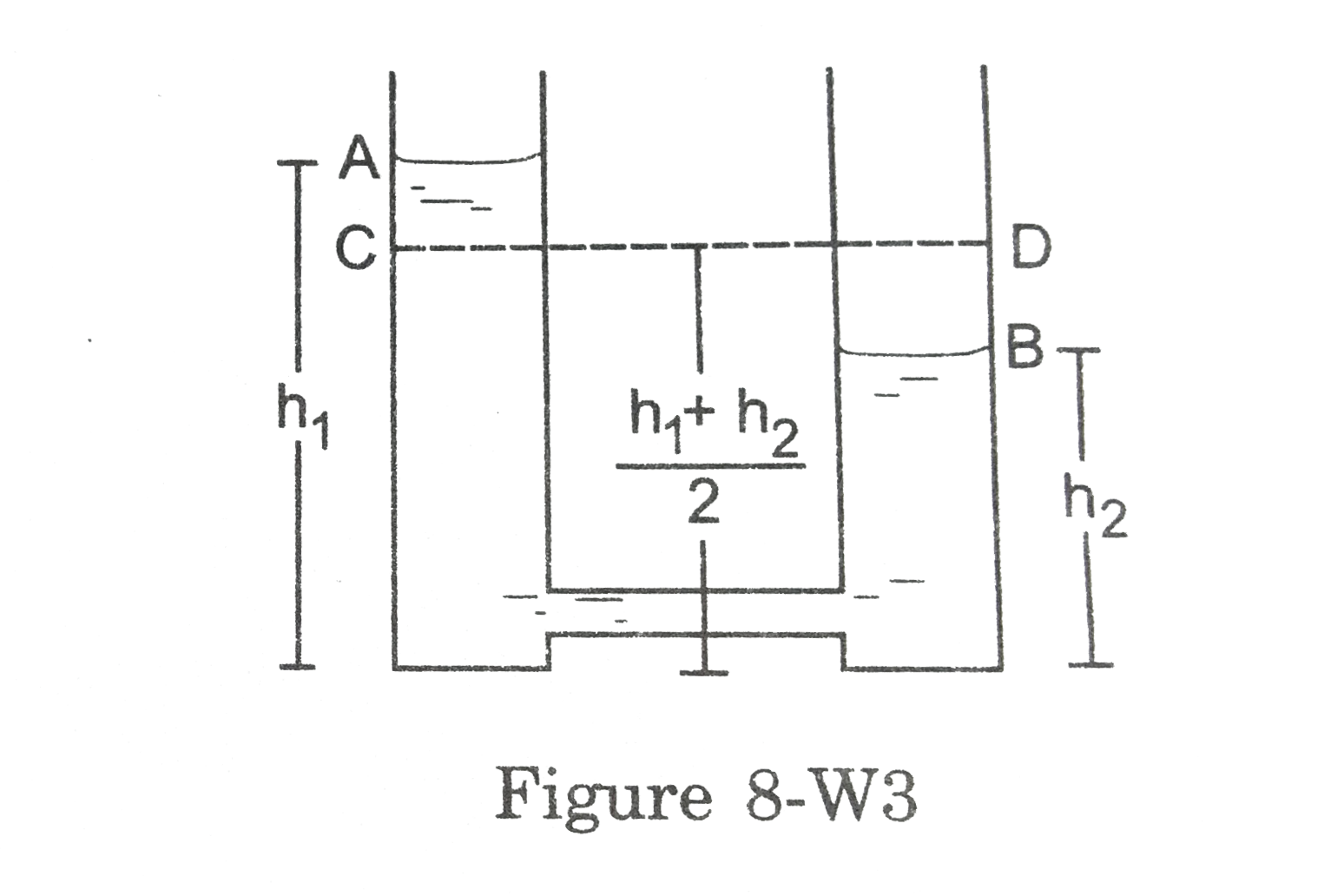
Since the total volume of the water is constant, the height in each vessel after interconnection will be `(h_1+h_2)/2`. The level in the left vessel shown in the ure, drops form A to C and that in the right vessel rises from B to D. Effectively, the water in the part AC has dropped down to DB.

The mass of this volume of water is
`m=rhoA(h_1-(h_1+h_2)/2)`
`rho A((h_1-h_2)/2)`
The height descended by this waster is `AC=(h_1-h_2)/2`. The work done by the force of gravity during this process is therefore,
`rhoA((h_1-h_2)/2)^2g`.
Promotional Banner

Topper's Solved these Questions

  • WORK AND ENERGY

    HC VERMA|Exercise Short Answer|15 Videos
  • WORK AND ENERGY

    HC VERMA|Exercise Objective 1|10 Videos
  • WORK AND ENERGY

    HC VERMA|Exercise Exercises|64 Videos
  • WAVE MOTION AND WAVES ON A STRING

    HC VERMA|Exercise Exercises|57 Videos

Similar Questions

Explore conceptually related problems

Two identical cylindrical vessels with their bases at the same level each, contain a liquid of density rho . The area of either base is A but in one vessel the liquid heigth is h_(1) and in the other liquid height is h_(2)(h_(2)lth_(1)) . If the two vessel are connected, the work done by gravity in equalizing the level is

Two identical cylindrical vessels with their bases at the same level each contain a liquid of density 1.30 xx 10^(3) kg//m^(3) . The area of each base is 4.25 cm^(2) , but in one vessel the liquid height is 0.854 m and in the other it is 1.560 m. Find the work done by the gravitational force in equalizing the levels when the two vessels are connected

Two identical cylindrical vessels are kept on the ground and each contain the same liquid of density d. The area of the base of both vessel is x_(1) and in the other, x_(2) . When both cylinders are connected through a pipe of negligible volume very close to the bottom, the liquid flows from one vessel to the other until it comes to equilibrium at a new height. The change in energy of the system in the process is :

Two identical cylindrical vessels have the same base area but are filled with different volumes of water . The forces on the bases of the two vessels are same .

A U-tube of cross section A and 2A contains liquid of density rho . Initially, the liquid in the two arms are held with a level difference h as shown in figure. After being released the levels equalize after some time. The work done by gravity forces on the liquid in the process is :

A cylindrical vessel contains a liquid of density rho up to height h . The liquid is closed by a piston of mass m and area of cross section A . There is a small hole at the bottom of the vessel. The speed v with which the liquid comes out of the hole is

Two vessels have different base area. They are filled with water to the same height. If the amount of water in one be 6 times that in the other, then the ratio of pressure on their botton will be

