Home
Class 11
PHYSICS
The density of a linear rod of length L ...

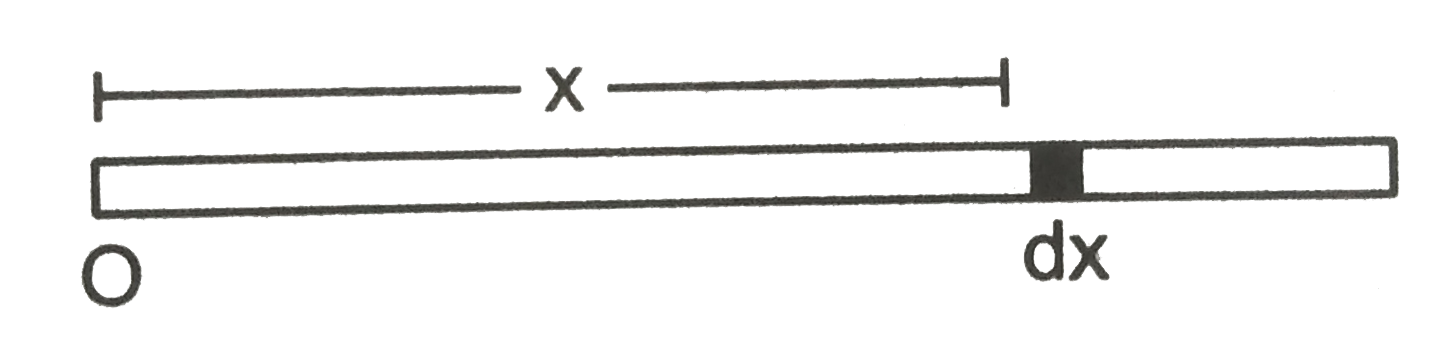
The density of a linear rod of length L varies as `rho=A+Bx` where x is the distance from the left end. Locate the centre of mass.

Text Solution

Verified by Experts

Let the cross sectioN/Al area be `alpha`. The mass of an element of length dx located at a distance x away from the left end is `(A+Bx) alphadx`. The x coordilN/Ate of the centre of mass is given by
`X_(CM)=(intx dm)/(int dm)=(int_0^Lx(A+Bx)alpha dx)/(int_0^L(A+Bx)alphaxd)`
`=(AL^2/2+BL^3/3)/(AL+BL^2/2)=(3AL+2BL^2)/(3(2A+BL))`
Promotional Banner

Similar Questions

Explore conceptually related problems

The linear density of a thin rod of length 1m lies as lambda = (1+2x) , where x is the distance from its one end. Find the distance of its center of mass from this end.

If the linear density of a rod of length L varies as lambda = A+Bx , find the position of its centre of mass .

The density of a thin rod of length l varies with the distance x from one end as rho=rho_0(x^2)/(l^2) . Find the position of centre of mass of rod.

If the linear density (mass per unit length) of a rod of length 3 m is proportional to x , where x , where x is the distance from one end of the rod, the distance of the centre of gravity of the rod from this end is.

If linear density of a rod of length 3m varies as lambda = 2 + x, them the position of the centre of gravity of the rod is

If linear density of a rod of length 3m varies as lamda=2+x , then the position of the centre of mass of the rod is P/7m . Find the value of P.

Find coordinates of mass center of a non-uniform rod of length L whose linear mass density lambda varies as lambda=a+bx, where x is the distance from the lighter end.

A rod of length L is of non uniform cross-section. Its mass per unit length varies linearly with distance from left end. Then its centre of mass from left end is at a distance. (Take linear density at left end=0).

The mass per unit length of a non- uniform rod OP of length L varies as m=k(x)/(L) where k is a constant and x is the distance of any point on the rod from end 0 .The distance of the centre of mass of the rod from end 0 is

The linear mass density of a thin rod AB of length L varies from A to B as lambda (x) =lambda_0 (1 + x/L) . Where x is the distance from A. If M is the mass of the rod then its moment of inertia about an axis passing through A and perpendicualr to the rod is :
