Home
Class 11
PHYSICS
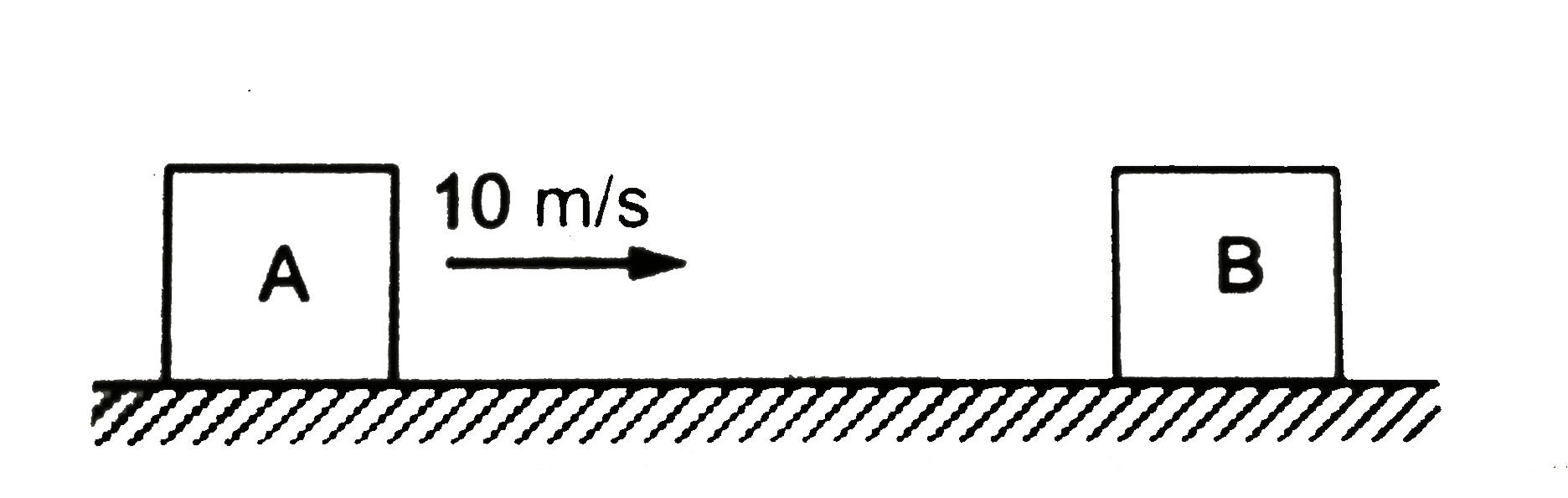
The blocks shown in figure have equal ma...

The blocks shown in figure have equal masses. The surface of A is smooth but that of B has a friction coefficient of 0.10 with the floor. Block A is moving at a speed of 10 m/s towards B which is kept at rest. Find the distance travelled by B if a. the collision is perfectly elastic and b. the collision is perfectly inelastic. Take `g=10 m/s^2`.

Text Solution

Verified by Experts

`V_1=10 m/s`
`V_2=0`
`v_1, v_2rarr` velcity of A and B after collision a. if the collision is perfectly elastic
`mV_1+mV_2=Mv_1+mv_2`
`rarr 10+0=v_1+v_2`
`v_1+v_2=10`…..i
Again `v_1+v_2=-(u_1-v_2)`
`=-(10.0)=-10`…ii
Substracting ii frm ii
`2v_2=20`
`rarr v_2=10 m/s`
the deceleration of B
`putting work energy principle
`:.(1/2)xxmxx(0)^2-91/2)xxmxxv^2`
`=-mxxaxxh`
`rarr -(1/2)xx (10)^2=-mugxxh
`rarr h=100/(2xx1xx10)=50m`
b. if the collision is perfectly in elastic
`mxxu_1+mxxu_2=(m+m)xxv`
`rarr mxx10+mxx0=2mxxv`
`rarr v=(10/2)=5m/s`
The two blocks will move together sticking to each other
`:. Putting work energy principle
`(1/2)xx2mxx(0)^2xx2mxx(v)^2`
`=2mxxmugxxs`
`rarr ((5)^2)/(0.1xx10xx2)=S`
`=S=12.5m`
Promotional Banner

Topper's Solved these Questions

  • CENTRE OF MASS, LINEAR MOMENTUM, COLLISION

    HC VERMA|Exercise Objective 2|11 Videos
  • CALORIMETRY

    HC VERMA|Exercise Exercises|18 Videos
  • CIRCULAR MOTION

    HC VERMA|Exercise Exercises|30 Videos

Similar Questions

Explore conceptually related problems

In the previous problem another block C of mass m is placed at distance 1 m right of block B . Find (a) the distance travelled by the combined mass if the collision is completely inelastic and (b) separation between the blocks when they stop after head - on elastic collision.

The friction coefficient between the horizontal surface and each of the block shown in the figure is 0.2 . The collision between the blocks is perfectly elastic. Find the separation between them when they come to rest. (Take g=10m//s^2 ).

Two particles each of mass m moving with equal speed 2m/s along the indicated direction in the figure undergo a perfectly inelastic collision.Velocity of combined system after collision is ?

A system is shown in the figure. Block A is moving with 1m//s towards left. Wedge is moving with 1m//s towards right. Then speed of the block B will be :

Two steel balls A and B of mass 10 kg and 10 g rolls towards each other with 5 m/s and 1 m/s respectively on a smooth floor. After collision, with what speed B moves (perfectly elastic collision)?

Two steel balls A and B of mass 10 kg and 10 g rolls towards each other with 5m/s and 1 m/s respectively on a smooth floor. After collision, with what speed B moves [perfectly elastic collision]?

The friction coefficient between the horizontal surfce and ech of the blocks shown in figure is 0.20. The collision between the blocks is perfectly elastic. Find the separation between the two blocks when they come to rest. Take g=10 m/s^2 .

A buttle weighting 10 g and moving with a velocity 800 ms^(-1) strikes a 10 kg block resting on a frictionless surface. The speed of the block after the perfectly inelastic collision is approximately

Three blocks A, B and C are lying on a smooth horizontal surface, as shown in the figure. A and B have equal masses, m while C has mass M. Block A is given an inita speed v towards B due to which it collides with B perfectly inelastically. The combined mass collides with C, also perfectly inelastically (5)/(6)th of the initial kinetic energy is lost in whole process. What is balue of M//M?

The friction coefficient between the horizontal surface and blocks A and B are (1)/(15) and (2)/(15) respectively. The collision between the blocks is perfectly elastic. Find the separation (in meters) between the two blcoks when they come to rest.

HC VERMA-CENTRE OF MASS, LINEAR MOMENTUM, COLLISION-Exercises
  1. Solve tehh previous problem if the coefficient of restitution is e. Us...

    Text Solution

    |

  2. A block of mass 180 g is suspended by a massless spring. The spring ex...

    Text Solution

    |

  3. A bullet of mass 25 g is fired horizontally into a ballistic pendulum ...

    Text Solution

    |

  4. A bullet of mass 20 g moving horizontally at speed of 300 m/s is fire...

    Text Solution

    |

  5. Two masses m1 and m2 re connected by a spring of spring constnt k and ...

    Text Solution

    |

  6. Two blocks of masses m1 and m2 are connected by a spring of spring con...

    Text Solution

    |

  7. Cionsider the situation of the previous problem. Suppose each of tbe b...

    Text Solution

    |

  8. consider the situastion of the previous problem. Suppose the block of ...

    Text Solution

    |

  9. Consider a gravity free hall in which an experimetner of mass 50 kg is...

    Text Solution

    |

  10. The track shown in figure is frictionles. The block B of mass 2m is ly...

    Text Solution

    |

  11. A bullet of mass 10 g moving horizontally at asped dof 50sqrt7m/s stri...

    Text Solution

    |

  12. Two balls having masses m and 2m are fastened to two light strings of ...

    Text Solution

    |

  13. A uniform chain of mass M and length L is held verticallyi in such a w...

    Text Solution

    |

  14. The blocks shown in figure have equal masses. The surface of A is smoo...

    Text Solution

    |

  15. The friction coefficient between the horizontal surface and each of th...

    Text Solution

    |

  16. A block of mas m is placed on a triangular block of mas m, which in tu...

    Text Solution

    |

  17. Figure shows a small body of mass m placed over a larger mass M whose ...

    Text Solution

    |

  18. A small block of superdennse material has a mass of 3xx10^24 kg. It i...

    Text Solution

    |

  19. A body of mass m makes an elastic collision with another identical bod...

    Text Solution

    |

  20. A small particle travelling with a velocity v collides elastically wit...

    Text Solution

    |
