Home
Class 11
PHYSICS
A small block of mass m is kept on a big...

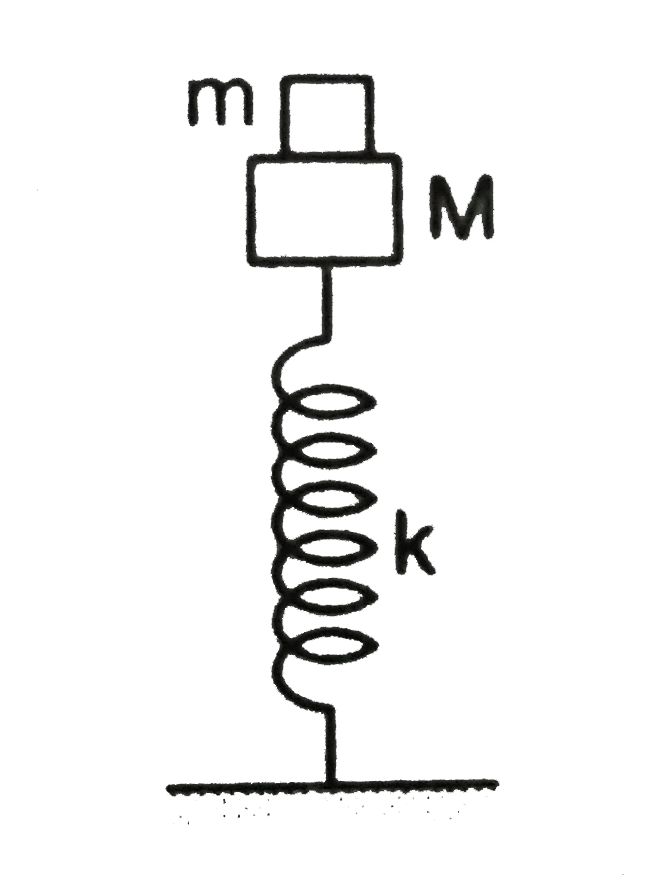
A small block of mass m is kept on a bigger block of mass M which is attached to a vertical spring of spring constant k as shown in the figure. The system oscilates verticaly. a.Find the resultant force on the smaller block when it is displaced through a distance x above its equilibrium position. b. find the normal force on the smaller blok at this position. When is this force smallest smaller block at this position. When is this force smallest in magnitude? c. What can be the maximum amplitude with which the two blocks may oscillate together?

Text Solution

Verified by Experts

The correct Answer is:

`x=(mkx)/(M+m)``=
-mg-(mkx)/(M+N)`
maximum amplitude
`=(g(M+m))/k`

`a`. From the fre bdoy diagram
:. `R+momegay^2x-mg=0` ……….
Resultant force `momega^2x=mg-R`
`rarr momega^2x=m(k/(M+m))x`
`x=(mkx)/(M+m)`
`omega=sqrt({k/(M+m)})`
[for spring mas system]
`b`. `R=mg-momega^2x`
`=mg-m(mk)/(M+N)x`
`=-mg-(mkx)/(M+N)`
For LR to be smallest `momega^2x` should be max, i.e. x is maximum.
The particle should be at the highest point.
`c`. We have `R=mg-momega^2x`
The two blocks may oscillate together in such a way that R is greater than 0.
At limiting condition R=0
`mg=momega^2x`
`=x=(mg)/(momega^2)=(mg.(M+m))/(mk)`
So the maximum amplitude
`=(g(M+m))/k`
Promotional Banner

Topper's Solved these Questions

  • SIMPLE HARMONIC MOTION

    HC VERMA|Exercise Objective-2|2 Videos
  • ROTATIONAL MECHANICS

    HC VERMA|Exercise Exercises|86 Videos
  • SOME MECHANICAL PROPERTIES OF MATTER

    HC VERMA|Exercise Exercises|32 Videos

Similar Questions

Explore conceptually related problems

A block of mass m is connected to another .block of mass M by a massless spring of spring constant k. A constant force f starts action as shown in figure, then:

A block of mass m is attached to two unstretched springs of spring constants k_1 and k_2 as shown in figure. The block is displaced towards right through a distance x and is released. Find the speed of the block as it psses through the mean position shown.

A small block of mass 2 kg is placed on a bigger block of mass 4 kg which is attached to horizontal spring of spring constant K = 500 N //m as shown in figure, coefficient of friction between block is 0.2 .Maximum amplitude of system so that there is no relative slipping between blocks.

A block of mass 0.2 kg is attached to a mass less spring of force constant 80 N/m as shown in figure. Find the period of oscillation. Take g=10 m//s^(2) . Neglect friction

A block of mass m is attached to four unstretched massless springs of spring constant k_1 and k_2 as shown in figure. The block is displaced towards right through distance x and is released. Speed of block when displacement of block is x/2 from mean position is :

A block of mass m is attached to two unstretched springs of springs constant k_(1) and k_(2) as shown in figure. The block is displaced towards right through a distance x and is released. Find the speed of the block as it passes through the mean position shown.

A small block is connected to a massless rod, which in turns attached to a spring of force constnat (K =2N//m) as shown in the fig. The block is displaced down slightly and left free. Find its time period.

A block of mass m is attached to two unstretched springs of spring constant k , each as shown. The block is displaced towards right through a distance x and is released The speed of the block as it passes through the mean position will be

A small block is connected to a mass less rod, which is turn is attached to a spring of force constant k as shown in Fig. The blcok is displaced down slightly, and left free. Find time period of small oscillations.

HC VERMA-SIMPLE HARMONIC MOTION-Exercises
  1. A body of mass 2 kg suspended through a vertical spring executes simpl...

    Text Solution

    |

  2. A spring stores 5J of energy when stretched by 25 cm. It is kept verti...

    Text Solution

    |

  3. A small block of mass m is kept on a bigger block of mass M which is a...

    Text Solution

    |

  4. The block of mass m1 shown in figure is fastened to the spring and the...

    Text Solution

    |

  5. In figue k=100Nm^-1 M=1kg and F=10N. a. Find the compression of the sp...

    Text Solution

    |

  6. Find the time period of the oscillation of mass m in figure a,b,c wha...

    Text Solution

    |

  7. The spring shown in figure is unstretched when a man starts pulling on...

    Text Solution

    |

  8. A particle of mass m is asttached to three springs A,B and C of equla ...

    Text Solution

    |

  9. Repeat the previous exercise if the angle between each pair of springs...

    Text Solution

    |

  10. The springs shown in the figure are all unstretched in the beginning w...

    Text Solution

    |

  11. Find the elastic potential energy stored in each spring shown in figu...

    Text Solution

    |

  12. The string ,the spring and the pulley shown in figure are light. Find ...

    Text Solution

    |

  13. Solve the previous problem if the pulley has a moment of inertia I abo...

    Text Solution

    |

  14. Consider the situastion shown in figure. Show that if that blocks are ...

    Text Solution

    |

  15. A rectangular plate of sides a and b is suspended fropm a ceilling by ...

    Text Solution

    |

  16. A 1kg block is eecuting simpe hrmonic motion of ampliltude 0.1 m m on ...

    Text Solution

    |

  17. The left block in figure moves at a speed v towards the right block pl...

    Text Solution

    |

  18. Find the time period of the motion of the particle shown in figure. Ne...

    Text Solution

    |

  19. All the surfaces shown in figure are frictionless. The mass of the car...

    Text Solution

    |

  20. A uniform table of mas M stays horizontally and symmetrically on two w...

    Text Solution

    |
