Home
Class 11
PHYSICS
All the surfaces shown in figure are fri...

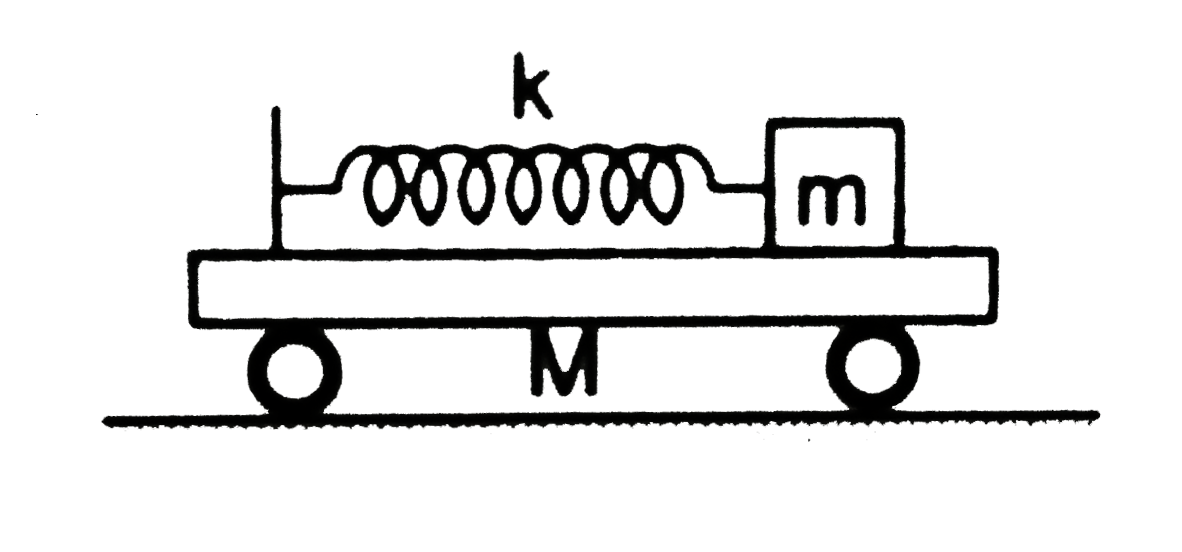
All the surfaces shown in figure are frictionless. The mass of the car is M, that of the block is mk and the spring has spring constant. Initialy the car and the block are at rest and the spring is stretched through a length `x_0` when the system is released. a. Find the amplitude of the simple harmonic motion of the blocks and of the car as seen from the road. b. Find the time periods of the two simple harmonic motions.

Text Solution

Verified by Experts

The correct Answer is:

A, B

Let the amplitude of oscillation of m and M be `x_1 and x_2` respectively.
a. From law of conservation of momentum `mx_1=Mx_2` ………1
[Block and mass oscillates in opposite direction bt `xprarr` stretched part]. From equation 1 and equation 2`
`:. x_0=x_1+m/Mx_1`
`=((M+m)/M)x`
`so, x_2=x_0-x_1`
`x_0[1-M/(M+m)]`
`=(mx_0)/(M+m)` respectively
b. At any position, let the velocity be `v_1 and v_2` respectively. Here `v_1 velocity of m'` with respect to M. By energy method,
Total Energy=Constant
`1/2mv_2^2+1/2m(v_1-v_2)^2+1/2k(x_1+x_2)^2` ltbr.gt =constant.......3
`[v_1-v-2=` absolute velocity of mass m as seen from the road]
`Mx_2=mx_1`
`rarr x_1=(M/m)x_2`.........4
`Mv_2=m(v_1-v_2)`
`rarr (v_1-v_2)=(M/m)v_2`..........5
Putting the above values in equation 3 we get
`1/2Mv_2^I2+1/2m M/m^2 v_2^2+1/2kx_2^2(1+M/m)`
`:.M(1+M/m)v_2^2+k(1+M/m)x_2^2=constant`
`rarr Mv_2^2+k(1+M/m)x_2^2=constant`
Taking derivative of both sides,
`M_2v_2(dv_2)/(dt)=k((M+m)/m)2x_2(dx_2)/(dt)=0`
`rarr ma_2+k((M+m)/m)x_2=0`
`[because v_2=(dx_2)/(dt)]`
`a_2/x_2=(-kM+m)/(Mm)omega^2`
`:. omega=(-k(M+m))/(Mm)`
So time period
`T=2pi sqrt((Mm)/(M+m))`
Promotional Banner

Topper's Solved these Questions

  • SIMPLE HARMONIC MOTION

    HC VERMA|Exercise Objective-2|2 Videos
  • ROTATIONAL MECHANICS

    HC VERMA|Exercise Exercises|86 Videos
  • SOME MECHANICAL PROPERTIES OF MATTER

    HC VERMA|Exercise Exercises|32 Videos

Similar Questions

Explore conceptually related problems

The block shown in figure is released from rest. Find out the speed of the block when the spring is compressed by 1 m

In the adjoining figure, block A is of mass (m) and block B is of mass2 m. The spring has force constant k. All the surfaces are smooth and the system is released form rest with spring unstretched. .

The block of mass m is released when the spring was in its natrual length. Spring constant is k. Find the maximum elongation of the spring.

A block of mass m is connect to another block of mass M by a massless spring of spring constant k. The blocks are kept on a smooth horizontal plane. Initially the blocks are at rest and the spring is unsrtretched when a constnt force F starts acting on the block of mass M to pull it. Find the maximum extension of the spring.

Two blocks A and B of mass m and 2m respectively are connected by a light spring of force constant k. They are placed on a smooth horizontal surface. Spring is stretched by a length x and then released. Find the relative velocity of the blocks when the spring comes to its natural length

A block of mass m suspended from a spring of spring constant k . Find the amplitude of S.H.M.

A constant force F is applied on a spring block system as shown in figure. The mass of the block is m and spring constant is k. The block is placed over a smooth surface. Initially the spring was unstretched. Choose the correct alternative(s)

Find the maximum tension in the spring if initially spring at its natural length when block is released from rest.

A block of mass m is connected to another block of mass M by a spring (massless) of spring constant k. The block are kept on a smooth horizontal plane. Initially the blocks are at rest and the spring is unstretched. Then a constant force F starts acting on the block of mass M to pull it. Find the force of the block of mass M.

HC VERMA-SIMPLE HARMONIC MOTION-Exercises
  1. The left block in figure moves at a speed v towards the right block pl...

    Text Solution

    |

  2. Find the time period of the motion of the particle shown in figure. Ne...

    Text Solution

    |

  3. All the surfaces shown in figure are frictionless. The mass of the car...

    Text Solution

    |

  4. A uniform table of mas M stays horizontally and symmetrically on two w...

    Text Solution

    |

  5. Find the length of seconds pendulum at a place where g = pi^(2) m//s^(...

    Text Solution

    |

  6. The angle made by the string of a simple pendulum with the vertical de...

    Text Solution

    |

  7. The pendulum of certain clock has time period 2.04 s. How fast or slow...

    Text Solution

    |

  8. A pendulum clock giving correct time at a place where g=9.800 ms^-2 is...

    Text Solution

    |

  9. A simple pendulum is constructed by hanging a heavy ball by a 5.0 long...

    Text Solution

    |

  10. The maximum tension in the string of an oscillating pendulum is double...

    Text Solution

    |

  11. A small block oscillates back and forth on as smooth concave surface o...

    Text Solution

    |

  12. A spherical ball of mass m and radius r rolls without slipping on a ro...

    Text Solution

    |

  13. The simple pendulum of length 40 cm is taken inside a deep mine. Assum...

    Text Solution

    |

  14. Assume that a tunnel is dug across the earth (radius=R) passing throug...

    Text Solution

    |

  15. Assume that a tunnel ils dug along a chord of the earth, at a perpendi...

    Text Solution

    |

  16. A simple pendulum of length l is suspended throught the ceiling of an ...

    Text Solution

    |

  17. A simple pendulum of length 1 feet suspended from the ceiling of an el...

    Text Solution

    |

  18. A simple pendulum fixed in a car has a time period of 4 seconds when t...

    Text Solution

    |

  19. A simple pendulum of length l is suspended from the ceilling of a car ...

    Text Solution

    |

  20. The ear ring of a lady shown in figure has a 3 cm long light suspensi...

    Text Solution

    |
