

Home
Class 11
PHYSICS
Figure 14.26 (a) shows a spring of force...

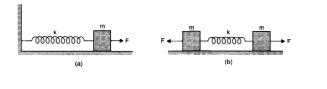
Figure 14.26 (a) shows a spring of force constant k clamped rigidly at one end and a mass m attached to its free end. A force F applied at the free end stretches the spring. Figure 14.26 (b) shows the same spring with both ends free and attached to a mass m at either end. Each end of the spring in Fig. 14.26(b) is stretched by the same force F.

(a) What is the maximum extension of the spring in the two cases ?
(b) If the mass in Fig. (a) and the two masses in Fig. (b) are released, what is the period of oscillation in each case ?

Promotional Banner

Similar Questions

Explore conceptually related problems

Figure 14.26 (a) shows a spring of force constant k clamped rigidly at one end and a mass m attached to its free end. A force F applied at the free end stretches the spring. Figure 14.26 (b) shows the same spring with both ends free and attached to a mass m at either end. Each end of the spring in Fig. 14.26(b) is stretched by the same force F. What is the maximum extension of the spring in the two cases ?

Figure 14.26 (a) shows a spring of force constant k clamped rigidly at one end and a mass m attached to its free end. A force F applied at the free end stretches the spring. Figure 14.26 (b) shows the same spring with both ends free and attached to a mass m at either end. Each end of the spring in Fig. 14.26(b) is stretched by the same force F. What is the maximum extension of the spring in the two cases ?

Figure 14.26 (a) shows a spring of force constant k clamped rigidly at one end and a mass m attached to its free end. A force F applied at the free end stretches the spring. Figure 14.26 (b) shows the same spring with both endsfree and attached to a mass m at either end. Each end of the spring in Fig. 14.26(b) is stretched by the same force F What is the maximum extension of the spring in the two cases ?

Figure a) shows a spring of force constant k clamped rigidly at once end and a mass m attached to its free end. A force F applied at the free end stretches the spring. Figure b) shows the same spring with both ends free and attached to a mass m at either end. Each end of the spring in figure is stretched by the same force F. (a) What is the maximum extension of the spring in the two cases ? (b) If the mass in figure and the two masses in figure are released free, what is the period of oscillation in each case?

Figure a) shows a spring of force constant k clamped rigidly at once end and a mass m attached to its free end. A force F applied at the free end stretches the spring. Figure b) shows the same spring with both ends free and attached to a mass m at either end. Each end of the spring in figure is stretched by the same force F. (a) What is the maximum extension of the spring in the two cases ? (b) If the mass in figure and the two masses in figure are released free, what is the period of oscillation in each case?

spring of force constant k clamped rigidly at onoe end and a mass m attached to its free end. A force F applied at the free end stretches the spring. Figure shows the same spring with both ends free and attached to a mass m at either end. Each end of the spring in figure is stretched by the same force F. (a) What is the maximum extension of the spring in the two cases ? (b) If the mass in figure and the two masses in figure are released free, what is the period of oscillation in each case?