Home
Class 12
PHYSICS
Find the size of the image formed in the...

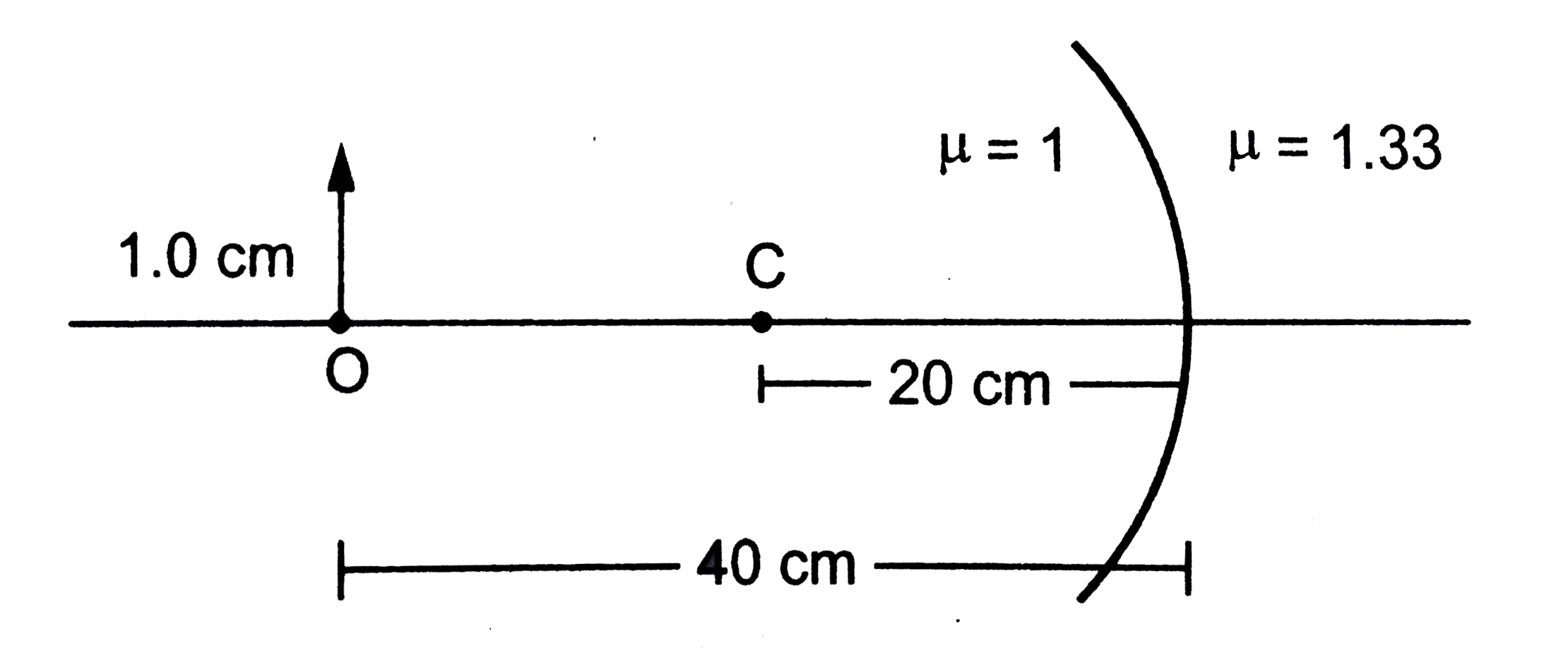
Find the size of the image formed in the situation shown in figure.

A

`-0.6cm`

B

`+0.6cm`

C

`+0.1cm`

D

`+1.2cm`

Text Solution

Verified by Experts

The correct Answer is:

B

Here u=-40cm, R=-20cm, `mu_1=1, mu_2=1.33. We have`
`mu_2/v-mu_1/u=(mu_2-mu_1)/R`
`or, 1.33/v-1/(-40cm)=1.33/(-20cm)`
or, `1.33/v=-1/(40cm)-0.3./(20cm)`
`or v=-32cm`
The magnification is
`m=h_2/h_1=(mu_1v)/(mu_2u)`
`or h_2/(1.0cm)=(-32cm)/(1.33x(-40cm)`
or `h_2=+0.6cm`
The image is erect.
Promotional Banner

Topper's Solved these Questions

  • GEOMETRICAL OPTICS

    HC VERMA|Exercise Worked out Examples|28 Videos
  • GEOMETRICAL OPTICS

    HC VERMA|Exercise Short Answer|18 Videos
  • GEOMETRICAL OPTICS

    HC VERMA|Exercise Exercises|79 Videos
  • GAUSS LAW

    HC VERMA|Exercise Exercises|24 Videos
  • LIGHT WAVES

    HC VERMA|Exercise Exercises|41 Videos

Similar Questions

Explore conceptually related problems

Find the location and size of image for the situation shown in figure. Height of the object is 2 cm. Radius of curvature of surface is 25 cm and object is kept at a distance 50 cm from the surface.

Locate the image formed by refraction in the situation shown in figure

An object of height 1mm is placed inside a sphere of refractive index mu=2 and radius of curvature 20 cm as shown in the figure. Find the position, size, and nature of image, for the situation shown in Figure. Draw ray diagram.

Find the positon of final images formed. (The gap shown in figure of negligible width)

Find the velocity of the image of a moving object in situation shown in figure in which object and mirror velocities in horizontal and vertical directions are shown.

Find the acceleration of the block of mass M in the situation shown in figure. All the surfaces are frictionless.

find the acceleration of the block of mass M in the situation shown in figure. All the surfaces are frictionless and the pulleys and the string are light.

what is the position and nature of image formed by lens combination shown in figure ? (f_(1),f_(2) are focal lengths)

Find the position of the image formed by the lens combination given in the following figure :
