Home
Class 12
MATHS
Let A B C be a triangle such that /A C B...

Let `A B C` be a triangle such that `/_A C B=pi/6` and let `a , ba n dc` denote the lengths of the side opposite to `A , B ,a n dC` respectively. The value(s) of `x` for which `a=x^2+x+1,b=x^2-1,a n dc=2x+1` is(are)

A

`-(2+sqrt(3))`

B

`1+sqrt(3)`

C

`2+sqrt(3)`

D

`4sqrt(3)`

Text Solution

Verified by Experts

The correct Answer is:
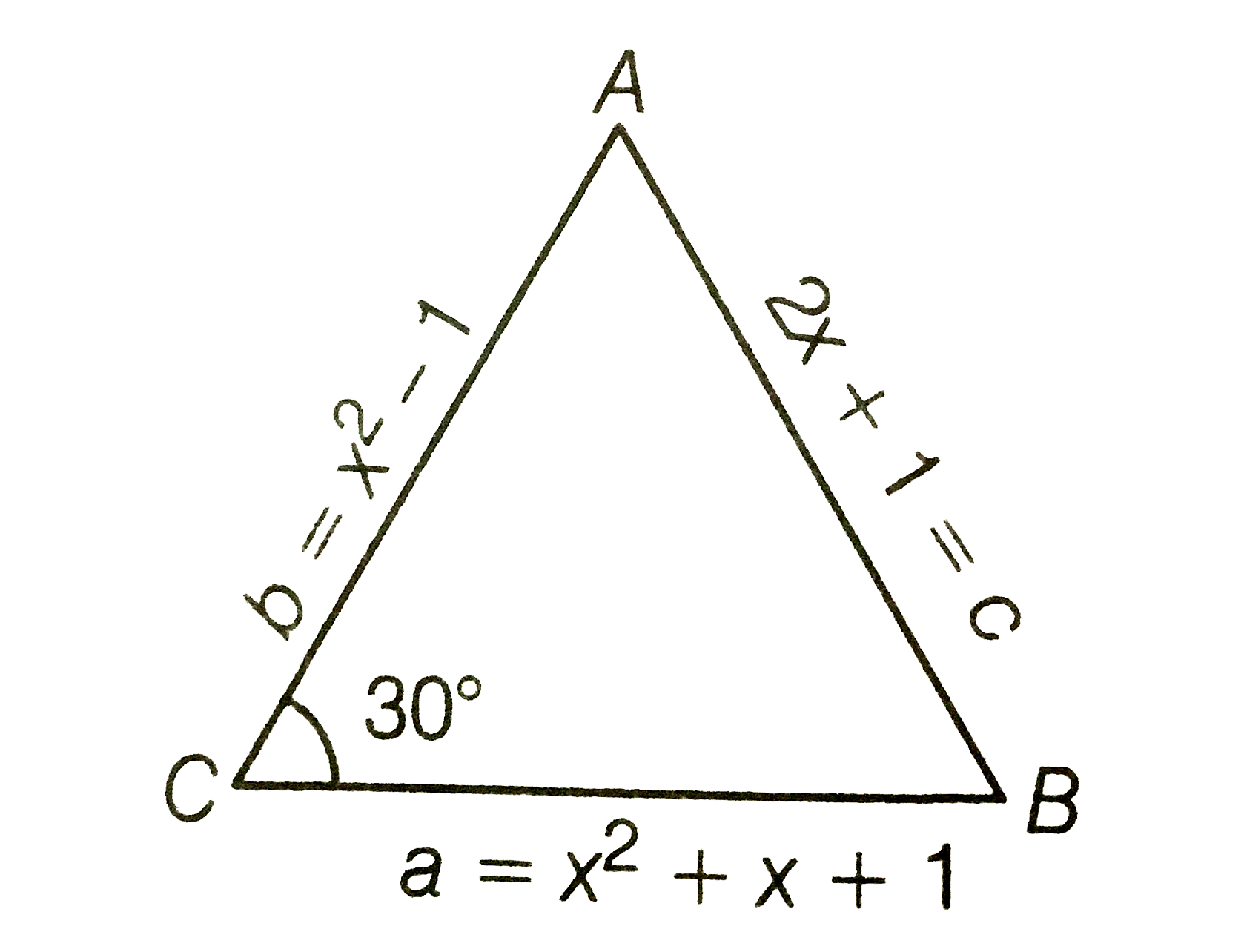
B

Using , `cosC=(a^(2)+b^(2)-c^(2))/(2ab)`

`rArr(sqrt(3))/(2)=((x^(2)+x+1)^(2)+(x^(2)-1)^(2)-(2x+1)^(2))/(2(x^(2)+x+1)(x^(2)-1))`
`rArr(x+2)(x+1)(x-1)x+(x^(2)-1)^(2)=sqrt(3)(x^(2)+x+1)(x^(2)-1)`
`rArrx^(2)+2x+(x^(2)-1)=sqrt(3)(x^(2)+x+1)`
`rArr(2-sqrt(3))x^(2)+(2-sqrt(3))x-(sqrt(3)+1)=0`
`rArrx=-(2-sqrt(3))andx=1+sqrt(3)`
But , `x=-(2+sqrt(3))rArrc` is negative ,which is not possible `x=1+sqrt(3)` is the only solution.
Promotional Banner

Similar Questions

Explore conceptually related problems

Let ABC be a triangle such that angleACB=pi/6 and let a , b and c denote the lengths of the side opposite to A ,B and C respectively. The value of x for which a=x^(2)+x+1,b=x^(2)-1 and c=2x+1 is

Let ABC be a triangle such that /_ACB=(pi)/(6) and let a,b and c denote the lengths of the side opposite to A,B, and C respectively.The value(s) of x for which a=x^(2)+x+1,b=x^(2)-1, and c=2x+1 is(are) -(2+sqrt(3))( b) 1+sqrt(3)2+sqrt(3)(d)4sqrt(3)

Let ABC be a triangle such that /_ABC=(pi)/(6) and let a,b and c denote the lengths of the sides opposite to A,B and C respectively. The value(s) of x for which a=x^(2)+x+1,b=x^(2)-1 and c=2x+1 is /are(a)-(2+sqrt(3))(b)1+sqrt(3)(c)2+sqrt(3) (d) 4qsrt3

Consider a triangle ABC and let a,b and c denote the lengths of the sides opposite to vertices A,B and C respectively.If a=1,b=3 and C=60^(@), the sin^(2)B is equal to

Let P Q R be a triangle of area with a=2,b=7/2,a n dc=5/2, w h e r ea , b ,a n dc are the lengths of the sides of the triangle opposite to the angles at P ,Q ,a n dR respectively. Then (2sinP-sin2P)/(2sinP+sin2P)e q u a l s

In a "Delta"A B C , let a ,b , and c denote the length of sides opposite to vertices A, B, and C respectively. If b=2,c=sqrt(3) and /_B A C=pi/6, then value of circumradius of triangle ABC is- 1/2 (2) 1 (3) 2 (4) 1/4

If A and B are the coefficients of x^(n) in the expansion (1+x)^(2n) and (1+x)^(2n-1) respectively,then

Let the base A B of a triangle A B C be fixed and the vertex C lies on a fixed circle of radius rdot Lines through Aa n dB are drawn to intersect C Ba n dC A , respectively, at Ea n dF such that C E: E B=1:2a n dC F : F A=1:2 . If the point of intersection P of these lines lies on the median through A B for all positions of A B , then the locus of P is a circle of radius r/2 a circle of radius 2r a parabola of latus rectum 4r a rectangular hyperbola

