Home
Class 12
MATHS
The function f(x)=x^(3)-3x is...

The function `f(x)=x^(3)-3x ` is

A

increasing in `(-oo,-1)cup(1,oo)` and decreasin in `(-1,1)`

B

increasing in `(0,oo)` and decreasingg in `(-oo,0)`

C

decreasing in `(0,oo)` and increasing in `(-oo,0)`

D

decreasing in `(-oo,-1)cup(1,oo)` and increasingg in (-1,1)

Text Solution

Verified by Experts

The correct Answer is:
A

We have, function `f(x)=x^(3)-3x`
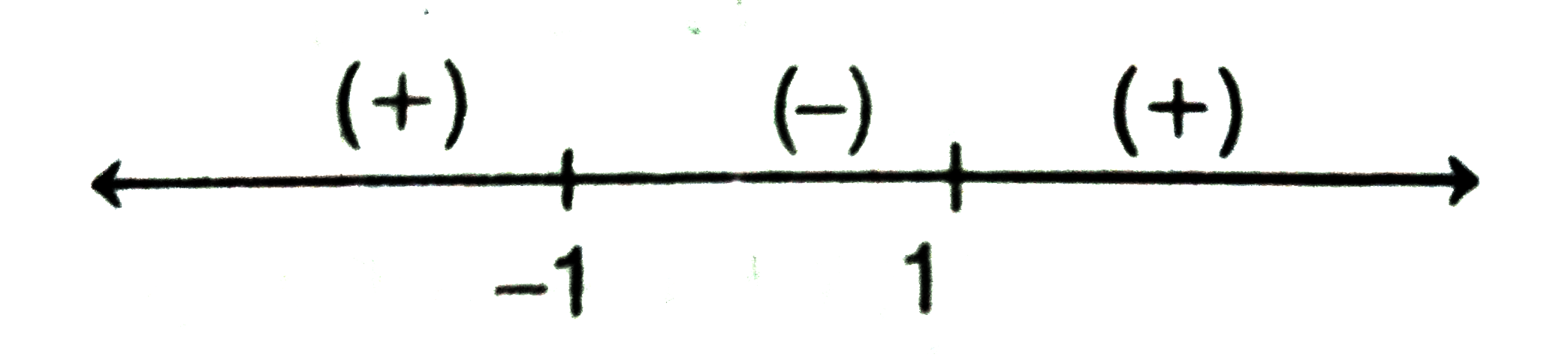
`impliesf(x)=3x^(2)-3=3(x+1)(x-1)`

here, `f'(x) ge 0 ` in `(-oo, -1)cup(1,oo) and f'(x) lt 0` in (-1,1) `thereforef(x)` is increasing `(-oo,-1),cup(1,00)` and decreasing in (-1,1).
Promotional Banner

Topper's Solved these Questions

  • SOLVED PAPER 2018

    MHTCET PREVIOUS YEAR PAPERS AND PRACTICE PAPERS|Exercise MCQS|50 Videos
  • STRAIGHT LINE

    MHTCET PREVIOUS YEAR PAPERS AND PRACTICE PAPERS|Exercise EXERCISE 2(MISCELLANEOUS PROBLEMS)|30 Videos

Similar Questions

Explore conceptually related problems

If the largest interval of x in which the function f(x)=x^(3)-3x+1 is decreasing is (a, b), then the value of a+2b is equal to

The value of c in Rolle's theorem for the function f(x) = x^(3) - 3x in the interval [0,sqrt(3)] is

The value of c in Rolle's theorem for the function f(x) = x^(3) - 3x in the interval [0,sqrt(3)] is

If the sum of infinite tems of a decreasing G.P. is equal to the greatest value of the function f(x)=x^(3)-3x+9 in [-2,3] and the difference between first two terms is |f'(0)| then first term of G.P.is

Find the value of c in Rolles theorem for the function f(x)=x^(3)3x in[sqrt(3),0]

For the function f (x)= x^(3) - 3x + 7 , choose the correct option

The function f(x)=x^(3)-3x^(2)+6 is an increasing funciton for :

The difference between the maximum and minimum values of the function f(x)=x^(3)-3x+4, AA x in {0, 1] is

The range of the function f(x)=(x-3)/(3-x) is :

The function f(x) = x^(3) - 3x^(2) + 3x -100, x in R is:

MHTCET PREVIOUS YEAR PAPERS AND PRACTICE PAPERS-SOLVED PAPER 2019-MCQS
  1. If P(6,10,10),Q(1,0,-5),R(6,-10,lamda) are vertices of a triangle righ...

    Text Solution

    |

  2. For L.P.P, maximize z=4x(1)+2x(2) subject to

    Text Solution

    |

  3. The function f(x)=x^(3)-3x is

    Text Solution

    |

  4. If x=sintheta,y=sin^(3)theta then (d^(2)y)/(dx^(2)) at theta=(pi)/(2) ...

    Text Solution

    |

  5. The area of the region enclosed between pair of the lines xy=0 and the...

    Text Solution

    |

  6. If three dices are thrown then the probability that the sum of the num...

    Text Solution

    |

  7. If f(x)=3x+6,g(x)=4x+k and fog(x)=gof(x) then k= . .

    Text Solution

    |

  8. If the sum of an infinite GP be 9 and sum of first two terms be 5 them...

    Text Solution

    |

  9. the negation of AA, n in N, n +7 gt 6 is . . .

    Text Solution

    |

  10. If the vectors x hati-3hatj+7hatk and hati+yhatj-zhatk are collinear t...

    Text Solution

    |

  11. If int tan(x-alpha)tan(x+alpha)*tan2xdx=plog|sec2x|+qlog|sec(x+alpha)|...

    Text Solution

    |

  12. Using differentiation, approximate value of f(x)=x^(2)-2x+1 at x=2.99 ...

    Text Solution

    |

  13. A particle moves so that x=2+27t-t^(3). The direction of motion revers...

    Text Solution

    |

  14. Which of the following is not equal to w*(uxxv)?

    Text Solution

    |

  15. The value of sin18^(@) is

    Text Solution

    |

  16. If the foot of the perpendicular drawn from the point (0,0,0) to the p...

    Text Solution

    |

  17. int(x^(2)+1)/(x^(4)-x^(2)+1)dx= . . .

    Text Solution

    |

  18. If x^y=e^(x-y); then (dy)/(dx) is

    Text Solution

    |

  19. If A=[(1+2i,i),(-I,1-2i)], where i=sqrt(-1), then A(adjA)=. . .

    Text Solution

    |

  20. Which of the following statements is contingency?

    Text Solution

    |

