Home
Class 11
PHYSICS
A thermodynamic system is taken through ...

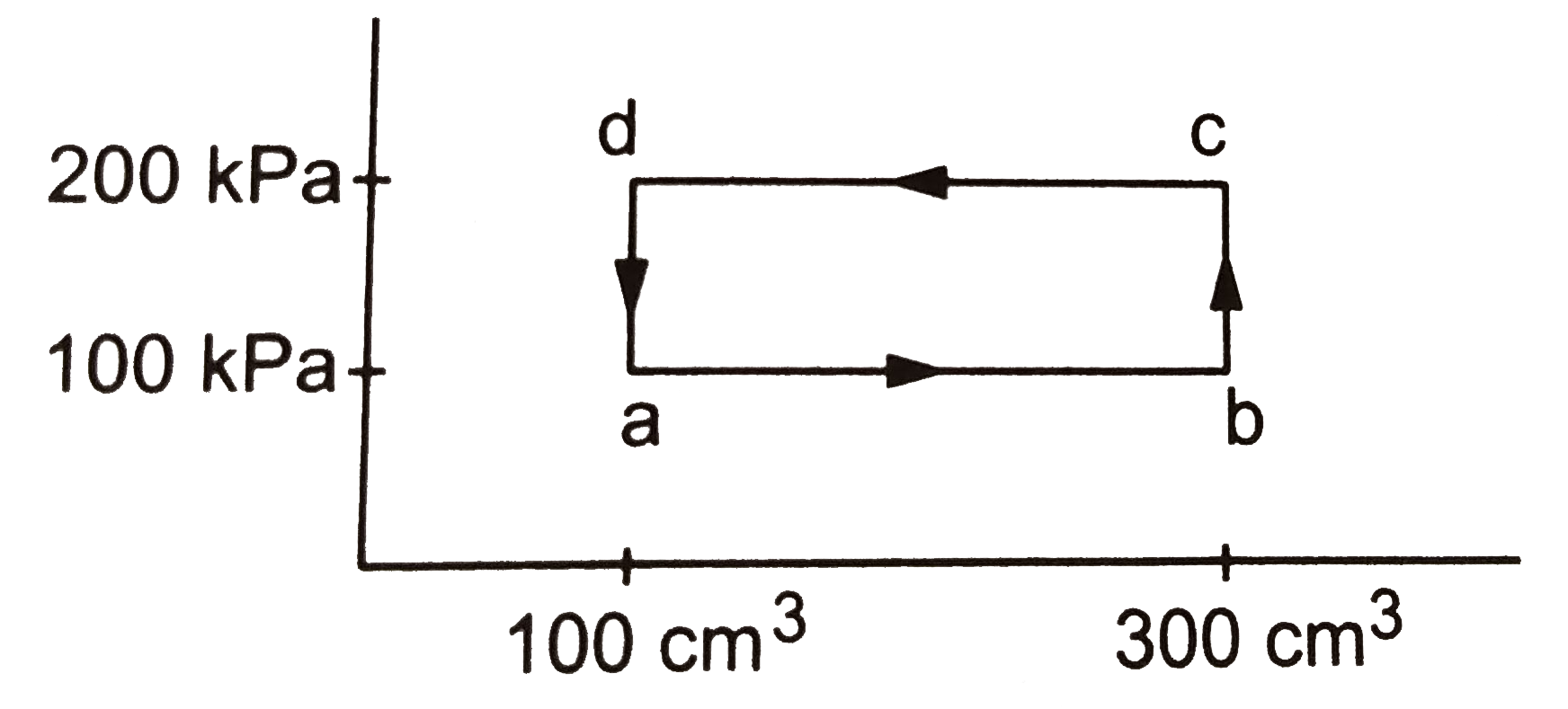
A thermodynamic system is taken through the cycle abcda during the parts ab, bc, cd and da. (b) find the total heat rejected by the gas during the process.

Text Solution

Verified by Experts

(a) The work done during the part ab,
`=int_(a)^(b)pdV=(100 kPa)int_(a)^(b) dV`
`=(100 kPa)(300 cm^(3)-100 cm^(3))
`=20 J`
The work done during bc is zero as the volume does not change. The work done during cd
`=int_(c)^(d) pdV=(200 kPa)(100 cm^(3)-300 cm^(3)) ==-40 J)`.
The work done during da is zero as the volume does not change.
(b) The total work done by the system during the cycle abcda
`DeltaW=20 J-40 J=-20 J`.
The change in internal energy `DeltaU=0` as the initial state is the same as the final state. thus `DeltaQ=DeltaU+DeltaW=20 J`. so the system reject 20 J of heat during the cycle.
Promotional Banner

Topper's Solved these Questions

  • LAWS OF THERMODYNAMICS

    HC VERMA|Exercise Objective 1|9 Videos
  • LAWS OF THERMODYNAMICS

    HC VERMA|Exercise Objective 2|5 Videos
  • LAWS OF THERMODYNAMICS

    HC VERMA|Exercise Short Answer|15 Videos
  • KINETIC THEORY OF GASES

    HC VERMA|Exercise Exercises|62 Videos
  • NEWTON'S LAWS OF MOTION

    HC VERMA|Exercise Exercises|42 Videos

Similar Questions

Explore conceptually related problems

A thermodynamics system is taken through the cyclic process abca as shown in the figure. If the heat absorbed by the gas during the cycle is 5x joule then find the value of x.

A thermodynamic system is taken through the cycle ABCD as shown in the figure. Heat rejected by the gas during the cycle is

Two moles of an ideal monoatomic gas is taken through a cycle ABCA as shown in the p - T diagram. During the process AB, the pressure and temperature of the gas vary such that pT = constant. If T_(1)= 300 K and the amount of heat released by the gas during the process AB is Q = -x R , then the value of x is

One mole of an ideal monatomic gas is taken round the cyclic process ABCA as shown in figure. Calculate (a) the work done by the gas. (b) the heat rejected by the gas in the path CA and the heat absorbed by the gas in the path AB, (c) the net heat absorbed by the gas in the path BC, (d) the maximum temperature attained by the gas during the cycle.

A sample of an ideal gas is taken through the cyclic process abca . It absorbs 50 J of heat during the part ab, no heat during bc and rejects 70 J of heat during ca. 40 J of work is done on the gas during the part bc.(a) find the internal energy of the gas at b and c if it is 1500 J at a. (b) calculate the work done by the gas during the part ca.

Two moles of an ideal monoatomic gas is taken through a cyclic process as shown in the P-T diagram. In the process BC, PT^(-2)= constant. Then the ratio of heat absorbed and heat released by the gas during the process AB and process BC respectively as.

An ideal gas is taken around the cycle ABCA as shown in the P-V diagram. The total work done by the gas during the cycle is

An ideal gas (gamma = 1.5) undergoes a thermodynamic process in which the temperature and pressure of the gas are related as T^(-1)P^(2) = constant. The molar heat capacity of the gas during the process is
