Home
Class 11
PHYSICS
50 eal of heat should be supplied to tak...

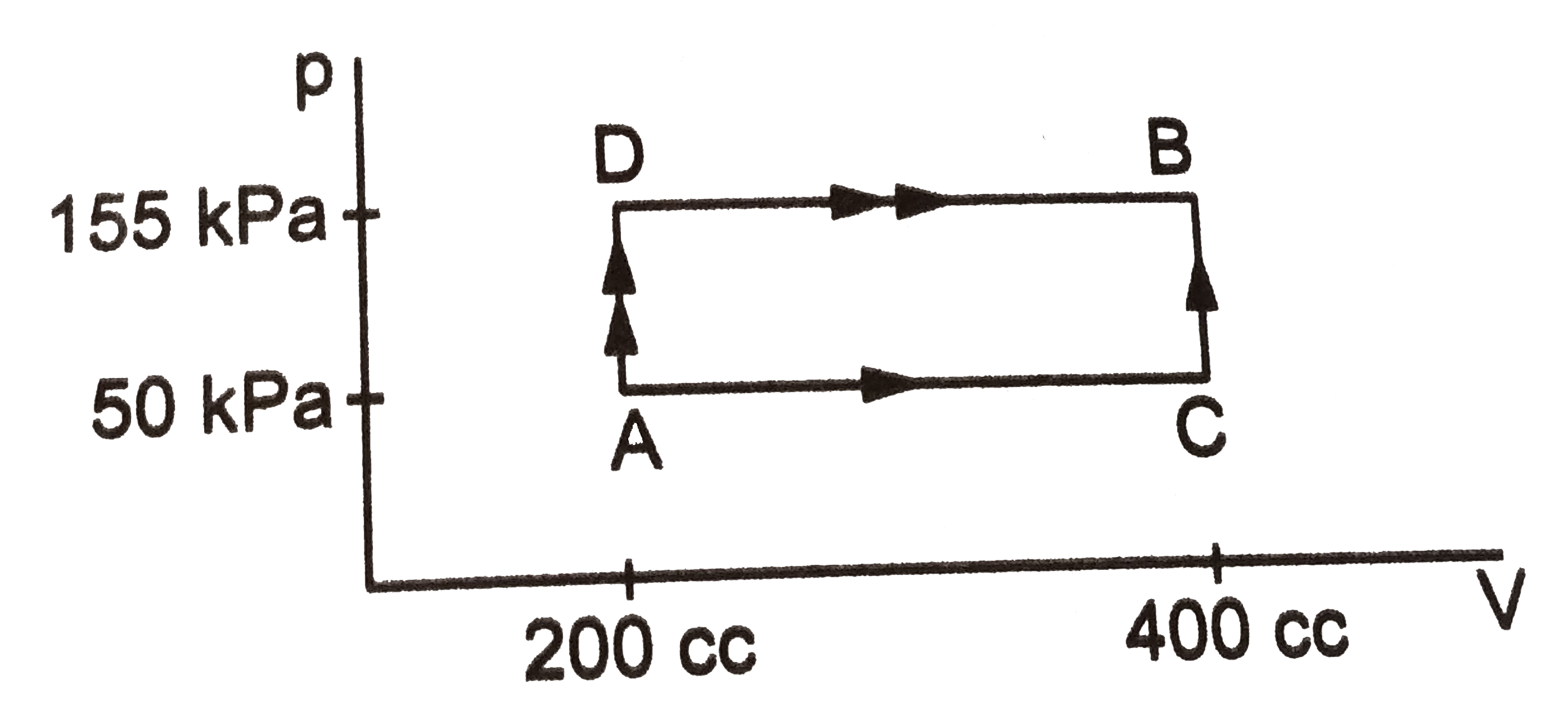
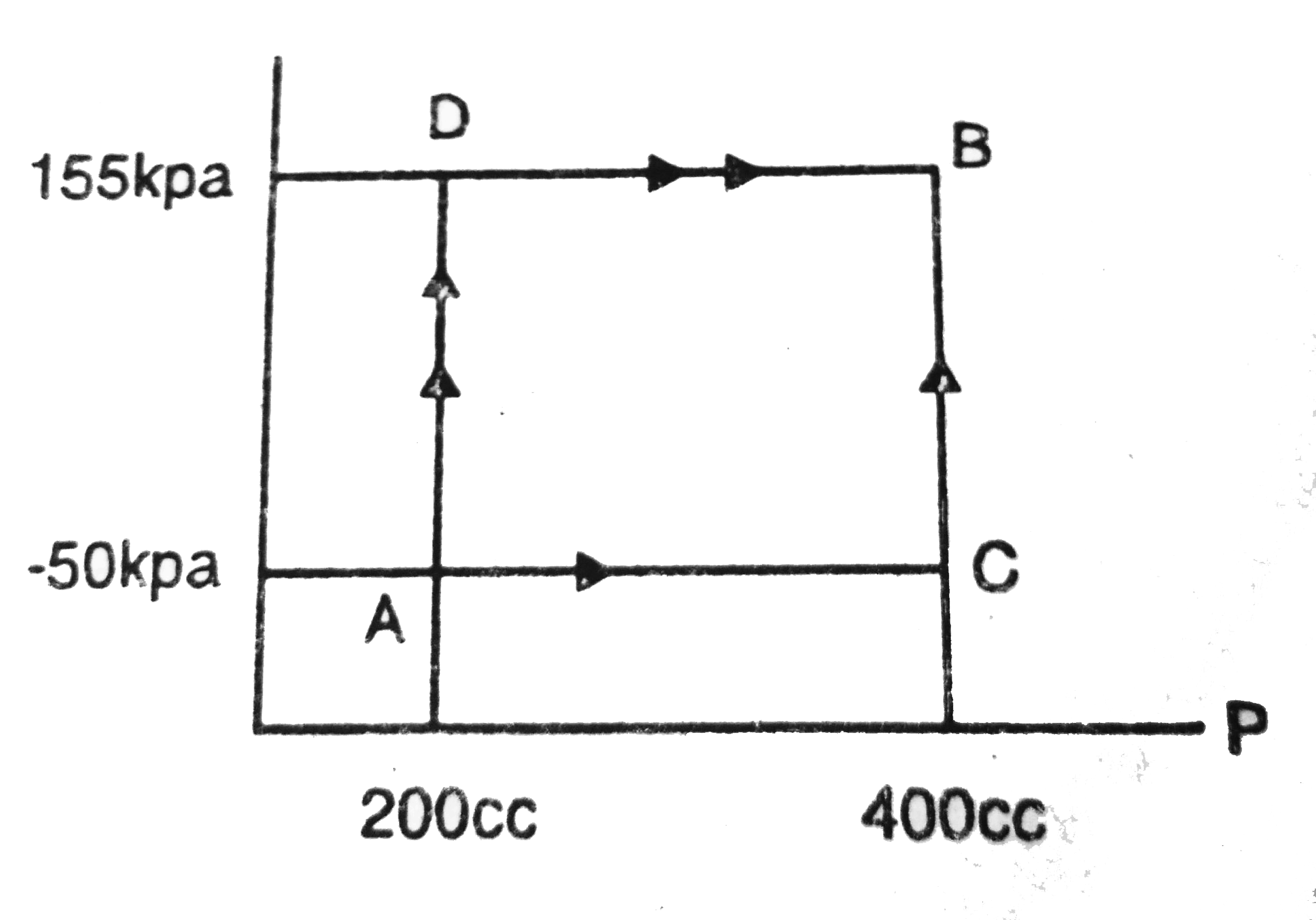
50 eal of heat should be supplied to take a system from the state A to the state B through the path ABC as shown in ,find the quantity of heat to be supplied to take it from A to B via ADB.

Text Solution

Verified by Experts

The correct Answer is:
A, C

In path ACB,`DeltaQ =50cal.=(50xx4*2)J`
`=`210J`,
`DeltaW=W_(AC)+W_(CB`
`=`50xx10^-3xx200xx10^-6`
`=`10Jltbrge10J`
`DeltaQ=DeltaU+DeltaW`
``rArrDeltaU=DeltaQ-DeltaQ-Delta-DeltaW=(210-10)J
200J
Inpath ADB,DeltaQ=?
DeltaU=200J
(Internal energy change between two point is always same)`
`DeltaW=W(AD)+W(DB)=DeltaWltbrge0 + 155xx10^3xx200xx10^(-6)`
` = 31J`
`Delta Q = Delta U+deltaW`
` = (200+31)J = 231J`
` = 55cal.
Promotional Banner

Topper's Solved these Questions

  • LAWS OF THERMODYNAMICS

    HC VERMA|Exercise Short Answer|15 Videos
  • LAWS OF THERMODYNAMICS

    HC VERMA|Exercise Objective 2|5 Videos
  • KINETIC THEORY OF GASES

    HC VERMA|Exercise Exercises|62 Videos
  • NEWTON'S LAWS OF MOTION

    HC VERMA|Exercise Exercises|42 Videos

Similar Questions

Explore conceptually related problems

50 cal of heat should be supplied to take a system from the state A to the state B through the path ACB as shown in Figure. The quantity of heat to be supplied to take it from A to B via ADB.

The given figure shown a change of state A to state C by two paths ABC and AC for an ideal gas. Calculate the : (a) Path along which work done is least. (b) Internal energy at C if the internal energy of gas at A is 10 J and amount of heat supplied to change its state to C through the path AC is 200 J . (c) Amount of heat supplied ot the gas to go from A to B, if internal energy of gas at state B is 10 J .

An ideal gas undergoes change in its state from the initial state I to the final state F via two possible paths as shown. Then

An ideal system can be brought from stage A to B through four paths as shown in the figure. The heat energy given to the system is minimum in :

shows three paths through which a gas can be taken from the state A to the state B. calculate the work done by the gas in each of the three paths.

In the adjoinign P-V diagram, 100 J of heat is given in taking a system from A to C along the path ADC and 50 J of work is done by system in this path. a. If the work done by the suystem is 15 J along the path ABC, then how much heat is to be given in taking the system from A to C along ABC? b. How much heat will be absorbed or given out if the work done on the system along the curved path from CA to A is 15 J? c. If U_(B)-U_(A)=40J , then how much heat will be absorbed in each process AB and BC?

Figure shows three paths through which a gas can be taken from the state A to the state B. Calculate the work done by the gas in each of the three paths.

In the given figure, an ideal gas changes it state from A to state C by two paths ABC and AC . (i) Find the path along which work done is the least. (ii) The internal energy of the gas at A to 10J and the amount of heat supplied to change its state to C through the path AC is 200J . Calculate the internal energy at C . (iii) The internal energy of the gas at state B is 30J . Find the amount of heat supplied to the gas to go from A to B .

HC VERMA-LAWS OF THERMODYNAMICS-Exercises
  1. A 100 kg block is started with a speed of 2.0 m s^(-1) on a long, roug...

    Text Solution

    |

  2. calculate the change in internal energy of a gas kept in a rigid conta...

    Text Solution

    |

  3. the pressure of a gas change linearly with volume from 10kPa, 200 cc t...

    Text Solution

    |

  4. An ideal gas is taken from an inirial state I to a final state f in s...

    Text Solution

    |

  5. shows three paths through which a gas can be taken from the state A to...

    Text Solution

    |

  6. when a system is taken through the process abc shown in 80 J of heat i...

    Text Solution

    |

  7. 50 eal of heat should be supplied to take a system from the state A t...

    Text Solution

    |

  8. calculate the heat absorbed by a system in going through the cyclic pr...

    Text Solution

    |

  9. A gas is taken through a cyclic process ABCA as shown in, if 2.4 cal o...

    Text Solution

    |

  10. A substance is taken through the process abc as shown in, if the inte...

    Text Solution

    |

  11. A gas is taken along the path AB as shown in , if 70 cal of heat is ex...

    Text Solution

    |

  12. The internal energy of a gas is given by U=1.5pV. It expands from 100c...

    Text Solution

    |

  13. A gas is enclosed in a cylindrical vessel fitted with a frictionless p...

    Text Solution

    |

  14. A gas is initinaly at a pressure of 100 kPa and its volume is 2.0 m^(3...

    Text Solution

    |

  15. Consider the cyclic process ABCA, shown in, performed on a sample of ...

    Text Solution

    |

  16. shows the variation in the internal energy U with the volume V of 2.0 ...

    Text Solution

    |

  17. Find the change in the internal energy of 2 kg of water as it heated f...

    Text Solution

    |

  18. Calculate the increase in the internal energy of 10 g of water when it...

    Text Solution

    |

  19. shows a cylindrial tube of volume V with adiabatic walls containing an...

    Text Solution

    |

  20. An adiabatic vessel of total volume V is divided into two equal parts ...

    Text Solution

    |

