Home
Class 11
PHYSICS
Figure shows an adiabatic cylindrical tu...

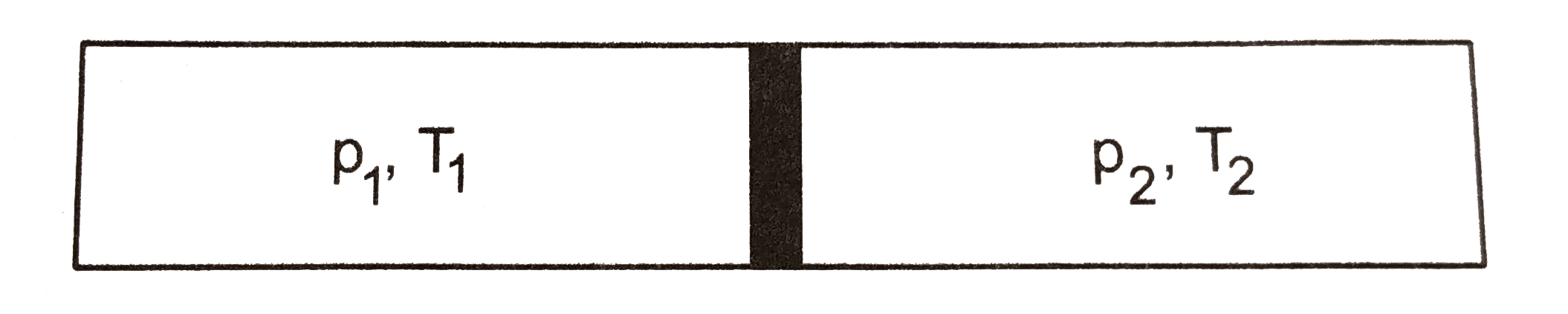
Figure shows an adiabatic cylindrical tube of volume `(V_0)` divided in two parts by a frictionless adibatic separator . Initially, the separator is kept in the middle, an ideal gas at pressure `(p_1)` and the temperatures `(T_1)` is injected into the left part and the another ideal gas at pressures `(P_2)` and temperature `(T_2)` is injected into the right part. `(C_p / C_v = gamma)` is the same for both the gases. The separator is slid slowly and is released at a position where it can stay in equilibrium. Find (a) the volumes of the parts, (b) the heat given to the gas in the left part and (c) the final common pressure of the gases.

Text Solution

Verified by Experts
For an adiabatic process, `PV^gamma= Constant`
So `P_1V_1^gamma = P_2V_2^gamma` … (i)
According to the problem
`V_1 + V_2 = V_0`
Then the euation (i)
`P_1V_2^gamma = P_2(V_0-V_1)^gamma`
or `((P_1)/(P_2))^(1/gamma) = (V_0 -V_1)/(V_1)`
or `V_1 -P_1^(1/gamma) = V_0-P_2^(1/gamma)-V_1P_2^(1/gamma)`
or `V_1(P_1^(1/gamma) + P_2 ^(1/gamma)) = V_0 P_2^(1/gamma)`
or `V_1 = (P_2^(1/gamma)V_0)/(P_1^(1/gamma) + P_2^(1/gamma))`
`V_2 = (P_1^(1/gamma)V_0)/(P_1^(1/gamma) + P_2^(1/gamma))`
(b) Since the whole process takes place in adiabatic surroundings, the separator is adiabatic.
Hence heat given to the gas in the left part = 0
(c) There will be a common pressure 'p' when the equilibrium is reached.
`P_1V_1^gamma + P_2V_2^gamma = PV_0^gamma`
For equilibrium, `V_1=V_2= V_0/2`
Hence,
`P_1((V_0)/(2))^gamma + P_2((V_0)/(2))^gamma = P(V_0)^gamma`
`P = ((P_1^(1/gamma) + P_2^(1/gamma))/(2))^gamma`
Promotional Banner

Topper's Solved these Questions

  • SPECIFIC HEAT CAPACITIES OF GASES

    HC VERMA|Exercise Objective 2|7 Videos
  • SOUND WAVES

    HC VERMA|Exercise Exercises|89 Videos
  • THE FORCES

    HC VERMA|Exercise Exercises|12 Videos
HC VERMA-SPECIFIC HEAT CAPACITIES OF GASES-Exercises
  1. The volume of an ideal gas (gamma 1.5 ) is changed adiabatically from ...

    Text Solution

    |

  2. An ideal gas at pressure 2.5 xx 10^(5) pa and temperture 300k occupies...

    Text Solution

    |

  3. Air (gamma = 1.4 ) is pumped at 20atm pressure in a motor tyre at 20^@...

    Text Solution

    |

  4. A gas is enclosed in a cylindrical can fitted with a piston. The walls...

    Text Solution

    |

  5. The initial pressure and volume of a given mass of a gas (Cp / Cv = ga...

    Text Solution

    |

  6. Conider a given sample of an ideal gas (Cp / Cv = gamma ) having initi...

    Text Solution

    |

  7. A given sample of an ideal gas (gamma = 1.5 ) is compressed adiabatica...

    Text Solution

    |

  8. Three samples A, B and C of the same gas (gamma = 1.5) have equal volu...

    Text Solution

    |

  9. Two samples A and B of the same gas have equal volumes and pressures ....

    Text Solution

    |

  10. 1 liter of an ideal gas (gamma =1.5) at 300k is suddenly compressed to...

    Text Solution

    |

  11. Figure shows a cylindridcal tube with a adibatic walls and fitted with...

    Text Solution

    |

  12. Figure shows two rigid vessels A and B, each of volume 200 cm ^(3) con...

    Text Solution

    |

  13. Figure shows two vessels with adiabatic walls, one containing 0.1 g of...

    Text Solution

    |

  14. Two vessels A and B of equal volume (V0) are connected by a narrow tub...

    Text Solution

    |

  15. Figure shows an adiabatic cylindrical tube of volume (V0) divided in t...

    Text Solution

    |

  16. An adibatic cylindrical tube of cross-sectional area 1 cm^(2) is close...

    Text Solution

    |

  17. The speed of sound in hydrogen at 0^@c is 1280 m s^(-1). The density o...

    Text Solution

    |

  18. 4.0 g of helium occupies 22400 cm^(3) at STP. The specific heat capaci...

    Text Solution

    |

  19. An ideal gas having density 1.7 xx 10^(-3) g cm ^(-3) at a preesure 1....

    Text Solution

    |

  20. Standing waves of frequency 5.0 kHz are produced in a tube filled with...

    Text Solution

    |