

Home
Class 11
PHYSICS
A particle is moving in a circular orbit...

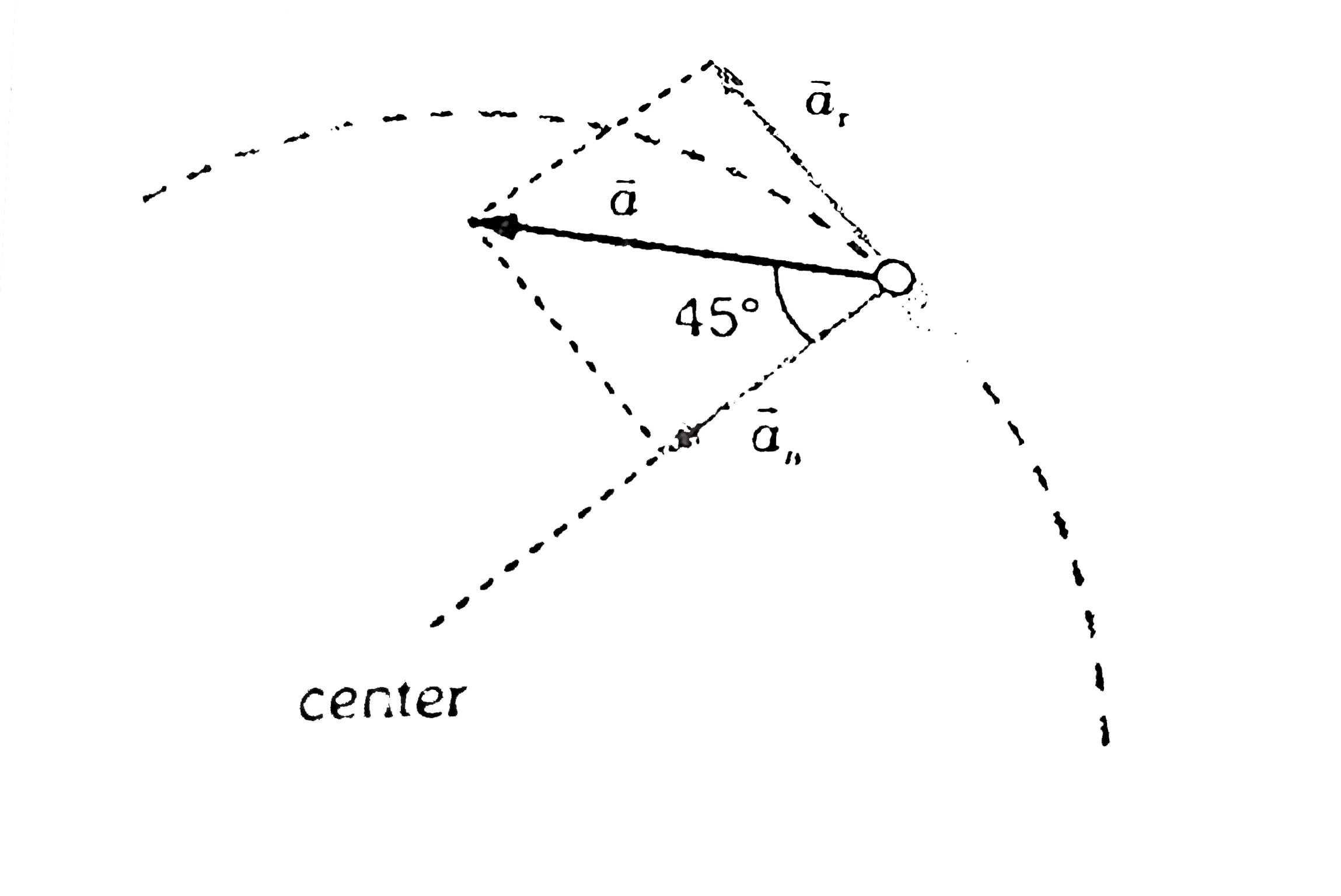
A particle is moving in a circular orbit when a constant tangential acceleration. After `2s` from the beginning of motion, angle between the total acceleration vector and the radius E becomes `45^(@)`. What is the angular acceleration of the particle?

Promotional Banner

Similar Questions

Explore conceptually related problems

A particle is moving in a circular orbit with a constant tangential acceleration. After a certain time t has elapsed after the beginning of motion, the between the total acceleration a and the direction along the radius r becomes equal to 45^(@) . What is the angular acceleration of the particle.

A particle is moving in a circular orbit with a constant tangential acceleration. After a certain time t has elapsed after the beginning of motion, the between the total acceleration a and the direction along the radius r becomes equal to 45^(@) . What is the angular acceleration of the particle.

A particle is moving in a circular orbit with a constant tangential acceleration. After a certain time t has elapsed after the beginning of motion, the between the total acceleration a and the direction along the radius r becomes equal to 45^(@) . What is the angular acceleration of the particle.

A particle is moving in circular path with constant acceleration. In time t after the beginning of motion the direction of net acceleration is at 30^(@) to the radius vector at that instant. The angular acceleration of the particle at that time t is

A particle starts travelling on a circle with constant tangential acceleration. The angle between velocity vector and acceleration vector, at the moment when particle completes half the circular track. Is

A particle starts travelling on a circle with constant tangential acceleration. The angle between velocity vector and acceleration vector, at the moment when particle completes half the circular track. Is

A particle starts travelling on a circle with constant tangential acceleration. The angle between velocity vector and acceleration vector, at the moment when particle completes half the circular track. Is

A point moves along a circle having a radius 20cm with a constant tangential acceleration 5 cm//s^(2) . How much time is needed after motion begins for the normal acceleration of the point to be equal to tangential acceleration?

A particle starts moving on circular path of radius (9)/(4)m with tangential acceleration 3ms^(-2) . Find angle between acceleration of the particle and radius vector at time t=1 sec.

A point moves along a circle having a radius 20cm with a constant tangential acceleration 5cm//s^(2) . How much time is needed after motion begins for the normal acceleration of the point to be equal to tangential acceleration?