

Home
Class 11
PHYSICS
Consider the adjacent figure. A piston d...

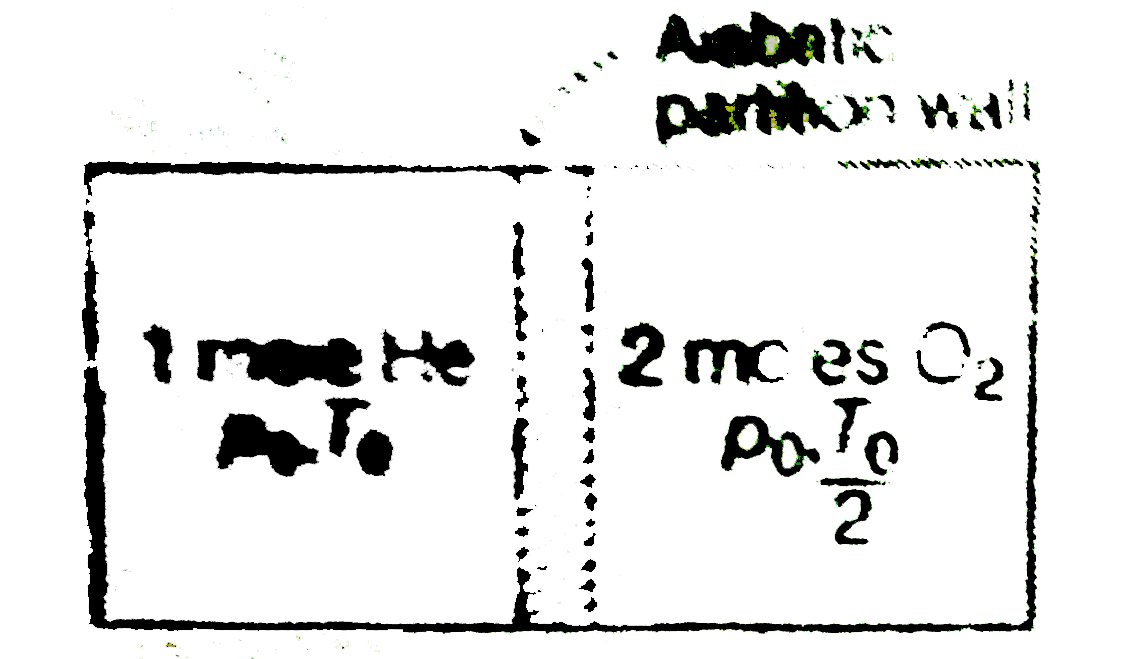
Consider the adjacent figure. A piston divides a cylindrical container into two equal parts. The lets part contains 1 mole of helium gas and the right part contains two moles or oxygen gas. The initial temperatures and pressures of the gases in the left chamber are `T_(0)` and `p_(0)` and the right chamber are `(T_(0))/(2)` and `p_(0)` respectively as shown in the figure. The piston as well as the walls of the container are adiabatic. After removal of the piston, gases mix homoganeously and the final pressure becomes `p=(4n)/(13)p_(0)`. Find the value of n.

Promotional Banner

Similar Questions

Explore conceptually related problems

A diathermic piston divides adiabatic cylinder of volume V0 into two equal parts as shown in the figure. Both parts contain ideal monoatomic gases. The initial pressure and temperature of gas in left compartment are P0 and T0 while that in right compartment are 2P0 and 2T0. Initially the piston is kept fixed and the system is allowed to acquire a state of thermal equilibrium. The pressure in left compartment after thermal equilibrium is achieved is

A diathermic piston divides adiabatic cylinder of volume V0 into two equal parts as shown in the figure. Both parts contain ideal monoatomic gases. The initial pressure and temperature of gas in left compartment are P0 and T0 while that in right compartment are 2P0 and 2T0. Initially the piston is kept fixed and the system is allowed to acquire a state of thermal equilibrium. The heat that flown from right compartment to left compartment before thermal equilibrium is achieved is

A weightless piston divides a thermally insulated cylinder into two equal parts. One part contains one mole of an ideal gas with adiabatic exponent gamma , the other is evacuated. The initial gas temperature is T_0 . The piston is released and the gas fills the whole volume of the cylinder. Then the piston is slowly displaced back to the initial position. Find the increment of the internal energy and entropy of the gas was resulting from these two processes.

A diathermic piston divides adiabatic cylinder of volume V0 into two equal parts as shown in the figure. Both parts contain ideal monoatomic gases. The initial pressure and temperature of gas in left compartment are P0 and T0 while that in right compartment are 2P0 and 2T0. Initially the piston is kept fixed and the system is allowed to acquire a state of thermal equilibrium. If the pin which was keeping the piston fixed is removed and the piston is allowed to slide slowly such that a state of mechanical equilibrium is achieved. The volume of left compartment when piston is in equilibrium is

A gas of temperature T_0 is enclosed in a container whose walls are (initially) at temperature T. Now, the gas exerts a higher pressure on the walls of the container when

A cylindrical adiabatic container of total volume 2V_(0) divided into two equal parts by a conducting piston which is free to move as shown in figure. Each part containing identical gas at pressure P_(0) . Initially temperature of left and right part is 4T_(0) and T_(0) respectively. An external force is applied on the piston of area 'A' to keep the piston at rest. The value of external force required when thermal equilibrium is reached is.

A cylindrical adiabatic container of total volume 2V_(0) divided into two equal parts by a conducting piston which is free to move as shown in figure. Each part containing identical gas at pressure P_(0) . Initially temperature of left and right part is 4T_(0) and T_(0) respectively. An external force is applied on the piston of area 'A' to keep the piston at rest. The value of external force required when thermal equilibrium is reached is.

A cylindrical adiabatic container of total volume 2V_(0) divided into two equal parts by a conducting piston which is free to move as shown in figure. Each part containing identical gas at pressure P_(0) . Initially temperature of left and right part is 4T_(0) and T_(0) respectively. An external force is applied on the piston of area 'A' to keep the piston at rest. The value of external force required when thermal equilibrium is reached is.

(i) A conducting piston divides a closed thermally insulated cylinder into two equal parts. The piston can slide inside the cylinder without friction. The two parts of the cylinder contain equal number of moles of an ideal gas at temperature T_(0) . An external agent slowly moves the piston so as to increase the volume of one part and decrease that of the other. Write the gas temperature as a function of ratio (beta) of the volumes of the larger and the smaller parts. The adiabatic exponent of the gas is gamma . (ii) In a closed container of volume V there is a mixture of oxygen and helium gases. The total mass of gas in the container is m gram. When Q amount of heat is added to the gas mixture its temperature rises by Delta T . Calculate change in pressure of the gas.