

Home
Class 12
PHYSICS
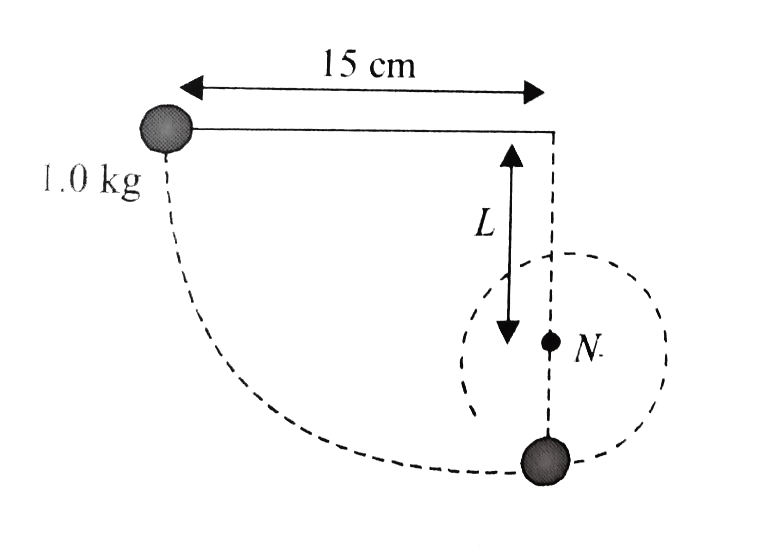
A ball weighing 1.0 kg is tied to a stri...


A ball weighing 1.0 kg is tied to a string 15 cm long initially the ball is held in position such that the string is horizontal. The ball is now released. A nail N is situated vertically below the support at a distance L. The minimum value of L such that the string will be would round the nail is.

Promotional Banner

Similar Questions

Explore conceptually related problems

Mass of the bob of a pendulum is 100g and the length of the string is 1m . The bob is initially held is such a way that the string is horizontal . The bob is then released. Find the kinetic energy of the bob when the string makes an angle of (i) 0^@ with vertical

A ball of mass 100 g is suspended by a string 40 cm long. Keeping the string taut, the ball describes a horizontal circle of radius 10 cm. Find the angular speed.

A ball of mass 0.1 kg is suspended by a string 30 cm long. Keeping the string always taut, the ball describes a horizontal circle of radius 15 cm. Find its angular speed and tension.

A ball A of mass m attached to a string of length L is released when the string is horizontal. It strikes another ball B of mass 2 m suspended to another string of length L at rest as shown. Find the maximum angle made by the string if the collision is completely inelastic.

A ball of mass 0.1kg is suspended by a string 30 cm long Keeping the string always taut the ball describe a horizontal circle of radius 15cm Calculate the angular speed of the ball .

A ball of mass 1 kg is attached to an inextensible string. The ball is released from the position shown in figure. Find the impulse imparted by the string to the ball immediately after the string becomes taut.

A small positively charged ball of mass m is suspended by an insulating thread of length L. This ball remains in equilibrium with string horizontal when another small charged ball is placed exactly at a distance L below the point of suspension of the first ball. The second ball is slowly moved away from the first ball to a far away point. (The second ball is moved horizontally so that the first ball does not accelerate). As a result the first ball lowers down to the original position of the second ball and the string become vertical. Find the work done by the external agent in removing the second ball.