Home
Class 12
PHYSICS
A block, resting on the ground, has the ...

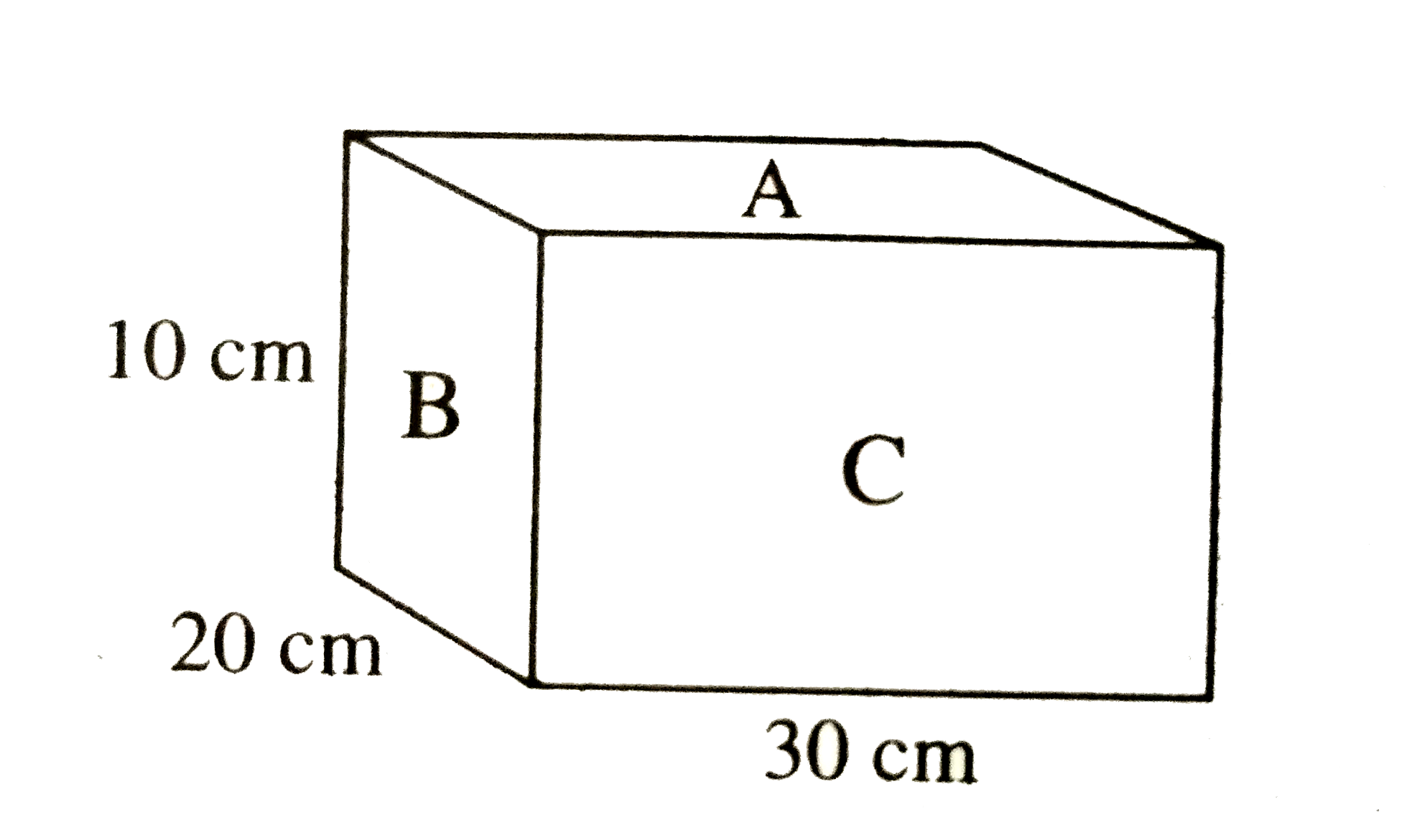
A block, resting on the ground, has the dimensions as shown in the diagram. The face which experiences the smallest stress, when the block rests on that face is

A

face C

B

face A

C

face B

D

all the faces experience the same stress.

Text Solution

Verified by Experts

The correct Answer is:

B

The areas of the faces, `A_(A) gt A_(C) gt A_(B)` , and the stress on a face is equal to the weight of the block divided by the area of the face
Promotional Banner

Topper's Solved these Questions

  • MULTIPLE CHOICE QUESTIONS

    NAVNEET PUBLICATION - MAHARASHTRA BOARD|Exercise Surface Tension|6 Videos
  • MULTIPLE CHOICE QUESTIONS

    NAVNEET PUBLICATION - MAHARASHTRA BOARD|Exercise Wave Motion|6 Videos
  • MULTIPLE CHOICE QUESTIONS

    NAVNEET PUBLICATION - MAHARASHTRA BOARD|Exercise Oscillations|5 Videos
  • MODEL QUESTION PAPER FOR PRACTICE

    NAVNEET PUBLICATION - MAHARASHTRA BOARD|Exercise SECTION-D|5 Videos
  • QUESTION BANK 2021

    NAVNEET PUBLICATION - MAHARASHTRA BOARD|Exercise Semiconductors Devices (Long Answer ( LA) ( 4 marks Each) )|3 Videos

Similar Questions

Explore conceptually related problems

A block is pulled slowly as shown in the diagram. Show that force F increase as the block moves up. Find the force F when the block is at depth h .

A block of mass 3kg is at rest on a rough inclined plan as shown in the Figure. The magnitude of net force exerted by the surface on the block will be

In the shown diagram friction exits at each contact surface with coefficient mu and the blocks are at rest. Then :

Blocks A and B shown in the figure are having equal masses m. The system is released from rest with the spring unstretched. The string between A and ground is cut, when there is maximum extension in the spring. The acceleration of centre of mass of the two blocks at this instant is

Block A of mass 5 kg is resting on a frictionless floor. Another block B of mass 7kg is resting on it as shown in the figure. The coefficient of friction between the blocks is 0.5 while kinetic friction is 0.4. If a force of 100 N is applied to block B, the acceleration of the block A will be ( g =10 ms^(-2)) :

A block of mass m rests on a wedge of mass M which, in trun, rests on a horizontal table, as shown in figure. All surfaces are frictionless. If the system starts at rest with point P of the block a distance h above the table, find the speed of the wedge the instant point P touches the table.

The acceleration of 3 kg block in the arrangement shown in the diagram ,when the given system is released from rest is

A block of mass m slides down a wedge of mass M as shown . The whole system is at rest , when the height of the block is h above the ground. The wedge surface is smooth and gradually flattens. There is no friction between wedge and ground. If there would have been friction wedge and block , which of the following quantities would still remains conserved ?

A block of mass m slides down a wedge of mass M as shown . The whole system is at rest , when the height of the block is h above the ground. The wedge surface is smooth and gradually flattens. There is no friction between wedge and ground. As the block slides down, which of the following quantities associated with the system remains conserved ?
