Home
Class 12
PHYSICS
The mechanical force acting on a unit ar...

The mechanical force acting on a unit area of a charged conductor is

Text Solution

Verified by Experts
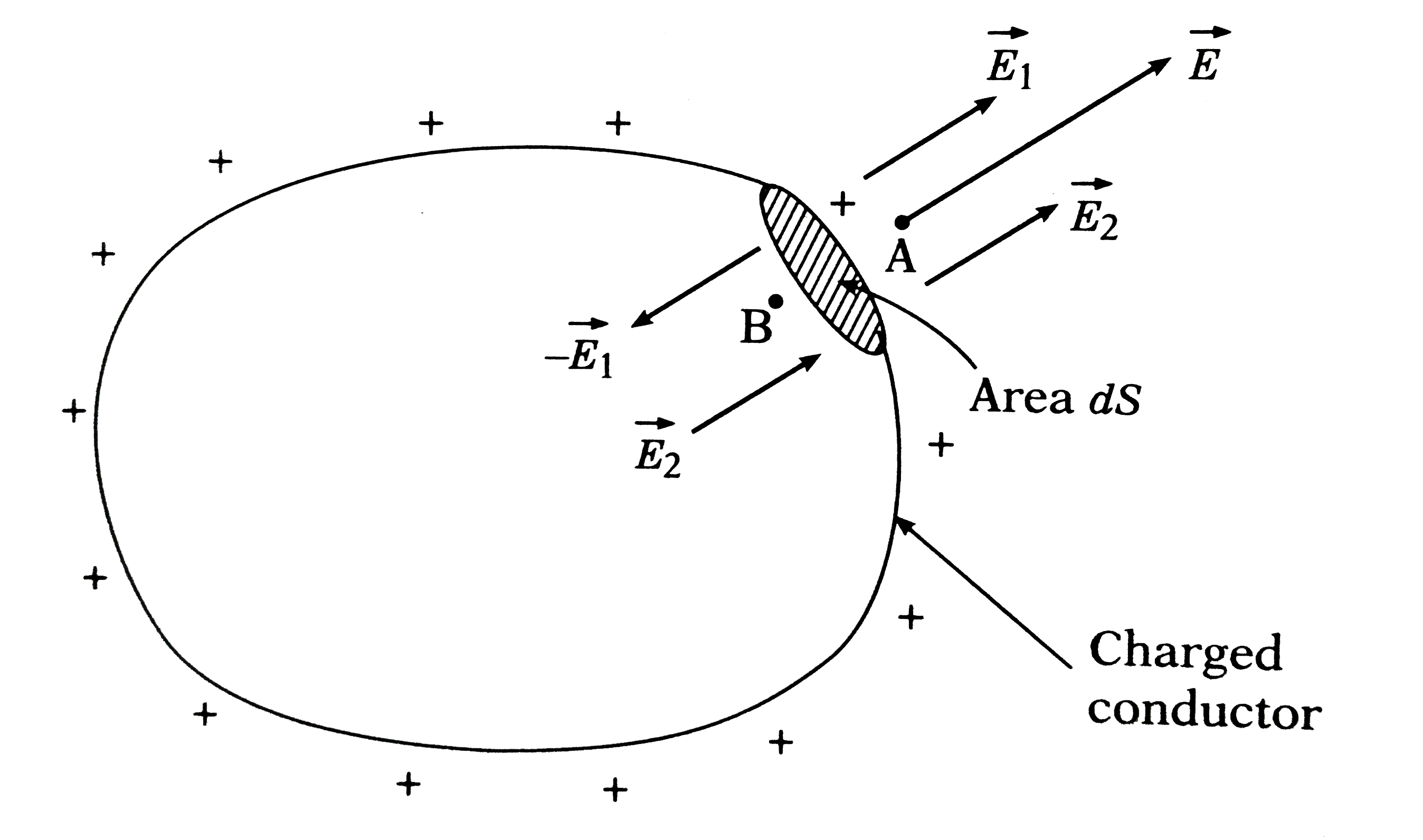
Consider a positively charged conductor of any shape placed in a dielectric medium of permittivity `epsilon.` Let dS be a very small area of the surface of the conductor drawn around point A as shown in the figure. If `sigma` is the surface charge density on dS, the charge on the area element `=sigma dS` and the electric field intensity at a point just outside the area element has a magnitude `E=(sigma)/(epsilon).`
`vec E` can be considered as a resultant of: (i) `vec E_(1)` due to the charge on area dS and (ii) `vec E_(2)` due to the charge on the remaining part of the conductor. Since `vecE_(1) and vec E_(2)` have the same direction,
`E=E_(1)+E_(2) " " ` ...(1)

`vec E_(1)` has opposite directions on the two sides of dS, but on both sides, `vec E_(2)` is directed along the outward normal to the element.
At point B inside the conductor, the electirc field is zero.
`therefore E_(2) -E_(1)=0`
`therefore E_(2)=E_(1)`
At A, just outside the conductor, `E_(1)+E_(2)=E`
`therefore E_(1)=E_(2)=(1)/(2) E`
But , `E=(sigma)/(epsilon) " " ` ...(2)
`therefore E_(1)=E_(2)=(sigma)/(2epsilon) " " ` ...(3)
Thus, the charged area element `sigma dS` is situated in an electric field of magnitude `E_(2)=(sigma)/(2epsilon)`, produced by the charge on the rest of the conductor and this field is outward. The force acting on dS due to the action of this field
= ( charge on area dS) `xx` ( electric field due to the remaining charge)
`therefore F=sigma dS xx (sigma)/(2epsilon) =(sigma^(2))/(2epsilon) dS " " ` ...(4)
This force acts outward, normal to the surface. The magnitude of the mechanichal force per unit area of the surface is
`f=(F)/(dS)=(sigma^(2))/(2epsilon) =(sigma^(2))/(2epsilon_(0)k) " " ` ...(5)
where `epsilon_(0)` is the permittivity (dielectric constant) of the medium.
From Eq. (2),
`sigma = epsilon E=epsilon_(0) k E`
Substituting this value of `sigma` in Eq. (5),
`f=((epsilon_(0)kE)^(2))/(2epsilon k) =(1)/(2) epsilon_(0)kE^(2) " " `...(6)
Thus, the mechanical force per unit area of a charged conductor,
`f=(sigma^(2))/(2epsilon_(0)k) or f=(2)/(2) k E^(2)`
Promotional Banner

Topper's Solved these Questions

  • DERIVATIONS-II

    NAVNEET PUBLICATION - MAHARASHTRA BOARD|Exercise Current Electricity|6 Videos
  • DERIVATIONS-II

    NAVNEET PUBLICATION - MAHARASHTRA BOARD|Exercise Magnetism|1 Videos
  • DERIVATIONS-II

    NAVNEET PUBLICATION - MAHARASHTRA BOARD|Exercise Interference and Diffraction|4 Videos
  • DERIVATIONS-I

    NAVNEET PUBLICATION - MAHARASHTRA BOARD|Exercise Assignments|9 Videos
  • DISTINGUISH BETWEEN

    NAVNEET PUBLICATION - MAHARASHTRA BOARD|Exercise Assingment|3 Videos

Similar Questions

Explore conceptually related problems

Which of the following factors does not affect the mechanical force per unit area of charged conductor ?

Force acting on a unit area is called _____

The surface density of charge on the surface of a charged conductor in the air is 26.5 muCm^(-2) . The the outward force per unit area of the charged conductor is (epsilon_0=8.85xx10^-12C^2N^-1m^-2)

Two long, thin parallel conductors, separated by a distance d , carrying currents i_(1) and i_(2) . The force acting on unit length of any one conductor is F

The surface density of charge on the surface of a charged conductor in air is 0.885 muC//m^(2) . If epsi_(0) =8.85xx10^(-12) C^(2)//N-m^(2) , then the outward force per unit area of the charged conductor is

explain. Force acting on a unit area is called pressure.

