Home
Class 12
PHYSICS
What is the effect of presence of a diel...

What is the effect of presence of a dielectric medium on
(i) capacitance of a parallel plate capacitor
(ii) electrostatic force between two charges ?

Text Solution

Verified by Experts
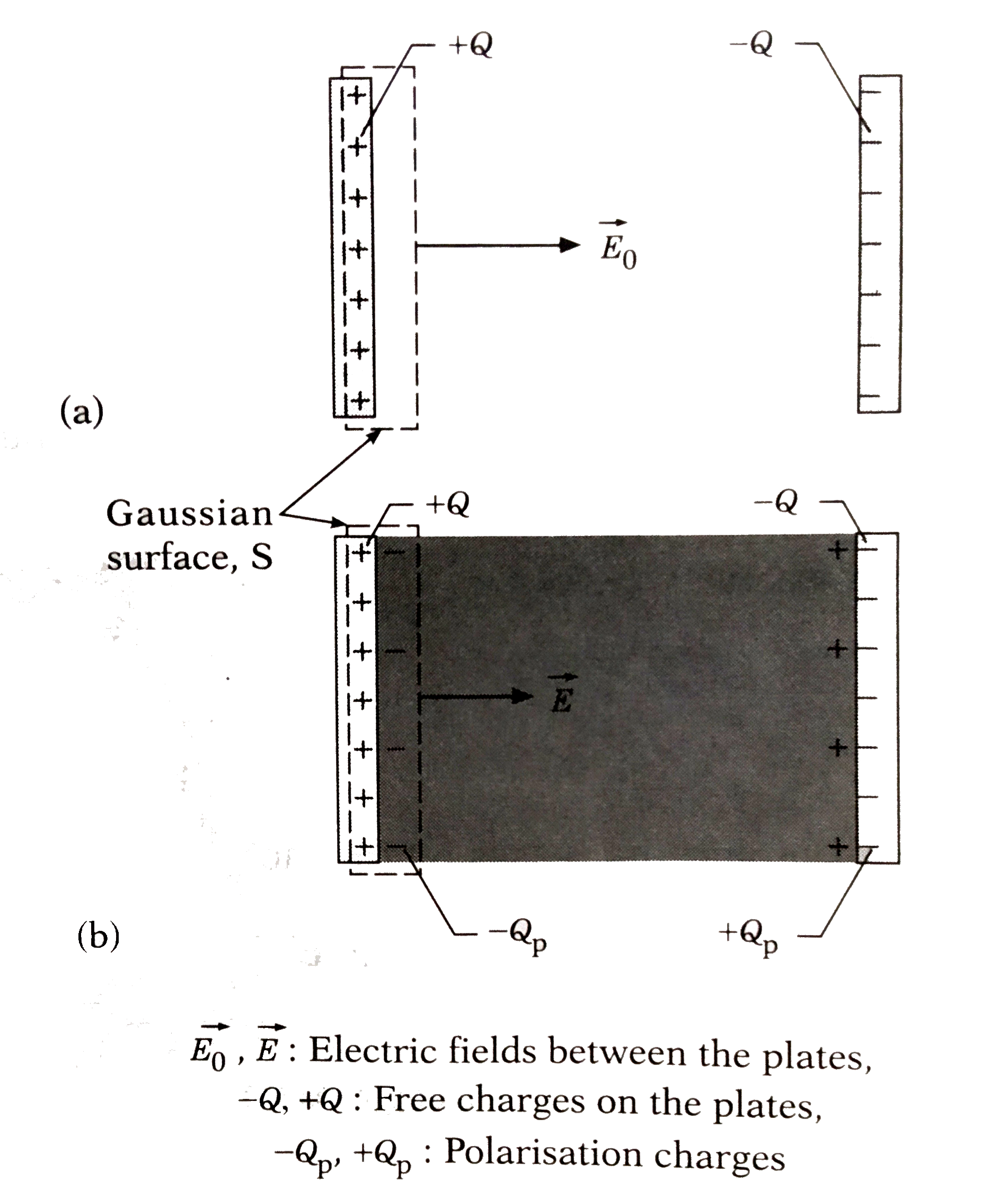
Consider a parallel-plate capacitor without a dielectric, of plate area A, plate separation d and capacitance `C_(0),` charged to a potential difference V and then isolated.
Suppose the free charges on its conducting plates are +Q and -Q, Fig. (a). The surface density of free charge is
`sigma =(Q)/(A) " "` ...(1)
If A is very large and d is very small, the electric field in the region between the plates is almost uniform, except at the edges. The magnitude of the electric field intensity is
`E_(0)=(V)/(d)=(sigma)/(epsilon_(0))=(Q)/(epsilon_(0)A) " " ` (2)
Now, suppose a dielectric completely fills the space the charged plates. A polarisation charge - `Q_(p)` appears on the exterior surface of the dielectric nearer to the positive plate while a polarisation charge `+Q_(p)` appears on its opposite face. Since the capacitor was isolated after charging, the free charge Q on the plates is the same as earlier.

Consider the Gaussian surface S as shown in Fig. (b). It encloses free charge +Q on the left plate and the bound polarisation charge - `Q_(p)` on the surface of the dielectric.
The net charge enclosed by `S=Q-Q_(p).`
`therefore` By Gauss's theorem, the TNEI over the Gaussian surface is
`epsilon_(0) underset(s) int vecE* d vecS=epsilon_(0)EA=Q-Q_(p)`
`therefore` The magnitude of the electric field intensity in the dielectric is
`E=(Q-Q_(p))/(epsilon_(0)A)=(Q)/(epsilon_(0)A)-(Q_(p))/(epsilon_(0)A)=(sigma)/(epsilon_(0))-(sigma_(p))/(epsilon_(0)) " " ` ...(3)
Writing `E=(E_(0))/(k),` where k is the relative permittivity (dielectric constant) of the medium, `(E_(0))/(k)=(sigma)/(epsilon_(0))-(sigma_(p))/(epsilon_(0))`
` therefore (sigma)/(k epsilon_(0))=(sigma)/(epsilon_(0))-(sigma_(p))/(epsilon_(0))`
`therefore (sigma)/(k)=sigma-sigma_(p)`
`therefore` The surface density of induced charge is
`sigma_(p)=sigma-(sigma)/(k)=sigma(1-(1)/(k)) " " ` ...(4)
Without the dielectric, the capacitance of the capacitor is, `C_(0)=Q//V.`
`therefore Q=C_(0)V=C_(0)E_(0)d " " ` ...(5)
Let the capacitance with the dielectric be C. Since the free charge Q remains the same, `Q=CEd " " `...(6)
Equating the right hand sides of Eqs. (5) and (6),
`CEd = C_(0)E_(0)d`
`therefore C=C_(0)((E_(0))/(E))=kC_(0) " " ` ...(7)
Thus, the capacitance increases by the factor of `k=E_(0)//E.`
Promotional Banner

Topper's Solved these Questions

  • DERIVATIONS-II

    NAVNEET PUBLICATION - MAHARASHTRA BOARD|Exercise Current Electricity|6 Videos
  • DERIVATIONS-II

    NAVNEET PUBLICATION - MAHARASHTRA BOARD|Exercise Magnetism|1 Videos
  • DERIVATIONS-II

    NAVNEET PUBLICATION - MAHARASHTRA BOARD|Exercise Interference and Diffraction|4 Videos
  • DERIVATIONS-I

    NAVNEET PUBLICATION - MAHARASHTRA BOARD|Exercise Assignments|9 Videos
  • DISTINGUISH BETWEEN

    NAVNEET PUBLICATION - MAHARASHTRA BOARD|Exercise Assingment|3 Videos

Similar Questions

Explore conceptually related problems

Derive an expression for the capacitance of a parallel-plate capacitor filled with a dielectric.

Explain why the capacitance of a parallel plate capacitor increases when a dielectric slab is introduced between the plates.

A dielectric slab is placed between the plates of a parallel plate capacitor. Its capacitance

A dielectric is inserted between the plates of an isolated fully-charged capacitor. The dielectric completely fills the space between the plates. The magnitude of electrostatic force on either metal plate decreases, as it was before the insertion of dielectric medium. Due to insertion of dielectric slab in an isolated parallel plate capacitor (the dielectric completely fills the space between the plates), the electrostatic potential energy of the capacitor decreases.

Define capacitance of a parallel plate capacitor,Derive an expression for the capacitance of a parallel plate capacitor with dielectric of thickness "t," where "(t

Briefly explain the principle of a capacitor. Derive an expression for the capacitance of a parallel plate capacitor, whose plates are separated by a dielectric medium.

When a dielectric is introduced between the plates of a charged parallel plate capacitor, whichi one of the following will not change?

