(1) Construction :
(a) The standard hydrogen electrode (S.H.E) consists of a glass tube at the end of which a piece of platinised platinum foil is attached as shown in the given figure. Around this plate there is an outer jacket of glass which has a side inlet through which pure and dry hydrogen gas
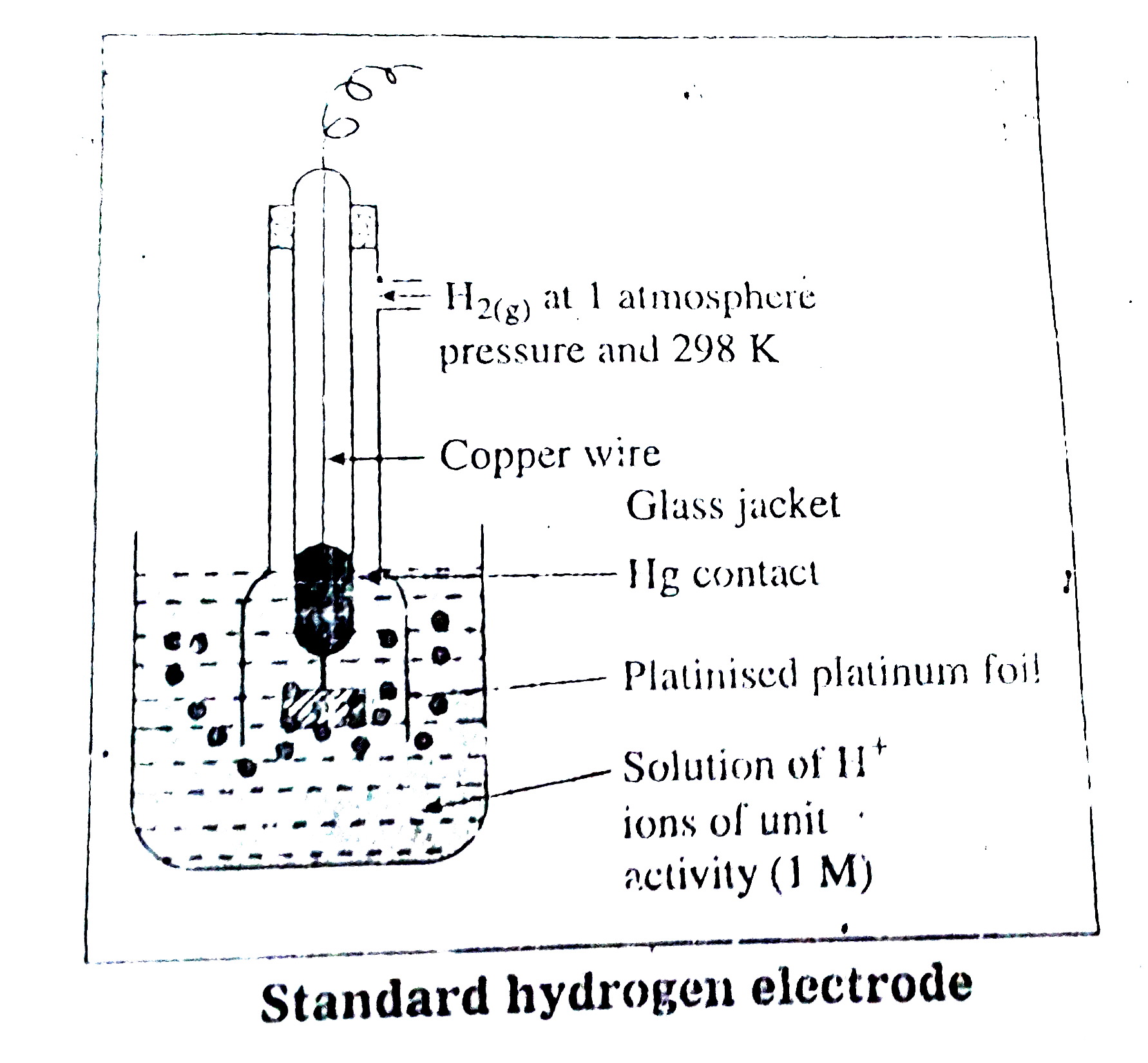
is bubbled at one atmosphere pressure. The inner tube is filled with a little mercury and a copper wire is dipped into it for an electrical contact.
(b) The whole assembly is kept immersed in a solution containing hydrogen ions `(H^(+))` of unit activity.
(c) This electrode is arbitrarily assigned zero potential .
(2) Representation of S.H.E. :
`H^(+) (1M)|H_(2)(g,1 atm)|Pt`
(3) Working : If the electrode acts as anode then,
Oxidation : `1/2H_(2(g)) hArr H_((aq))^(+) + e^(-) E^(0) = 0.00 V`
If the electrode acts as cathode then,
Reduction : `H_((aq))^(+) + e^(-) hArr 1/2 H_(2^((g))) E^(0) = 0.00 V`
`H_(2)` gas in contact with `H_((aq))^(+)` ions attains an equilibrium esta-blishing a potential.
Applications of SHE : A reversible galvanic cell with the experimental electrode , `Zn^(2+) (1M) |Zn_((ag))^(2+)(1 M)` and SHE can be developed as follows :
`Zn|Zn_((aq))^(2+) (1M)||H_((aq))^(+) (1M)|H_(2)(g,1atm) |Pt`
Then,
`E_(cell) = E_(SHE) - E_(M^(n+))//M`
`= 0 - E_(M^(n+)//M)`
` = - E_(M^(n+)//M)`
Thus the potential can be directly obtained.
(5) Disadvantages (Drawbacks or Difficulties) :
(1) It is difficult to construct and handle SHE.
(2) Pure and dry `H_(2)` gas cannot be obtained.
(3) Pressure of `H_(2)` gas cannot be maintained exactly at 1atmosphere.
(4) The active mass or concentration of `H^(+)` from `HCl` cannot be maintained exactly unity .


