Home
Class 10
PHYSICS
Assume that the force of gravitation F...

Assume that the force of gravitation `F prop 1/(r^(n))` . Then show that the orbital speed in a circular orbit of radius r is proportional to ` 1/(r^((n-1)//2))` , while its period T is proportional to ` r^((n+1)//2)`

Text Solution

Verified by Experts
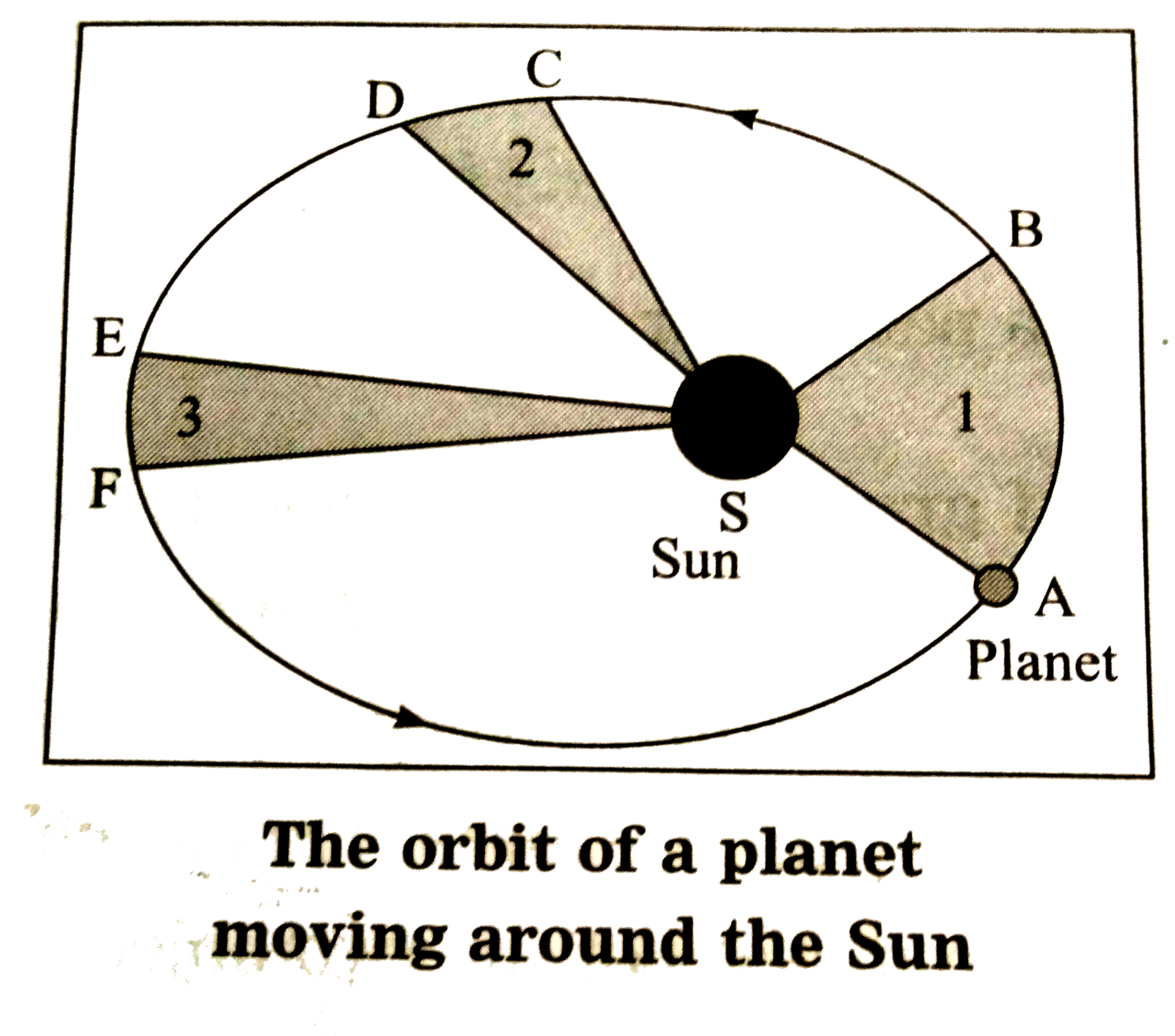
Kepler's first law: The orbit of a planet is an ellipse with the Sun at one of the foci.
The adjoining figure shows the elliptical orbit of a planet revolving around the Sun. S denotes the position of the Sun.
Kepler's second law : The line joining the planet and the Sun Sweeps equal areas in equal intervals of time.
Area ASB=area CSD=area ESF.
Kepler's third law :
The square of the period of revolution of a plant around the sun is directly proportional to the cube of the mean distance of the planets from the Sun.
Thus , if r is the average distance of the planet from the Sun and T is its period of revolution , then,
`T^(2) prop r^(3), ` i.e. `(T^(2))/(r^(3))` =constant =K
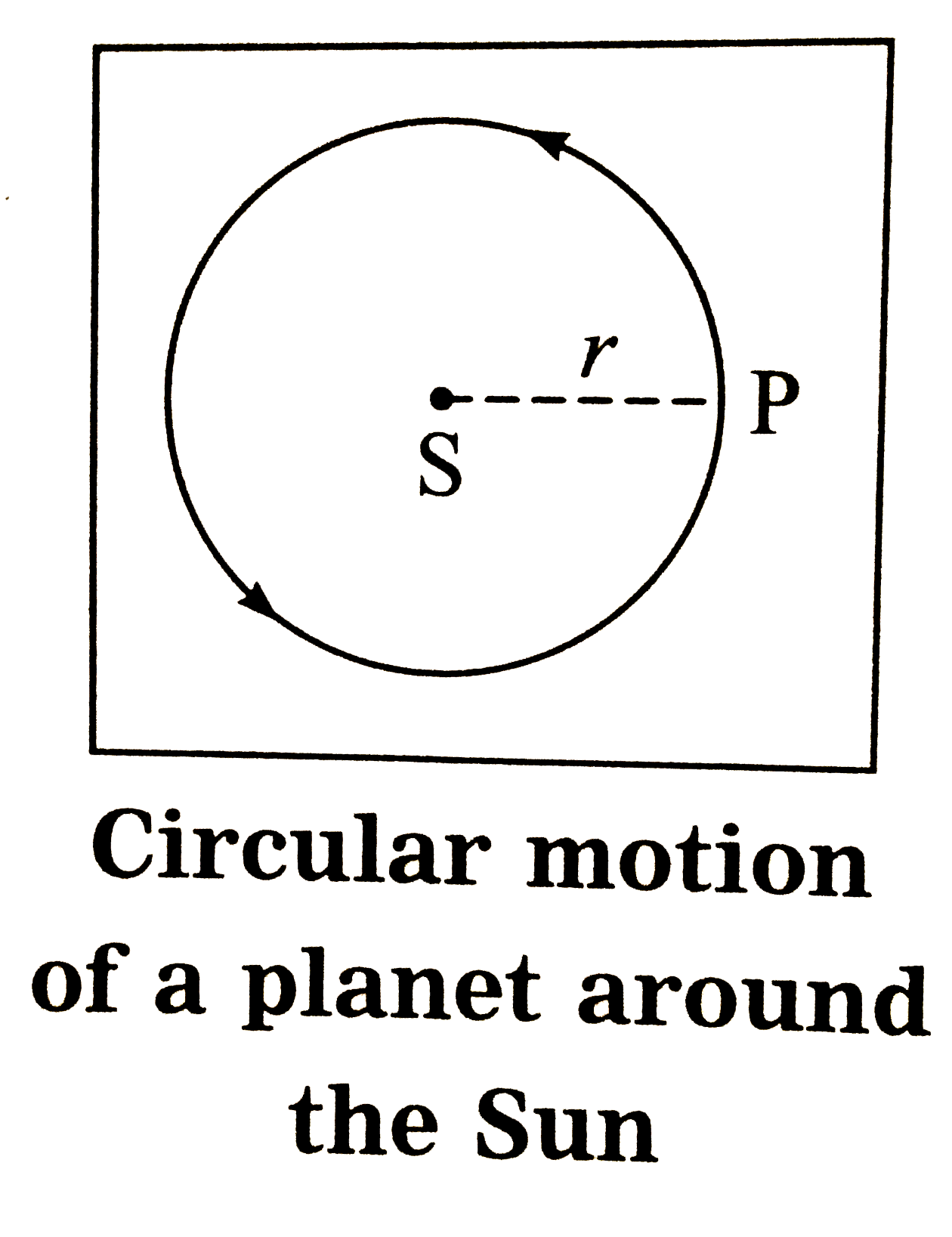
For simplicity we shall assume the orbit to be a circle. In the adjoining figure, S denotes the poistion of the Sun, P denotes the position of a planet at a given instant and r denotes the radius of the orbit (`-=` the distance of the planet from the Sun ). Here, the speed of the planet is uniform. It is
`v=("circumference of the circle")/("period of revolution of the planet")=(2pir)/(T)`
If m is the mass of the planet , the centripetal force exerted on the planet by the Sun (`-=` gravitational force), `F=(mv^(2))/(r)`
`therefore F=(m(2pir//T)^(2))/(r)=(4pi^(2)mr^(2))/(T^(2)r) =(4pi^(2)mr)/(T^(2))`
Accordign to Kepler's third law,
`T^(2)=Kr^(3)`
`therefore F=(4^(2)mr)/(Kr^(3))=(4pi^(2)m)/(K)((1)/(r^(2)))`
Thus, `F prop (1)/(r^(2))` as `(4pi^(2)m)/(K)` is constant in a particular case.

Promotional Banner

Topper's Solved these Questions

  • LAWS, RULES, UNITS AND DEFINITIONS

    NAVNEET PUBLICATION - MAHARASHTRA BOARD|Exercise Periodic Classification of Elements|6 Videos
  • LAWS, RULES, UNITS AND DEFINITIONS

    NAVNEET PUBLICATION - MAHARASHTRA BOARD|Exercise Chemical Reactions and Equations|20 Videos
  • HEAT

    NAVNEET PUBLICATION - MAHARASHTRA BOARD|Exercise NUMERICAL PROBLEMS FOR PRACTICE|12 Videos
  • LENSES

    NAVNEET PUBLICATION - MAHARASHTRA BOARD|Exercise Numerical Problems For Practice|20 Videos

Similar Questions

Explore conceptually related problems

If a planet is revolving around sun in circular orbit with force F propto r^(-5/2) , where r is radius, then square of the period is proportional to

Suppose gravitational pull varies inversely as nth power of the distance. Show that the time period of a planet in circular orbit of radius R around the sun will be proportinal to R^((n+1)//2)

The time period of a satellite in a circular orbit of radius R is T. The period of another satellite in a circular orbit of radius 9R is :

Suppose the gravitational force varies inverseley as the nth power of the distance. Show that the time period of a planet in circular orbit of raidus r arount the sun will be proportional to r^(n+1)//^(2) .

A planet is revolving around a star in a circular orbit of radius R with a period T. If the gravitational force between the planet and the star is proportional to R^(-3//2) , then

The period of a satellite in a circular orbit of radius R is T , the period of another satellite in a circular orbit of radius 4R is

Suppose the force of gravitation is inversely proportional to the cube of the radius of circular orbit in which satellite is revolving then its time period is proportional to

A particle is moving with a uniform speed in a circular orbit of radius R in a central force inversely proportional to the n^(th) power of R. If the period of rotation of the particle is T, then :