

Home
Class 11
PHYSICS
Two paritcles of mass m, constrained to ...

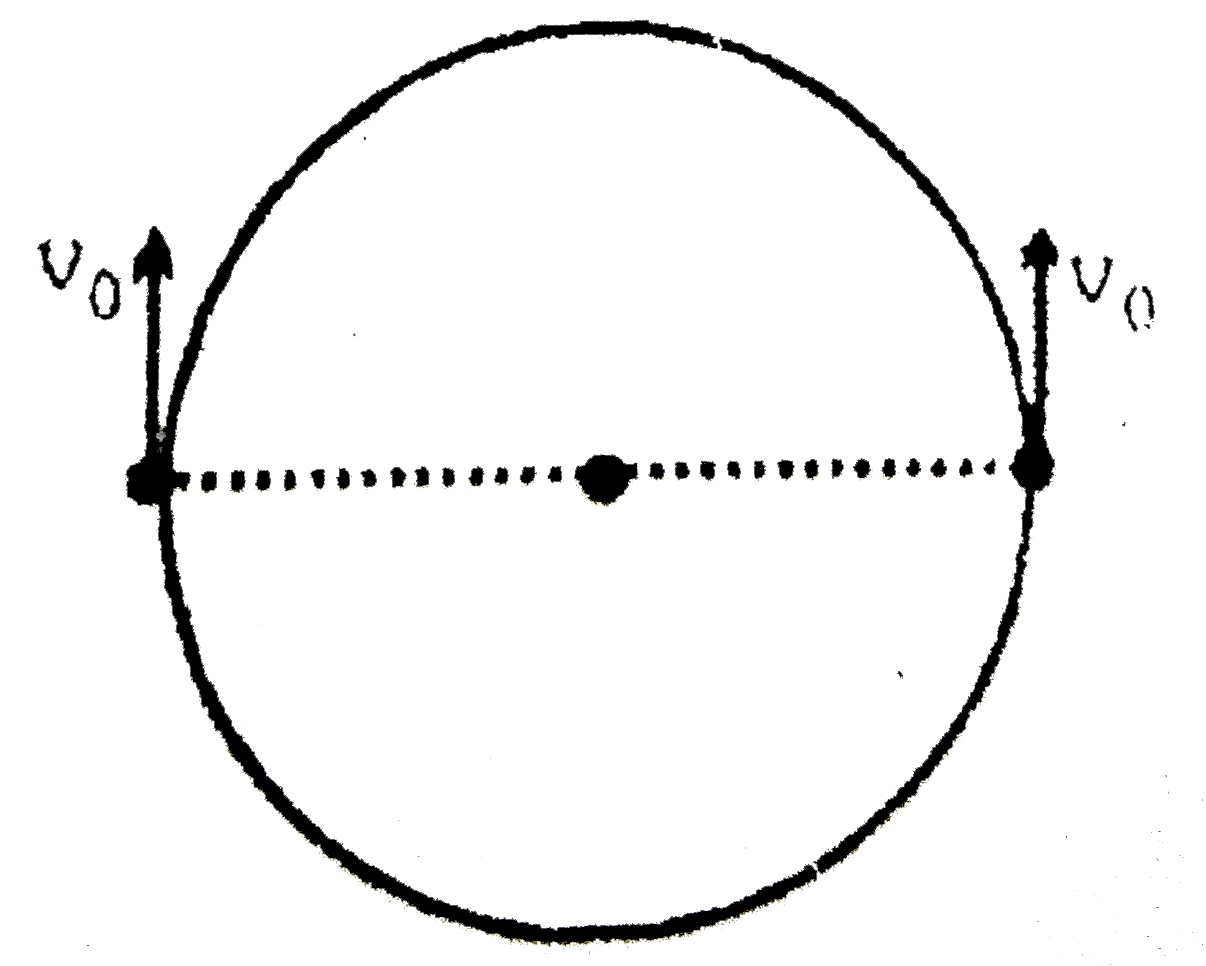
Two paritcles of mass m, constrained to move along the circumference of a smooth circular hoop of equal mass m, are initially located at opposite ends of a diameter and given equal velocities `v_(0)` shown in the figure. The entire arrangement is located in gracity free space. Their velocity just before collision is :-

Promotional Banner

Similar Questions

Explore conceptually related problems

Two particles of mass m, constrained to move along the circumference of a smooth circular hoop of equal mass m, are initially located at opposite ends of a diameter and given equal velocities v_(0) shown in the figure. The entire arrangement is located in gravity free space. Their velocity just before collision is :-

Two particles of mass m, constrained to move along the circumference of a smooth circular hoop of equal mass m, are initially located at opposite ends of a diameter and given equal velocities v_(0) shown in the figure. The entire arrangement is located in gravity free space. Their velocity just before collision is :-

Two particles of mass m and 2 m moving in opposite directions collide elastically with velocities v and 2v. Find their velocities after collision.

A particle of mass m strikes elastically with a disc of radius R , with a velocity vec"v" as shown in the figure. If the mass of the disc is equal to that of the particle and the surface of the contact is smooth, find the velocity of the disc just after the collision.

A small smooth disc of mass m and radius moving with an initial velocity 'v' along the positive x- axis collided with a big disc of mass 2m and radius 2r which was initially at rest with its centre at origin as shown in figure. If the coefficient of restitution is 0 then velocity of largen disc after collision is

A small smooth disc of mass m and radius moving with an initial velocity 'v' along the positive x- axis collided with a big disc of mass 2m and radius 2r which was initially at rest with its centre at origin as shown in figure. If the coefficient of restitution is 0 then velocity of larger disc after collision is

Two particles of masses m and 2m moving in opposite directions collide elastically with velocity 2v and v , respectiely. Find their velocities after collision.

Two balls of masses m and 2m moving in opposite directions collide head on elastically with velocities v and 2v . Find their velocities after collision.

Two balls of masses m and 2m moving in opposite directions collide head on elastically with velocities v and 2v . Find their velocities after collision.