Home
Class 12
PHYSICS
A block of mass m having a charge q is p...

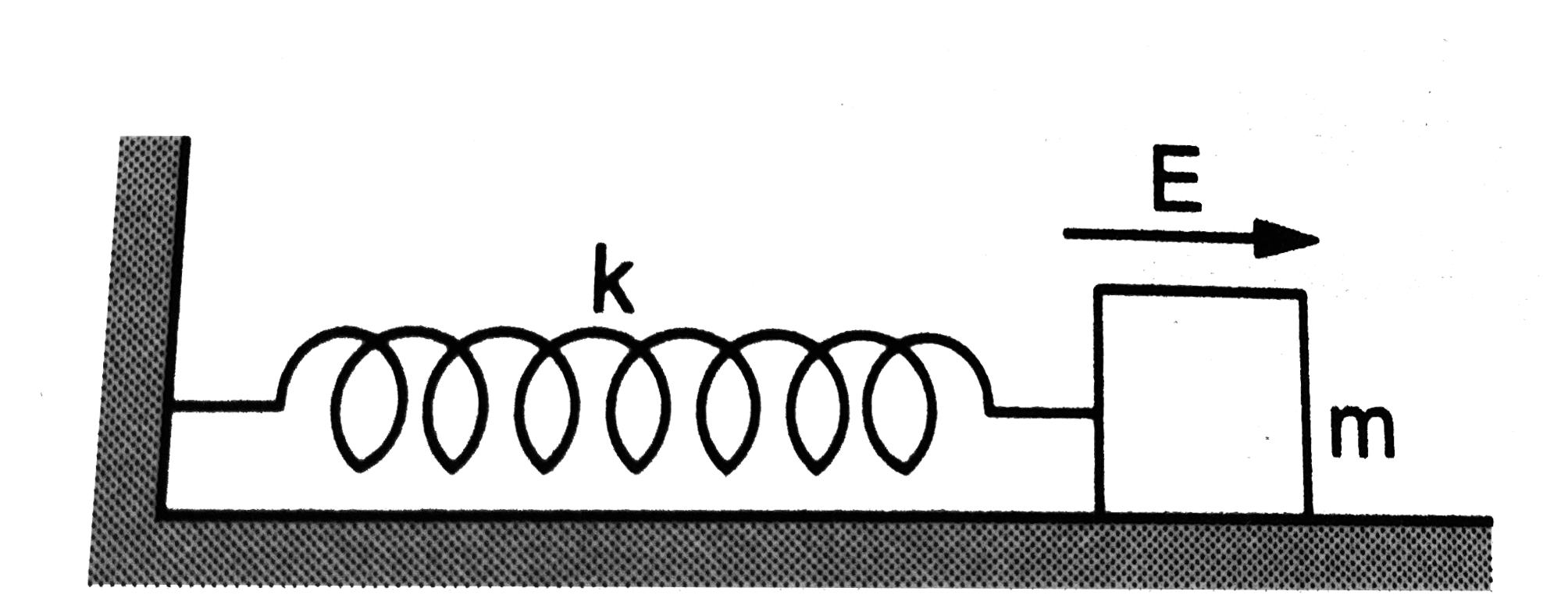
A block of mass m having a charge q is placed on a smooth horizontal table and is connected to a wall through an unstressed spring of spring constant k as shown in figure(29.E1) . A horizontal electric field E parallel to the spring is switched on. Find the amplitude of the resulting SHM of the block.

Text Solution

Verified by Experts

` F=qE,F-kx[where x amplitude] `
` qE=-kx `
` or x=(qE)/k`
Promotional Banner

Topper's Solved these Questions

  • ELECTRIC FIELD AND POTENTIAL

    HC VERMA|Exercise Objective 2|8 Videos
  • ELECTRIC CURRENT THROUGH GASES

    HC VERMA|Exercise Exercises|23 Videos
  • ELECTROMAGNETIC INDUCTION

    HC VERMA|Exercise EXERCISE|9 Videos

Similar Questions

Explore conceptually related problems

A particular of mass m and having a charge q is placed on a smooth horizontal table and is connected to walls through unstressed springs of constant k (shown in figure). A horizontal electric field E parallel to spring is switched On. The maximum speed of the particle

A block of mass m containing a net negative chage -q is placed on a froctionless horizontal tabe and is connected to a wall through an unstreached spring of spring constant k. If the horizontal electric field E parallel to spring is switched on , then the maximum compression of the spring is

A small cork block of mass m=1kg having charge q=-1C placed on a rough horizontal surface and is connected to a vertical wall through an unstretched non conducting light spring of spring consant k=9N//m as shown in the figure. If a horizontal constant electric field E=10N//C is switched on then the maximum compression in the spring is xm . Find the value of x . (Take g=10m//s^(2),mu=0.1 )

A block of mass m is moving with a speed v on a horizontal rought surface and collides with a horizontal monted spring of spring constant k as shown in the figure .The coefficient of friction between the block and the floor is mu The maximum cobnpression of the spring is

A spring mass system as shown in figure is suspended in a constant electric field E. A charge q is given to the mass.

A block of mass m moving with velocity v_(0) on a smooth horizontal surface hits the spring of constant k as shown. Two maximum compression in spring is

Two blocks of masses 3kg and 6kg respectivley are placed on a smooth horizontal surface. They are connected by a light spring of force constant k=200N//m . Initially the spring is unstretched. The indicated velocities are imparted to the blocks. Find the maximum extension of the spring.

A block of mass M=1 kg resting on a smooth horizontal surface is connected to a horizontal light spring of spring constant k=6N/m whose other end is fixed to a verticall wall. Another block of mass m=0.5 kg is placed over the block M. If the coefficient of friction between the two blocks mu =0.4, find the maximum kinetic energy (in J) that the system can have for simple hormonic oscillation under the action of the spring.

A spring of spring constant 'K' is fixed at one end has a small block of mass m and charge q is attached at the other end. The block rests over a smooth horizontal surface. A uniform and constant magnetic field B exists normal to the plane of paper as shown in figure. An electric field vec(E) = E_(0) hat (i)(E_(0) is a positive constant) is switched on at t =0 sec. The block moves on horizontal surface without ever lifting off the surface. Then the normal reaction acting on the block is :

A block of mass m sliding n a smooth horizontal surface with velocity vecv meets a long horizontal spring fixed ast one end and having spring constant k as shown n figure. Find the maximum compression of the spring. Will the velocity of the block be the same as v whenit comes back to the original position shown?

HC VERMA-ELECTRIC FIELD AND POTENTIAL-Exercises
  1. A ball of mass 100g and having a charge of 4.9xx 10^(-5) C is released...

    Text Solution

    |

  2. The bob of a simple pendulum has a mass of 40 g and a positive char...

    Text Solution

    |

  3. A block of mass m having a charge q is placed on a smooth horizontal t...

    Text Solution

    |

  4. A block of mass n containing a net positive charge q is placed on a sm...

    Text Solution

    |

  5. A Uniform electric field of 10NC ^(-1) exists in the vertically downwa...

    Text Solution

    |

  6. 12 j of work has to be done against an existion electric field to take...

    Text Solution

    |

  7. Two equal charges, 2.0xx10^(-7) C each, are held fixed at a separation...

    Text Solution

    |

  8. An electric field of 20 N//C exists along the x-axis in space. Calcula...

    Text Solution

    |

  9. Consider the situation of the previous problem. A charge of 2.0xx 10 ^...

    Text Solution

    |

  10. An electric field vecE = vec(i20 + vecj30 ) NC^(-1) exists in the spac...

    Text Solution

    |

  11. An electric field vecE = vec I Ax exists in the space, where A= 10 V ...

    Text Solution

    |

  12. The electric potential existing in space is V(x,y,z)= A (xy+ yz+zx).(a...

    Text Solution

    |

  13. Two charged particles, having equal charges of 2.0xx 10^(-5) C each, a...

    Text Solution

    |

  14. Some equipotential surfaces are shown in figure(29.E3) What can you sa...

    Text Solution

    |

  15. Consider a circular ring of radius r, uniformly charged with linear ch...

    Text Solution

    |

  16. An electric field of magnitude 1000 NC ^(-1) is produced between two p...

    Text Solution

    |

  17. A uniform field of 2.0 NC^(-1) exists in space in x direction (a) Taki...

    Text Solution

    |

  18. How much work has to be done in assembling three charged particles at ...

    Text Solution

    |

  19. The kinetc energy of a chargd particle decreased by 10 J as it moves f...

    Text Solution

    |

  20. Two identical particles, each having a charge of 2.0xx10^(-4) C and th...

    Text Solution

    |
