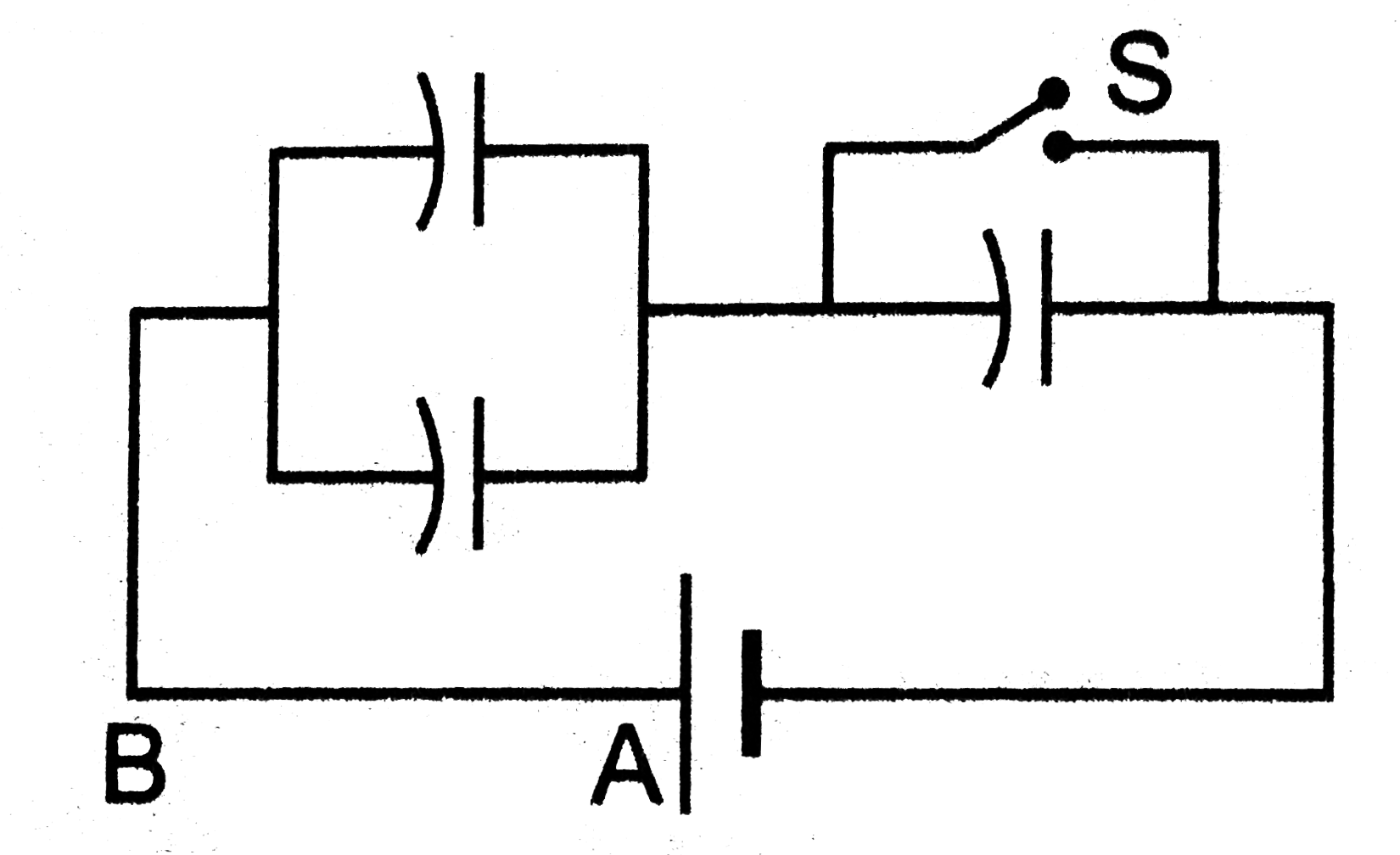
The particle P shown has amass of 10mg and a charge `of -0.01mu C.`Each plate has a surface area
Text Solution
Verified by Experts
Electerical force is blanced by the weight of the mass ` mg = qE E = elecrtric field ` or `mg = q. V. C / eplision _0 A` (:. Eplision_0 A / d = C :. 1 / d = C / eplision_0 A)` V = mg eplision_0 A / q.C ` `= 10^(-6) xx 9.8 xx 8.88 xx 10^(-12) xx 100 xx 10^(-4) / 10 xx 10^(-8) xx 0.04 xx 10^(-6)` `V = 43 m V`.
Topper's Solved these Questions
CAPACITORS
HC VERMA|Exercise Exercises|66 Videos
BOHR'S MODEL AND PHYSICS OF THE ATOM
HC VERMA|Exercise Exercises|46 Videos
DISPERSION AND SPECTRA
HC VERMA|Exercise Exercises|11 Videos
Similar Questions
Explore conceptually related problems
The particle P shown in the figure has a mass of 10 mg and a charge of -0.01 muC . Each plate has a surface area 10^(-2) m^2 on one side. What potential difference V should be applied to the combination to hold the particle P in equilibrium?
The particle P shown in the figure has a mass m and a charge -q. Each horizontal plate has a surface area A potential difference V=n((mg epsilon_(0)A)/(2qc)) should be applied to the combination to hold the particle p in equilibrium then find the value of n.
A metal cube of length 0.1 is charged by 12 mu C . Calculate its surface charge density.
Particle having a mass of 1.0 mg has a velocity of 3600 km/h. Calculate the wavelength of the particle.
A copper plate has a length of 0.1 m and a width of 0.12 m at 25^@C . The plate is uniformly heated to 175^@C . If the liner expansion coefficient for copper is 1.7 xx10^(-5)//""^@C what is the change in the area of the plate as a result of the increase in temperature ?
A parallel plate capacitors of plate area A has a total surface charge density +sigma on one plate and a total surface charge density -sigma on the other plate. The force one plate due to the other plate is given by :
A parallel plate capacitor of capacitance 1 mu F has a charge of + 2 mu C on one of the plates and a charge of + 4 mu C on the other. The potential difference developed across the capacitor is
Two circular rings A and B, each of radius a = 30cm, are placed coaxiallywith their axes vertical as shown in figure -1 .456. Distance between centres of these rings is h = 40cm . Lower ring A has a positive charge of 10mu C, while upper ringB has a negative charge of 20muC. A particle of mass m = 100 gm carrying a positive charge of q =10mu C is released from rest at the centre of the ring ltbergt (a) Calculate initial acceleration of the particle. (b) Calculate velocity of particle when it reaches at the centre ofupper ring B. (g= 10 ms^(-2))
A parallel air capacitance 245muF has a charge of magnitude 0.48muC on each plate. The plates are 0.328 mm apart. (a) What is the potential difference between the plates? (b) What is the area of each plate? (c) What is the surface charge density on each plate?