Home
Class 12
PHYSICS
A conducting wire of length l, lying nor...

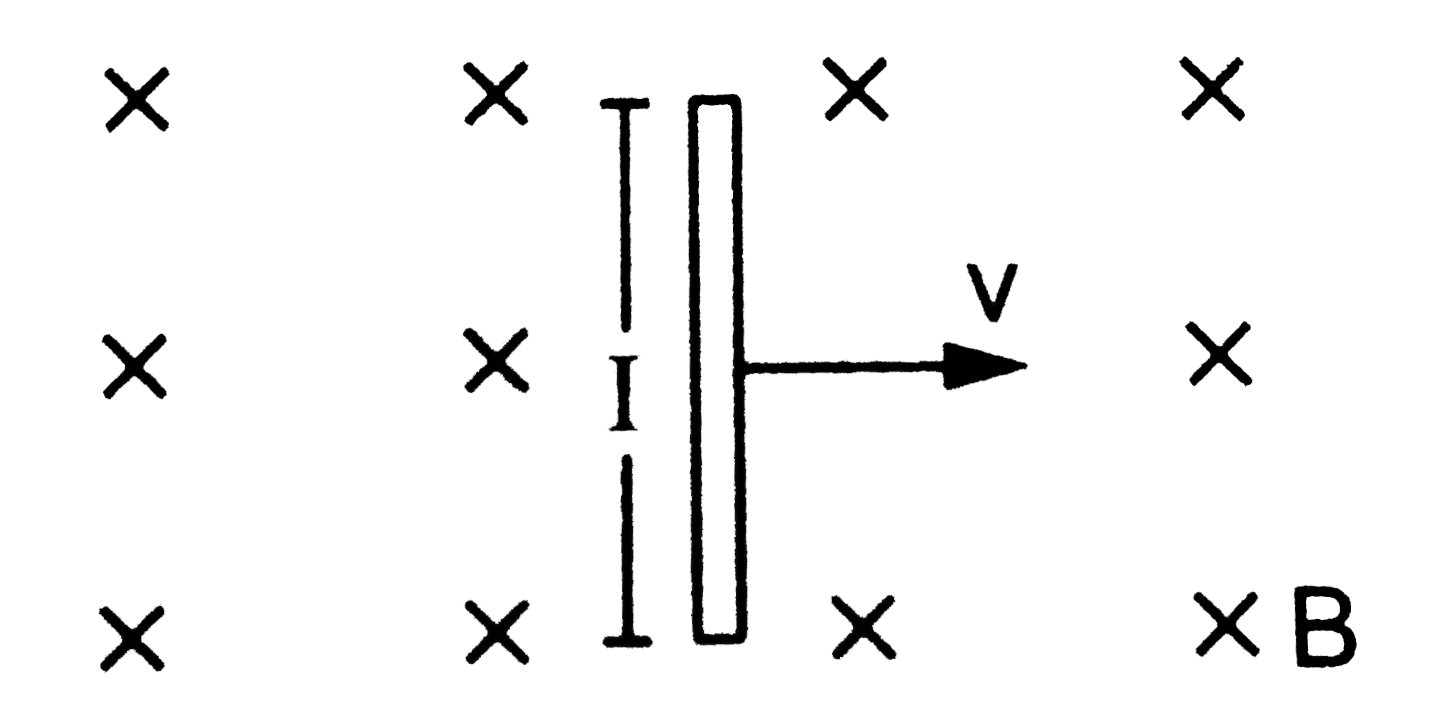
A conducting wire of length l, lying normal to a magnetic field B, moves with a velocity v as shown in (a) Find the average magnetic fore on a free electron of the wire. Due to this magnetic force, electrons concentrate at one end resulting in an electric field inside the wire. The redistribution stops when the electric force on the free electrons balances themagnetic force. Find the electric field developed inside the wire when the redistribution field developed inside the wire when the redistribution stops. (c) what potential difference is developed between the ends of the wire?

Text Solution

Verified by Experts

(a) Volocity of electron = V,
`Force = q(Vxx B) = qVB `
` (b) F= qE, F= qVB `
or ` qE = qVB ,`
`or aE = eVB or F= VB `
` ( c ) V = lE = LVB `.
Promotional Banner

Topper's Solved these Questions

  • MAGNETIC FIELD

    HC VERMA|Exercise Objective 2|10 Videos
  • LIGHT WAVES

    HC VERMA|Exercise Exercises|41 Videos
  • MAGNETIC FIELD DUE TO CURRENT

    HC VERMA|Exercise Exercises|61 Videos

Similar Questions

Explore conceptually related problems

Find the magnetic force on loop PQRS due to the wire.

An electron enters in an electric field with its velocity in the direction of the electric lines of force. Then

A currrent I is passed through a silver strip of width d and area of cross section A. The number of free electrons per unit volume is n. (a) Find the drift velocity v of the electrons. (b) If a magnetic field B exists in the region as shown in what is the average magnetic force on the free electrons? (c) Due to the magnetic force, the free electrons get accumulated on one side of the conductor along its length. This produces a transverse electric field in the conductor which opposes the magnetic force on the electrons. Find the magnitude of the electric field which will be the potential diference developed across the width of the conductor due to the electron- accumulation? The appearance of a transverse emf, when a current-carrying wire is placed in a magnetic field, is called hall effect.

An elelctron moves with velocity vecv=ahatk in a magnetic field, vecB=bhati+chatj . Find the magnetic force on the electron.

An electron moves with velocity vec(v) = ak In a magnetic field of intensity vec(B) = b hat(i) + c hat(j) . Find the magnetic force on the electron.

An electric charge q is moving with a velocity w in the direction of a magnetic field B. The magnetic force acting on the charge is

Assertion : Magnetic force is always perpendicualr to the magnetic field. Reason : Electric force is along the direction of electric field.

The free electrons is conducting wire are in constant thermal motion. If such a wire, carrying no current, is placed in a magnetic field, is there a magnetic force on each free electron? Is there a magnetic force on the wire?

HC VERMA-MAGNETIC FIELD-Exercises
  1. Suppose that the radius of cross section of the wire used in the previ...

    Text Solution

    |

  2. The magnetic field existing in a region is given by vecB =B0(1+(x)/(l)...

    Text Solution

    |

  3. A conducting wire of length l, lying normal to a magnetic field B, mo...

    Text Solution

    |

  4. A currrent I is passed through a silver strip of width d and area of...

    Text Solution

    |

  5. A particle having a charge of 2.0X10^(-8) C and a mass of 2.0X10^(-10...

    Text Solution

    |

  6. A proton describes a circle of radius 1 cm in a magnetic field of stre...

    Text Solution

    |

  7. An electron having a kinetic energy of 100eV circulates in a path of r...

    Text Solution

    |

  8. Protons having kinetic energy K emerge from an accelerator as a narrow...

    Text Solution

    |

  9. A charged particle is accelerated through a potential difference of 12...

    Text Solution

    |

  10. Doubly ionized helium ions are projected with a speed of 10kms^(-1) in...

    Text Solution

    |

  11. A proton is projected with a velocity of 3X10^6 m s ^(-1) perpendicula...

    Text Solution

    |

  12. (a) An electron moves along a circle of radius 1m in a perpendicular m...

    Text Solution

    |

  13. A particle of mass m and positive charge q, moving with a uniform velo...

    Text Solution

    |

  14. A charged particle (q, m) enters perpendicular in a uniform magnetic f...

    Text Solution

    |

  15. A narrow beam of singley charged carbon ions, moving at a constant ve...

    Text Solution

    |

  16. Fe ^+ ions are accelerated through a potential difference of 500 V and...

    Text Solution

    |

  17. A nerrow beam of singly charged potassium ions of kinetic energy 32ke...

    Text Solution

    |

  18. Shows a convex lens of focal length 12 cm lying in a uniform magnetic...

    Text Solution

    |

  19. Electrons emitted with negligible speed from an electron gun are accel...

    Text Solution

    |

  20. Two particles, each having a mass m are placed at a separation d in a ...

    Text Solution

    |
