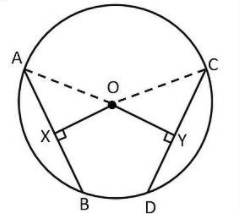
Theorem 10.6 : Equal chords of a circle (or of congruent circles) are equidistant from the centre (or centres).
Text Solution
Verified by Experts
Since `OXbotAB`
Perpendicular from the center to the chord, bisects the chord,
`AX=BX=(AB)/2`
Similarly,
`CY=DY=(CD)/2`
`AB=CD` (given)
Thus,
...
Topper's Solved these Questions
NCERT THEOREMS
NCERT|Exercise THEOREM 10.7|1 Videos
NCERT THEOREMS
NCERT|Exercise THEOREM 10.8|1 Videos
NCERT THEOREMS
NCERT|Exercise THEOREM 10.5|1 Videos
LINES AND ANGLES
NCERT|Exercise SOLVED EXAMPLES|8 Videos
NUMBER SYSTEMS
NCERT|Exercise EXERCISE 1.4|2 Videos
Similar Questions
Explore conceptually related problems
Theorem :-4(i) Equal chords of a circle (or of congruent circle) are equidistant from the centre (ii) Of any two chords of a circle larger chord will be nearer to the centre.
Equal chord of congruent circles are equidistant from the corresponding centres.
Equal chords of congruent circles are equidistant from the corresponding centres.
Equal chords of a circle are equidistant from the centre.
Chords of congruent circles which are equidistant from the corresponding centres, are equal.
Chords of congruent circlles which are equidistant from the corresponding centres; are equal.
Chords of a circle which are equidistant from the centre are equal.
Equal chords of a circle are equidistant from circle.
Theorem 10.1 : Equal chords of a circle subtend equal angles at the centre
Equal chords of congruent circles subtend equal angles at the centre.