

Home
Class 12
MATHS
If veca, vecb, vecc are the position vec...

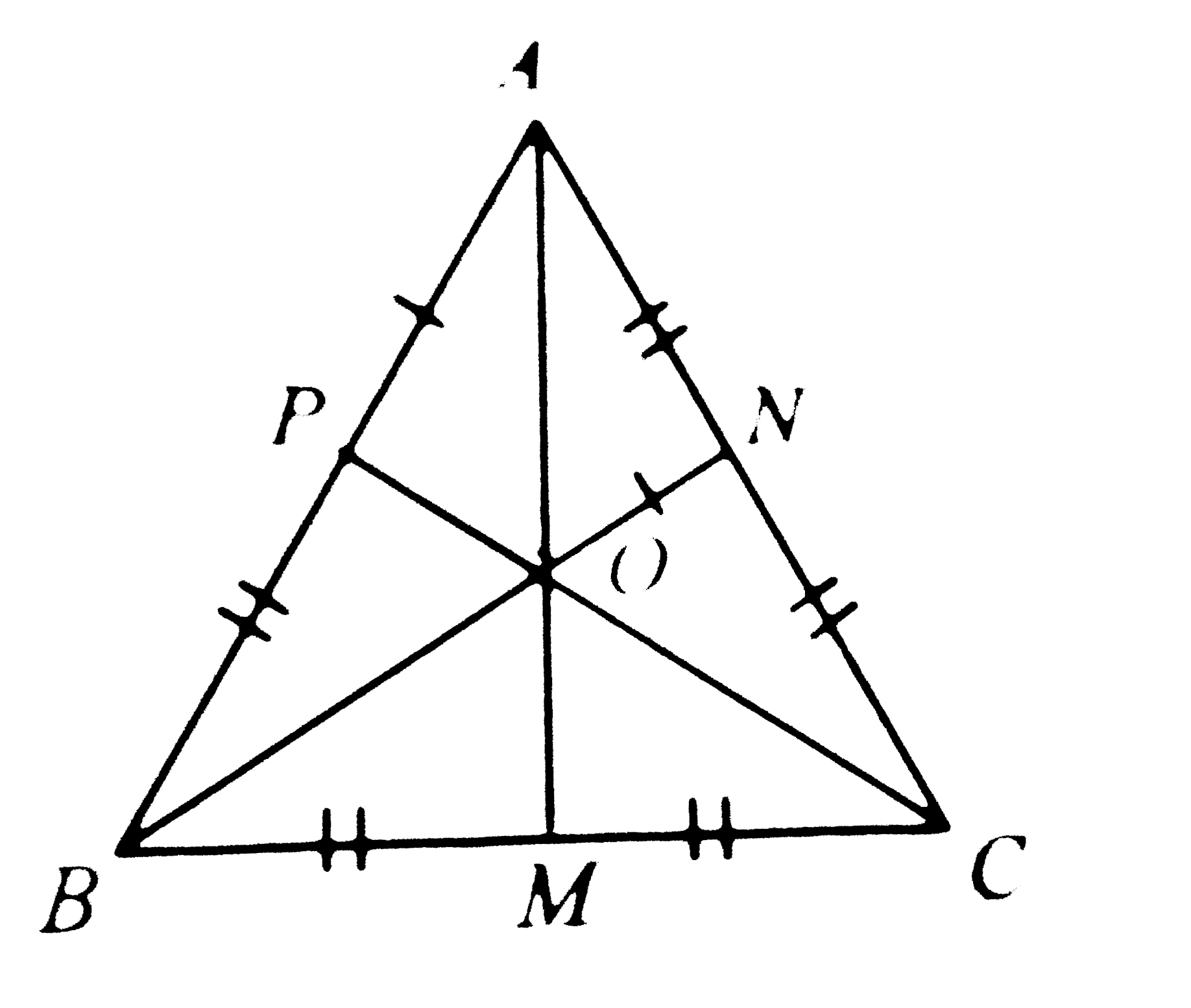
If `veca, vecb, vecc` are the position vectors of the vertices of an equilateral triangle whose orthocenter is at the origin, then

A

`vec(a)+vec(a)+vec(c)=vec(0)`

B

`vec(a)+vec(b)+vec(c)`= unit vector

C

`vec(a)+vec(b)=vec(c)`

D

`vec(a)=vec(b)+vec(c)`

Text Solution

Verified by Experts

The correct Answer is:
A

Position vectors of vertices A, B andC are `vec(a), vec(b) and vec(c)`.

`:'` triangle is equilateral.
`:.` Centroid and orthocenter will coincide.
Centroid `-=` orthocenter position vector
`=(1)/(3) (vec(a)+vec(b)+vec(c))`
`:'` given in question orthocenter is at origin.
Hence `(1)/(3)(vec(a)++vec(b)+vec(c))=0`
`vec(a)+vec(b)+vec(c)=0`
Promotional Banner

Topper's Solved these Questions

  • TRIGONOMETRY - RATIO & IDENTITY , TRIGONOMETRIC EQUATIONS

    NDA PREVIOUS YEARS|Exercise MCQ|238 Videos

Similar Questions

Explore conceptually related problems

IF veca, vecb, vecc are the position vectors of the vertices of an equilateral triangle whose orthocentre is at the origin, then

If vec a,vec b,vec c are the position vectors of the vertices of an equilateral triangle whose orthocenter is at the origin,then

If vec(a), vec(b) and vec(c ) are the position vectors of the vertices of an equilateral triangle whose orthocenter is at the origin, and then which one of the following is correct?

If veca , vecb, vecc are the position vectors of the vertices. A,B,C of a triangle ABC. Then the area of triangle ABC is

If veca, vecb and vecc are the position vectors of the vertices A,B and C. respectively , of triangleABC . Prove that the perpendicualar distance of the vertex A from the base BC of the triangle ABC is (|vecaxxvecb+vecbxxvecc+veccxxveca|)/(|vecc-vecb|)

If veca, vecb and vecc are the position vectors of vertices A,B,C of a Delta ABC, show that the area of triangle ABC is 1/2| veca xx vecb + vecbxx vec c+vec c xx veca|. Deduce the condition for points veca, vecb and vecc to be collinear.

ABCD is parallelogram vecA, vecB, vecC and vecD are the position vectors of vecticles A, B, C, and D with respect to any origin, them:

NDA PREVIOUS YEARS-VECTORS -MATH
  1. Let hat(a), hat(b) be two unit vectors and theta be the angle between...

    Text Solution

    |

  2. What is a vector of unit length orthogonal to both the vectors hat(...

    Text Solution

    |

  3. If veca, vecb, vecc are the position vectors of the vertices of an equ...

    Text Solution

    |

  4. What is the area of the parallelogram having diagonals 3hat(i) + hat(j...

    Text Solution

    |

  5. Let vec(a) = hat(i) + hat(j), vec(b) = 3 hat(i) + 4 hat(k) and vec (b)...

    Text Solution

    |

  6. Let vec(a) = hat(i) + hat(j), vec(b) = 3 hat(i) + 4 hat(k) and vec (b)...

    Text Solution

    |

  7. Let vec(a), vec(b) and vec(c) be three vectors such that vec(a) + vec...

    Text Solution

    |

  8. Let vec(a), vec(b) and vec(c) be three vectors such that vec(a) + vec...

    Text Solution

    |

  9. If in a right-angled triangle ABC, hypotenuse AC=p, then what is vec(A...

    Text Solution

    |

  10. Find the moment of vec F about point (2, -1, 3), where force vec ...

    Text Solution

    |

  11. If vec(a)=hat(i)-hat(j)+hat(k), vec(b) = 2 hat(i) + 3 hat( j) + 2 hat...

    Text Solution

    |

  12. Let A B C D be a p[arallelogram whose diagonals intersect at P and ...

    Text Solution

    |

  13. ABCD is a quadrilateral whose diagonals are AC and BD. Which one of th...

    Text Solution

    |

  14. If vec(a)xx vec(b) = vec(c) and vec(b) xx vec(c) = vec(a), then which ...

    Text Solution

    |

  15. If vec(a) = 2 hat(i) + 3 hat (j) + 4 hat(k) and vec(b) = 3 hat(i) + 2 ...

    Text Solution

    |

  16. If alpha, beta and lambda are the angles which the vector vec(OP) (O...

    Text Solution

    |

  17. Let vec(alpha)=hat(i) +2 hat(j) - hat(k), vec(beta) = 2 hat(i) - hat(j...

    Text Solution

    |

  18. If hata and hatb are two unit vectors, then the vector (hata + hatb) x...

    Text Solution

    |

  19. A force vec(F) = hat(i) + 3 hat(j) + 2 hat(k) acts on a particle to di...

    Text Solution

    |

  20. For any vector vec(a), |vec(a)xx hat(i)|^(2)+ |vec(a)xx hat(j)|^(2)+ |...

    Text Solution

    |