A
B
C
D
Text Solution
Verified by Experts
The correct Answer is:
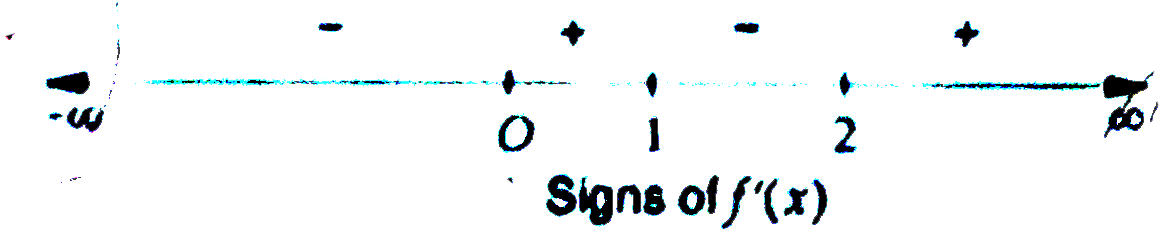



Topper's Solved these Questions
DEFINITE INTEGRALS
OBJECTIVE RD SHARMA|Exercise Section II - Assertion Reason Type|12 VideosDEFINITE INTEGRALS
OBJECTIVE RD SHARMA|Exercise Exercise|147 VideosDEFINITE INTEGRALS
OBJECTIVE RD SHARMA|Exercise Chapter Test 2|60 VideosCONTINUITY AND DIFFERENTIABILITY
OBJECTIVE RD SHARMA|Exercise Exercise|86 VideosDERIVATIVE AS A RATE MEASURER
OBJECTIVE RD SHARMA|Exercise Exercise|26 Videos
Similar Questions
Explore conceptually related problems
OBJECTIVE RD SHARMA-DEFINITE INTEGRALS-Section I - Solved Mcqs
- Let f(x) be an odd continuous function which is periodic with period 2...
Text Solution
|
- All the values of 'a' for which int(1)^(2) {a^(2)+(4-4a)x+4x^(3)}dxle1...
Text Solution
|
- Let f (x) be a function defined by f(x)=int(0)^(x) t(t^(2)-3t+2)dt, 1 ...
Text Solution
|
- If int(0)^(x){t}dt=int(0)^({x})t dt ("where" x gt0 neZ and and {*} rep...
Text Solution
|
- Let f(x)=max. {x+|x|,x-[x]} , where [x] denotes the greatest integer l...
Text Solution
|
- rArrint(0)^(oo) [(2)/(e^(x))]dx (where [*] denotes the greatest intege...
Text Solution
|
- If rArr int(0)^(1) (e^(-t))/(t+1) dt =a, "then"int(b-1)^(b) (e^(-1))/(...
Text Solution
|
- If rArr int(-1)^(-4) f(x)dx= 4 and int(2)^(-4) (3-f(x))dx=7 , then the...
Text Solution
|
- For x in R and a continuous function f(x) , let I(1)int(sin^(2)t)^(1+c...
Text Solution
|
- int(1)^(4) log(e)[x]dx equals
Text Solution
|
- If [*] denots the greatest integer function then the value of the inte...
Text Solution
|
- The value of int(0)^(100pi) sum(r=1)^(10) tan rx dx is equal to
Text Solution
|
- If I(1)=int(0)^(pi//2) cos(sin x) dx,I(2)=int(0)^(pi//2) sin (cos x)...
Text Solution
|
- For any n in N, the value of the intergral int(0)^(pi) (sin 2nx)/(sin...
Text Solution
|
- For any n in N, int(0)^(pi) (sin^(2)nx)/(sin^(2)x)dx is equal to
Text Solution
|
- For any n in N, int(0)^(pi) (sin (2n+1)x)/(sinx)dx is equal to
Text Solution
|
- If I(n) int(-pi)^(pi) (sin nx)/((1+pi^(x))sinx)dx,n=0,1,2,... then whi...
Text Solution
|
- If I(n)=int(0)^(pi//4) tan^(n)x dx, then (1)/(I(2)+I(4)),(1)/(I(3)+I...
Text Solution
|
- Let f(x) be a function defined on R satisfyin f(x) =f(1-x) for all x...
Text Solution
|
- The vlaue of ((5050)int(0)^(1)(1-x^(50))^(100)dx)/(int(0)^(1) (1-x^(50...
Text Solution
|