Home
Class 12
MATHS
The vertices of a square are z1,z2,z3 an...

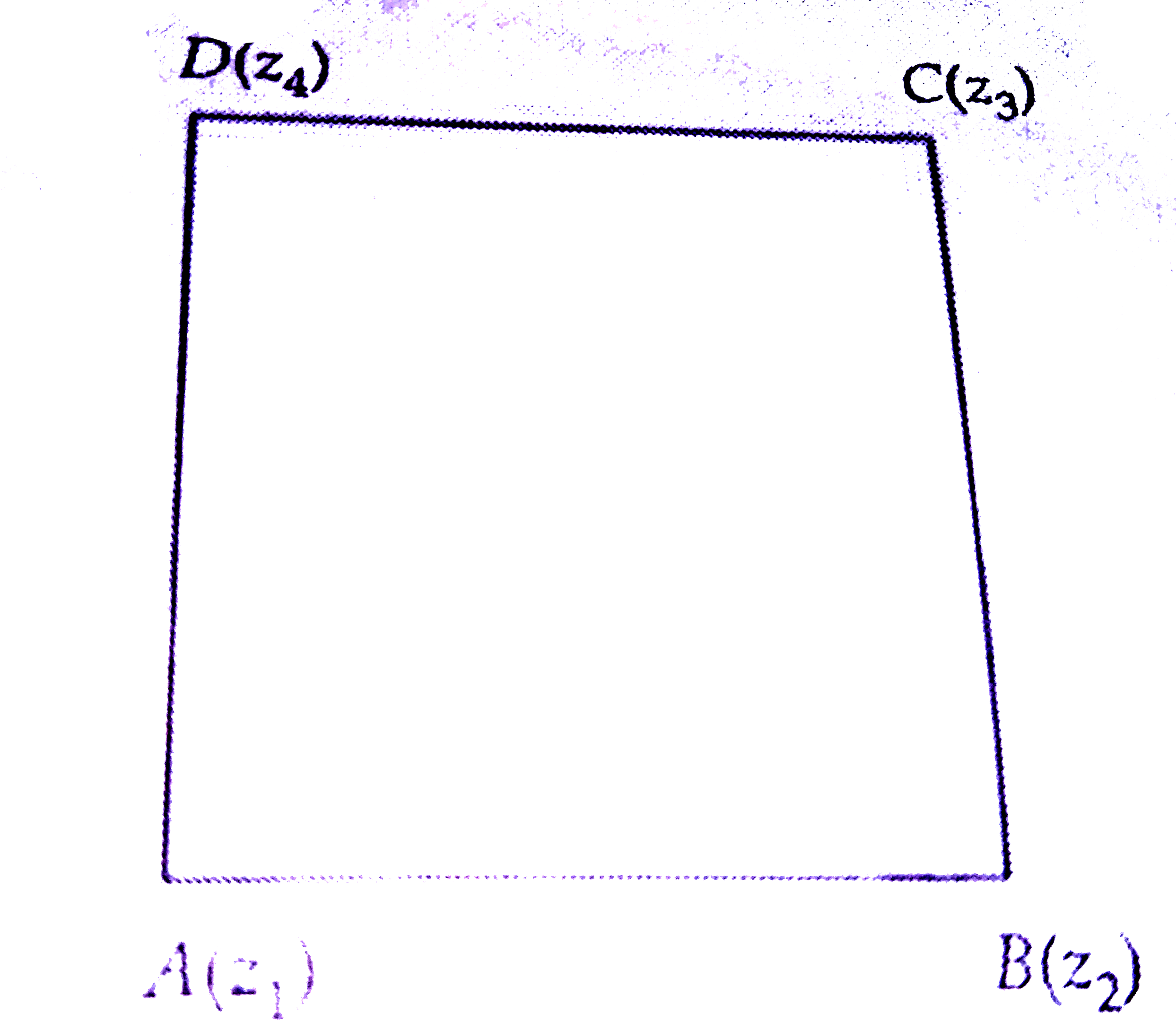
The vertices of a square are `z_1,z_2,z_3 and z_4` taken in the anticlockwise order, then `z_3=`

A

`-iz_(1)+(1+i)z_(2)`

B

`iz_(1)+(1-i)z_(2)`

C

`z_(1)+(1+i)z_(2)`

D

`(1+i)z_(1)+z_(2)`

Text Solution

Verified by Experts

The correct Answer is:
A

Let ABCD be the given square such that the affixes of the vertices A,B,C and D are `z_(1),z_(2),z_(3)` and `z_(4)` respectively.
The diagonals AC and BD bisect each other.

`therefore (z_(1)+z_(3))/(2) =(z_(2)+z_(4))/(2) rArr z_(1)+z_(3)=z_(2)+z_(4)` .................(i)
Clearly, `bar(AD)` can be obtained by rotating `bar(AB)` through `pi//2`.
`therefore bar(AD)=bar(AB)e^(ipi//2)`
`rArr z_(4)-z_(1)=(z_(2)-z_(1))e^(ipi//2)`
`rArr z_(4)-z_(1) = (z_(2)-z_(1))i rArr z_(4)=iz_(2)+(1-i)z_(1)`
Putting `z_(4)=iz-(2)+(1-i)z_(1)` in (i), we get `z_(3)=-iz_(1)+(1-i)z_(2)`.
Promotional Banner

Topper's Solved these Questions

  • COMPLEX NUMBERS

    OBJECTIVE RD SHARMA|Exercise Section I - Solved Mcqs|141 Videos
  • COMPLEX NUMBERS

    OBJECTIVE RD SHARMA|Exercise Section II - Assertion Reason Type|15 Videos
  • CIRCLES

    OBJECTIVE RD SHARMA|Exercise Chapter Test|55 Videos
  • CONTINUITY AND DIFFERENTIABILITY

    OBJECTIVE RD SHARMA|Exercise Exercise|86 Videos

Similar Questions

Explore conceptually related problems

Statement -1 : if 1-i,1+i, z_(1) and z_(2) are the vertices of a square taken in order in the anti-clockwise sense then z_(1) " is " i-1 and Statement -2 : If the vertices are z_(1),z_(2),z_(3),z_(4) taken in order in the anti-clockwise sense,then z_(3) =iz_(1) + (1+i)z_(2)

z_1,z_2 are represented by two consecutive vertices of a rhombus, the angle at z_1 being pi/4 . Find the complex numbers z_3,z_4 represented by the other vertices, the vertices z_1,z_2,z_3,z_4 being in the anticlockwise sense and origin being the center.

If z_(1),z_(2),z_(3) be vertices of an equilateral triangle occurig in the anticlockwise sense, then

If A(2+3i) and B(3+4i) are two vertices of a square ABCD (taken in anticlockwise order)in a complex plane, then the value of |Z_(3)|^(2)-|Z_(4)|^(2) (Where C is Z_(3) and D is Z_(4) ) is equal to

If z_(1),z_(2),z_(3),z_(4), represent the vertices of a rhombus taken in anticlockwise order,then

Let z_(1),z_(2),z_(3),z_(4) be the vertices A,B,C,D respectively of a square on the Argand diagramtaken in anticlockwise direction then prove that: 2z_(2)=(1+i)z_(1)+(1-i)z_(3)

If z_1,z_2,z_3,z_4 be the vertices of a parallelogram taken in anticlockwise direction and |z_1-z_2|=|z_1-z_4|, then sum_(r=1)^4(-1)^r z_r=0 (b) z_1+z_2-z_3-z_4=0 a r g(z_4-z_2)/(z_3-z_1)=pi/2 (d) None of these

If two vertices of an equilateral triangle are z_1,z_2 then find the complex number z_3 represented by the third vertex where z_1 , z_2,z_3 are anticlockwise.

z_(1),z_(2),z_(3) are the vertices of an equilateral triangle taken in counter clockwise direction. If its circumference is at the origin and z_(1)=1+i , then

OBJECTIVE RD SHARMA-COMPLEX NUMBERS -Chapter Test
  1. The vertices of a square are z1,z2,z3 and z4 taken in the anticlockwis...

    Text Solution

    |

  2. The locus of the center of a circle which touches the circles |z-z1|=a...

    Text Solution

    |

  3. If n1, n2 are positive integers, then (1 + i)^(n1) + ( 1 + i^3)^(n1) +...

    Text Solution

    |

  4. The modulus of sqrt(2i)-sqrt(-2i) is

    Text Solution

    |

  5. Prove that the triangle formed by the points 1,(1+i)/(sqrt(2)),a n di ...

    Text Solution

    |

  6. The value of (1+isqrt(3))/(1-isqrt(3))^(6)+(1-isqrt(3))/(1+isqrt(3))^(...

    Text Solution

    |

  7. If alpha+ibeta=tan^(-1) (z), z=x+iy and alpha is constant, the locus o...

    Text Solution

    |

  8. If cosA+cosB+cosC=0,sinA + sinB + sinC=0and A+B+C=180^0, then the valu...

    Text Solution

    |

  9. The value of the expression 1.(2-omega).(2-omega^2)+2.(3-omega)(3-omeg...

    Text Solution

    |

  10. The value of the expression (1+1/omega)(1+1/omega^(2))+(2+1/omega)(2+...

    Text Solution

    |

  11. The condition that x^(n+1)-x^(n)+1 shall be divisible by x^(2)-x+1 is ...

    Text Solution

    |

  12. The expression (1+i)^(n1)+(1+i^(3))^(n(2)) is real iff

    Text Solution

    |

  13. |{:("6i " "-3i " "1" ),("4 " " 3i" " -1"),("20 " "3 " " i"):}|=x+iy th...

    Text Solution

    |

  14. The centre of a square ABCD is at z0dot If A is z1 , then the centroid...

    Text Solution

    |

  15. If cosalpha+2cosbeta+3cosgamma=sinalpha+2sinbeta+3singamma=0 and alpha...

    Text Solution

    |

  16. If cosalpha+2cosbeta+3cosgamma=sinalpha+2sinbeta+3singamma=0 and alpha...

    Text Solution

    |

  17. Sum of the series sum(r=0)^n (-1)^r ^nCr[i^(5r)+i^(6r)+i^(7r)+i^(8r)] ...

    Text Solution

    |

  18. If az(1)+bz(2)+cz(3)=0 for complex numbers z(1),z(2),z(3) and real num...

    Text Solution

    |

  19. If 2z1-3z2 + z3=0, then z1, z2 and z3 are represented by

    Text Solution

    |

  20. Re((z+4)/(2z-1)) = 1/2, then z is represented by a point lying on

    Text Solution

    |

  21. The vertices of a square are z1,z2,z3 and z4 taken in the anticlockwis...

    Text Solution

    |

