A
B
C
D
Text Solution
Verified by Experts
The correct Answer is:
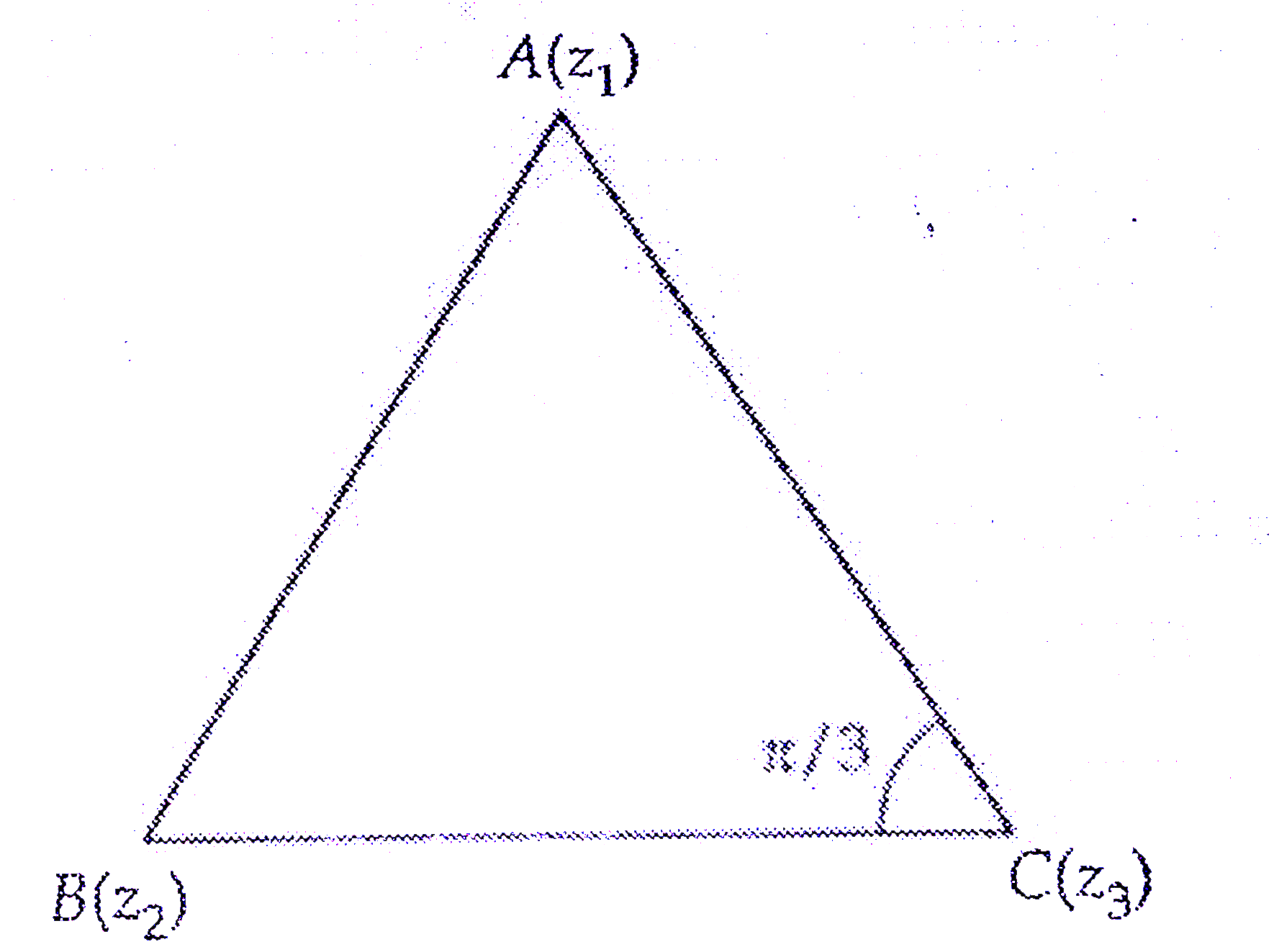



Topper's Solved these Questions
COMPLEX NUMBERS
OBJECTIVE RD SHARMA|Exercise Section II - Assertion Reason Type|15 VideosCOMPLEX NUMBERS
OBJECTIVE RD SHARMA|Exercise Exercise|131 VideosCOMPLEX NUMBERS
OBJECTIVE RD SHARMA|Exercise Chapter Test|59 VideosCIRCLES
OBJECTIVE RD SHARMA|Exercise Chapter Test|55 VideosCONTINUITY AND DIFFERENTIABILITY
OBJECTIVE RD SHARMA|Exercise Exercise|86 Videos
Similar Questions
Explore conceptually related problems
OBJECTIVE RD SHARMA-COMPLEX NUMBERS -Section I - Solved Mcqs
- If z(1),z(2),……………,z(n) lie on the circle |z|=R, then |z(1)+z(2)+………...
Text Solution
|
- Q. Let z1 and z2 be nth roots of unity which subtend a right angle at...
Text Solution
|
- The complex number z1,z2 and z3 satisfying (z1 - z3)/(z2 - z3) = ( 1 -...
Text Solution
|
- Let omega = - (1)/(2) + i (sqrt3)/(2), then the value of the determina...
Text Solution
|
- For all complex numbers z1,z2 satisfying |z1|=12 and |z2-3-4i|=5, fin...
Text Solution
|
- Let z1, z2 be two complex numbers represented by points on the circle ...
Text Solution
|
- If z lies on unit circle with center at the origin, then (1+z)/(1+barz...
Text Solution
|
- If |z1-1|<1, |z2-2|<2,|z3-3|<3 then |z1+z2+z3|
Text Solution
|
- Complex numbers z(1) and z(2) lie on the rays arg(z1)=theta and arg(z1...
Text Solution
|
- If z is a complex number satisfying |z|^(2)-|z|-2 lt 0, then the value...
Text Solution
|
- |z - i | <= 2 and z0 = 5 + 3i then max. value of |iz+z0| is :
Text Solution
|
- If |z|= "max"{|z-2|,|z+2|}, then
Text Solution
|
- if |(z-6)/(z+8)|=1, then the value of x in R, where z=x+i|{:(-3,2i,2+i...
Text Solution
|
- If |z-1|+|z+3|<=8, then the range of values of |z-4| is
Text Solution
|
- The equation |z-i|+|z+i|=k, k gt 0 can represent an ellipse, if k=
Text Solution
|
- Find the range of K for which the equation |z+i| - |z-i | = K represen...
Text Solution
|
- If |z+3i|+|z-i|=8, then the locus of z, in the Argand plane, is
Text Solution
|
- In Fig. 42, a point 'z' is equidistant from three distinct points z(1)...
Text Solution
|
- Let P(e^(itheta1)), Q(e^(itheta2)) and R(e^(itheta3)) be the vertices...
Text Solution
|
- If A(z(1)),B(z(2)), C(z(3)) are the vertices of an equilateral triangl...
Text Solution
|