Home
Class 12
MATHS
Let w = (sqrt 3 + iota/2) and P = { w^n ...

Let w = (`sqrt 3 + iota/2)` and `P = { w^n : n = 1,2,3, ..... },` Further `H_1 = { z in C: Re(z) > 1/2} and H_2 = { z in c : Re(z) < -1/2}` Where C is set of all complex numbers. If `z_1 in P nn H_1 , z_2 in P nn H_2` and O represent the origin, then `/_Z_1OZ_2` =

A

`pi/2, (5pi)/6`

B

`pi, (2pi)/3`

C

`(2pi)/3, (5pi)/3`

D

`(5pi)/3, (7pi)/3`

Text Solution

Verified by Experts

The correct Answer is:
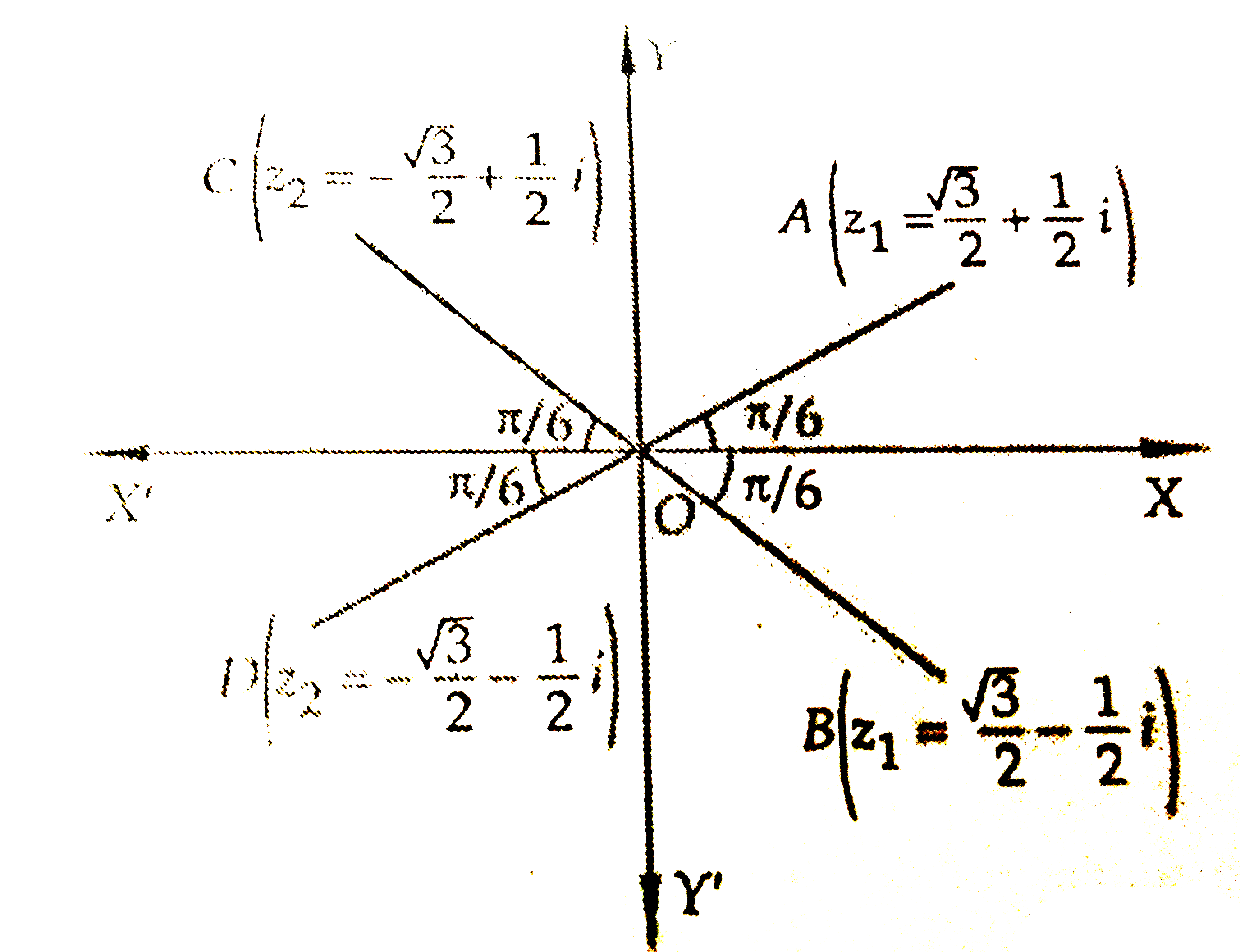
B

We have, `omega=sqrt(3)/2+1/2i=cospi/6+isinpi/6`
`rArr omega^(n)=cos(npi)/6+isin(npi)/6, n=1,2,3,…………`
`therefore P={omega^(n), n=1,2,3,…..} = {cos(npi)/6+ isin(npi)/6, n=1,2,3,….}`

Now, `z_(1) in P frown H_(1)`
`rArr z_(1) in P` and `z_(1) in H_(1)`
`rArr z_(1)cos(npi)/6+isin(npi)/6` for some `n in Z` and Re `(z_(1)) gt 1/2`
`rArr z_(1)=sqrt(2)/2 +1/2i, sqrt(3)/2-1/2i`
`z_(2) in P frown H_(2)`
`rArr z_(2) in P` and `z_(2) in H_(2)`
`rArr z_(2) = cos(npi)/6+isin(npi)/6` for some `n in N` and Re `z_(2) lt -1/2`
`rArr z_(2) = -sqrt(3)/2+1/2i, -sqrt(3)/2-1/2i`
If `z_(1)=sqrt(3)/2+1/2i` and `z_(2)=-sqrt(3)/2+1/2i`, then
`anglez_(1)Oz_(2)=angleAOC=pi-(pi/6+pi/6)=(2pi)/3`
If `z_(1)=sqrt(3)/2+1/2i` and `z_(2)=-sqrt(3)/2-1/2i`, then
`anglez_(1)Oz_(2)=angleAOD=pi`
If `z_(1)=sqrt(3)/2+1/2i` and `z_(2)=-sqrt(3)/2-1/2i`, then
If `z_(1)=sqrt(3)/2-1/2i` and `z_(2)=-sqrt(3)/2-1/2i`, then
`anglez_(1)Oz_(2)=angleBOD=(2pi)/3`
`If z_(1)=sqrt(3)/2-1/2i` and `z_(2)=-sqrt(3)/2+1/2i`, then
`anglez_(1)Oz_(2)=angleBOC=pi`
Hence, `anglez_(1)Oz_(2)=pi` or `(2pi)/3`
Promotional Banner

Topper's Solved these Questions

  • COMPLEX NUMBERS

    OBJECTIVE RD SHARMA|Exercise Section II - Assertion Reason Type|15 Videos
  • COMPLEX NUMBERS

    OBJECTIVE RD SHARMA|Exercise Exercise|131 Videos
  • COMPLEX NUMBERS

    OBJECTIVE RD SHARMA|Exercise Chapter Test|59 Videos
  • CIRCLES

    OBJECTIVE RD SHARMA|Exercise Chapter Test|55 Videos
  • CONTINUITY AND DIFFERENTIABILITY

    OBJECTIVE RD SHARMA|Exercise Exercise|86 Videos

Similar Questions

Explore conceptually related problems

Let w=(sqrt(3)+(iota)/(2)) and P={w^(n):n=1,2,3,....}, Further H_(1)={z in C:Re(z)>(1)/(2)} and H_(2)={z in c:Re(z)<-(1)/(2)} Where C is set of all complex numbers.If z_(1)in P nn H_(1),z_(2)in P nn H_(2) and O represent the origin,then /_Z_(1)OZ_(2)=

Let S=S_(1)nn S_(2)nn S_(3), where s_(1)={z in C:|z| 0} and S_(3)={z in C:Re z>0

For all complex number z_(1),z_(2) satisfying |z_(1)|=12 and |z_(2)-3-4 iota|=5, then |z_(2)-iota z_(1)|

If the points represented by complex numbers z_(1)=a+ib, z_(2)=c+id " and " z_(1)-z_(2) are collinear, where i=sqrt(-1) , then

If z_1=a+ib and z_2=c+id are two complex numbers then z_1 gt z_2 is meaningful if

The set {Re((2iz)/(1-z^(2))):z is a complex number,|z|=1,z=+-1}

Let |z|=2 and w-(z+1)/(z-1), where z,w,in C (where C is the set of complex numbers).Then product of least and greatest value of modulus of w is

If |Z-2|=2|Z-1| , then the value of (Re(Z))/(|Z|^(2)) is (where Z is a complex number and Re(Z) represents the real part of Z)

OBJECTIVE RD SHARMA-COMPLEX NUMBERS -Section I - Solved Mcqs
  1. The minimum value of |z(1)-z(2)| as z(1) and z(2) vary over the curves...

    Text Solution

    |

  2. Let complex numbers alpha and 1/alpha lies on circle (x-x0)^2(y-y0)^2=...

    Text Solution

    |

  3. Let w = (sqrt 3 + iota/2) and P = { w^n : n = 1,2,3, ..... }, Further ...

    Text Solution

    |

  4. Let S=S1 nn S2 nn S3, where s1={z in C :|z|<4}, S2={z in C :ln[(z-...

    Text Solution

    |

  5. Let S=S1 nn S2 nn S3, where s1={z in C :|z|<4}, S2={z in C :ln[(z-...

    Text Solution

    |

  6. Let z(k)=cos(2kpi)/10+isin(2kpi)/10,k=1,2,………..,9. Then, 1/10{|1-z(1)|...

    Text Solution

    |

  7. In Q. No. 121, 1-sum(k=1)^(9)cos(2kpi)/10 equals

    Text Solution

    |

  8. If z is a complex number such that |z|>=2 then the minimum value of |z...

    Text Solution

    |

  9. A complex number z is said to be uni-modular if |z|=1. Suppose z(1) a...

    Text Solution

    |

  10. If |z-2-i|=|z|sin(pi/4-a r g z)| , where i=sqrt(-1) ,then locus of z,...

    Text Solution

    |

  11. f(n) = cot^2 (pi/n) + cot^2\ (2 pi)/n +...............+ cot^2\ ((n-1) ...

    Text Solution

    |

  12. If z(1) and z(2) are lying on |z-3| le 4 and |z-1|=|z+1|=3 respecivel...

    Text Solution

    |

  13. If |z-1| =1 and arg(z)=theta, where z ne 0 and theta is acute, then (1...

    Text Solution

    |

  14. If z is a complex number lying in the first quadrant such that "Re"(z)...

    Text Solution

    |

  15. The maximum area of the triangle formed by the complex coordinates z,...

    Text Solution

    |

  16. If z is a complex number satisfying |z|^(2)+2(z+2)+3i(z-barz)+4 =0, th...

    Text Solution

    |

  17. Locus of z if arg[z - (1 + i)] = {(3pi)/4 when |z|le|z-2| and (-pi)/4...

    Text Solution

    |

  18. Let z in C and if A={z:"arg"(z)=pi/4}and B={z:"arg"(z-3-3i)=(2pi)/3}. ...

    Text Solution

    |

  19. Let S={z in C:z(iz(1)+1,|z(1)| lt 1}. Then, for all z in S, which one ...

    Text Solution

    |

  20. Let z=1+ai be a complex number, a > 0,such that z^3 is a real number....

    Text Solution

    |

