

Home
Class 11
PHYSICS
Three rods A, B and C of the same length...

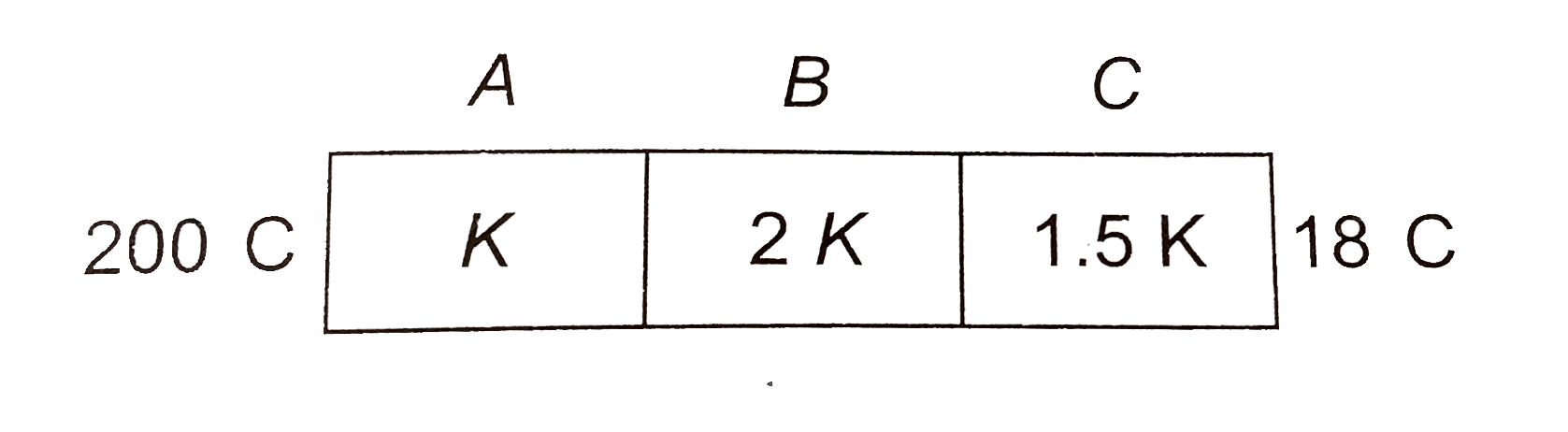
Three rods `A, B` and `C` of the same length and cross- sectional area are joined in series as shown. The temperature at the junction of `A` and `B`, in equilibriu, is

Promotional Banner

Similar Questions

Explore conceptually related problems

Three rods A, B and C of the same length and same cross-sectional area are joined as shown. Their thermal conductivities are in the ratio 1:2:3/2. If the open ends of A and C are at 200^@ C and 18^@ C, respectively, then the temperature at the junction of A at steady state is

Four rods of same material and having the same cross section and length have been joined, as shown. The temperature of the junction of four rods will be :

Three rods of same material and having the same cross-section are joined as shown in the figure.The tremperature of junction of three rods is : .

Two metal rods A and B of equal lengths and equal cross- sectional areas are joined end to end. The coefficients of thermal conductivities of A and B are in ratio 2 : 3 , when the free end of A is maintained at 100^(@)C , free end of B at 0^(@)C , the temperature of the junction is

Three rods of same material and of equal cross sectional area and length have been connected together as shown in the figure. The temperature of the junction of the rods approximately is

Three rods made of the same materail and having same cross-section area but diferent length 10 cm, 20 cm and 30 cm are joined as shown. The temperature of the junction is

Three rods each of same length and cross - section are joined in series. The thermal conductivity of the materials are K, 2K and 3K respectively. If one end is kept at 200^@C and the other at 100^@C . What would be the temperature of the junctions in the steady state? Assume that no heat is lost due to radiation from the sides of the rods.

Three rods each of same length and cross - section are joined in series. The thermal conductivity of the materials are K , 2K and 3K respectively. If one end is kept at 200^@C and the other at 100^@C . What would be the temperature of the junctions in the steady state? Assume that no heat is lost due to radiation from the sides of the rods.