

Home
Class 11
PHYSICS
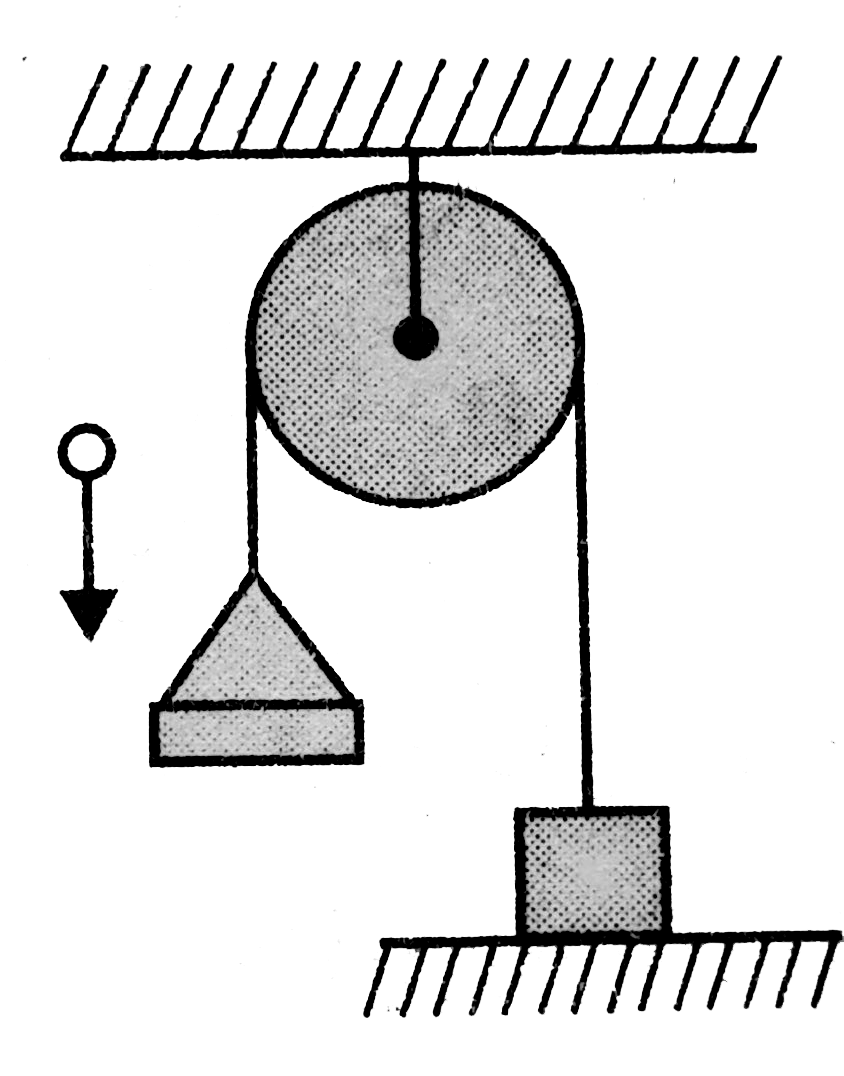
A pan of mass m = 1.5 kg and a block of ...

A pan of mass `m = 1.5 kg` and a block of mass `M = 3 kg` are connected to each other by a light inextensible string, passing over a light pulley as shown in Fig. Initially, the block is resting on a horizontal floor. A ball of mass `m_0 = 0.5 kg` collides with the pan at a speed `v_0= 20 m//s`. Consider this instant of collision as `t = 0`. Assume collision to be perfectly inelastic. Now, Fig. answer the following questions based on the above information.

Mark the correct statement(s) for this situation

Promotional Banner

Similar Questions

Explore conceptually related problems

A pan of mass m = 1.5 kg and a block of mass M = 3 kg are connected to each other by a light inextensible string, passing over a light pulley as shown in Fig. Initially, the block is resting on a horizontal floor. A ball of mass m_0 = 0.5 kg collides with the pan at a speed v_0= 20 m//s . Consider this instant of collision as t = 0 . Assume collision to be perfectly inelastic. Now, Fig. answer the following questions based on the above information. Find the time t at which the block strikes the floor for the first time

A pan of mass m = 1.5 kg and a block of mass M = 3 kg are connected to each other by a light inextensible string, passing over a light pulley as shown in Fig. Initially, the block is resting on a horizontal floor. A ball of mass m_0 = 0.5 kg collides with the pan at a speed v_0= 20 m//s . Consider this instant of collision as t = 0 . Assume collision to be perfectly inelastic. Now, Fig. answer the following questions based on the above information. Find the time t at which the block strikes the floor for the first time

A pan of mass m = 1.5 kg and a block of mass M = 3 kg are connected to each other by a light inextensible string, passing over a light pulley as shown in Fig. Initially, the block is resting on a horizontal floor. A ball of mass m_0 = 0.5 kg collides with the pan at a speed v_0= 20 m//s . Consider this instant of collision as t = 0 . Assume collision to be perfectly inelastic. Now, Fig. answer the following questions based on the above information. Find the velocity of pan + ball system at t = 2.6 s . Assume that the block comes to rest instantaneously after striking the floor.

A pan of mass m = 1.5 kg and a block of mass M = 3 kg are connected to each other by a light inextensible string, passing over a light pulley as shown in Fig. Initially, the block is resting on a horizontal floor. A ball of mass m_0 = 0.5 kg collides with the pan at a speed v_0= 20 m//s . Consider this instant of collision as t = 0 . Assume collision to be perfectly inelastic. Now, Fig. answer the following questions based on the above information. Find the velocity of pan + ball system at t = 2.6 s . Assume that the block comes to rest instantaneously after striking the floor.

A pan of mass m = 1.5 kg and a block of mass M = 3 kg are connected to each other by a light inextensible string, passing over a light pulley as shown in Fig. Initially, the block is resting on a horizontal floor. A ball of mass m_0 = 0.5 kg collides with the pan at a speed v_0= 20 m//s . Consider this instant of collision as t = 0 . Assume collision to be perfectly inelastic. Now, Fig. answer the following questions based on the above information. . Find the maximum height reached by the block alter the second jerk.

Two blocks A and B , each of mass 10 kg , are connected by a light string passing over a smooth pulley as shown in the figure. Block A will remain at rest if the friction on it is

Two masses of 10 kg and 20 kg are connected with an inextensible string passing over two smooth pulleys as shown in the figure. The acceleration of 20 kg mass will be :

Two masses of 10 kg and 20 kg are connected with an inextensible string passing over two smooth pulleys as shown in the figure. The acceleration of 20 kg mass will be :

Two masses M_(1)=5kg,M_(2)=10 kg are connected at the ends of an inextensible string passing over a frictionless pulley as shown. When masses are released, then acceleration of masses will be