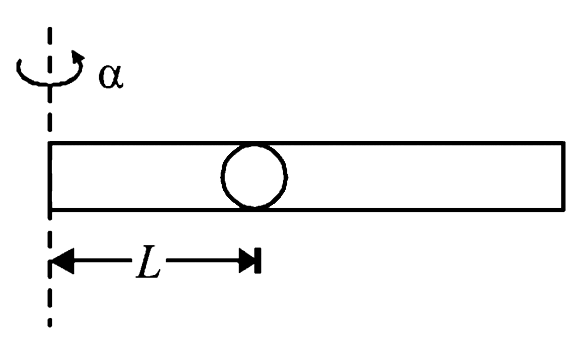
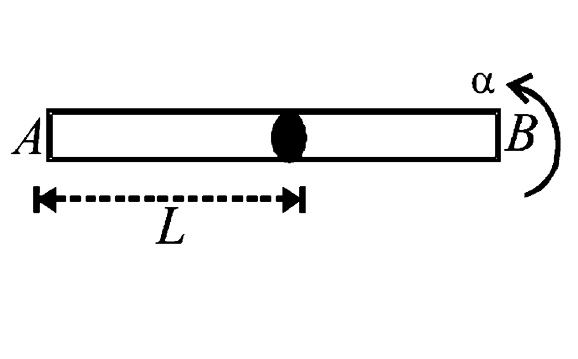
When we are giving an angular acceleration to
the rod, the bead is also having an instantanceous
acceleration `a = Lalpha.` This will happen when a force is
exerted on the bead by the rod. The bead has a tendency
to move away from the centre. But due to the friction
between the bead and the rod, this does not happen to
the extent to which frictional force is capable of holding
the bead.
The frictional force here provides the necessary
centripetal force. If instantaneous angular velocity is
`omega` then
`mLomega^2 = mu(ma) rArr mLomega^2 = mu mLalpha rArr omega^2 = mualpha`
By applying
`rArr omega = omega_0 + alphat,`
We get `omega =alphat`