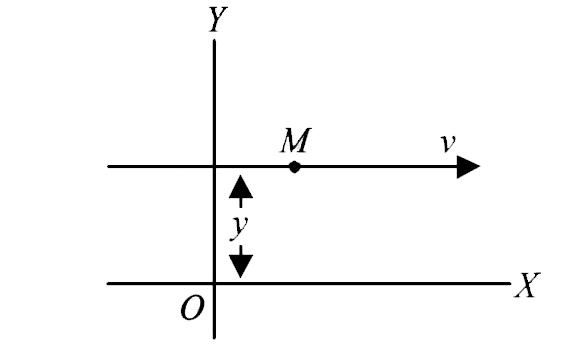
A mass M moving with a constant velocity parlale to the X-axis. Its angular momentum with respect to the origin
A
is zero
B
remains constant
C
goes on increasing
D
goes on decreasing
Text Solution
Verified by Experts
The correct Answer is:
B
(b) Angular momentum `vecL = vecr x vecP` L = Momentum xx perpendicular distance of line of action of momemtum w.r.t point of rotation L = Mvxxy. The quantities on the right side of the equation are not changing. The magnitude is constant. The direction is also constant.
Topper's Solved these Questions
ROTATIONAL MOTION
SUNIL BATRA (41 YEARS IITJEE PHYSICS)|Exercise MCQs with one correct answer|1 Videos
MOTION
SUNIL BATRA (41 YEARS IITJEE PHYSICS)|Exercise JEE Main And Advanced|63 Videos
SIMPLE HARMONIC MOTION
SUNIL BATRA (41 YEARS IITJEE PHYSICS)|Exercise JEE Main And Advanced|69 Videos
Similar Questions
Explore conceptually related problems
A particle moves with a constant velocity pralel to the X-axis. Its angular momentum with respect to the origin
Statement - 1 : A particle moves with a constant velocity parallel to the x-axis. Its angular momentum w.r.t. the origin will remains constant. Because Statement - 2 : Angular momentum is defined as vec(L) = vec(r) xx vec(P)
A body of mass m is moving with a constant velocity along a line parallel to the x-axis, away from the origin. Its angular momentum with respect to the origin
A mass m is moving with a constant velocity along a line parallel to the x-axis, away from the origin. Its angular momentum with respect to the origin.
A particle of mass m is moving with constant velocity v parallel to the x-axis as shown in the figure. Its angular momentum about origin O is
A particle performs uniform circular velocity along a line parallel to the x-axis, away from the origin. Its angular momentum with respect to the origin.
A mass m moving with a constant velocity along a line parallel to the axis, away from the origin. Its anguarl momentum with respect to the origin
If a particle of mass m is moving with constant velocity v parallel to x -axis in x-y plane as shown in fig. Its angular moment with respect to origin at any time t will be
A body of mass m is moving with a constant velocity along a line parallel to the x-axis, away from the origin. Calculate its angular momentum with respect to the origin?
SUNIL BATRA (41 YEARS IITJEE PHYSICS)-ROTATIONAL MOTION-MCQs with one correct answer