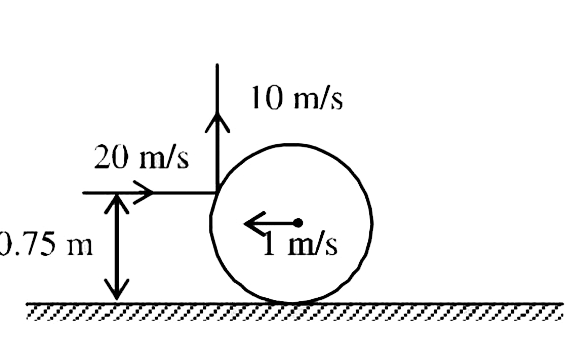
A thin ring of mass 2kg and radius 0.5 m is rolling without slipping on a horizontal plane with velocity 1m/s. A small ball of mass 0.1kg, moving with velocity 20 m/s in the opposite direction hits the ring at a height of 0.75m and goes vertically up with velocity 10m/s. Immediately after the collision
A
the ring has pure roation about its stationary CM.
B
the ring comes to a complete stop.
C
friction between the ring and the
D
there is no friction between the ring and the ground.
Text Solution
Verified by Experts
The correct Answer is:
C
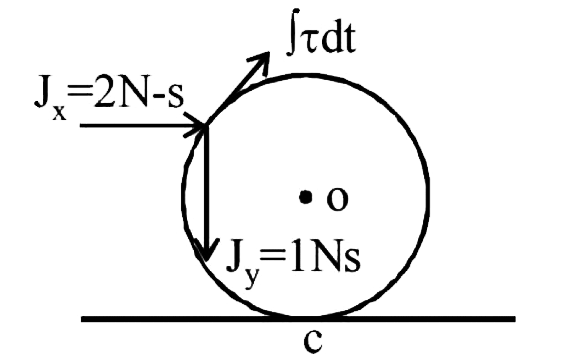
The frictional force between the ring and the ball is impulsive. The angular impulse created by this force tends to decrease the angular speed of the ring about O. After the collision the angular speed decreases but the ring remains rotatin in te anticlock wise direction. Therefore the friction between the ring and the ground (at the point of contact) is towards left.
Topper's Solved these Questions
ROTATIONAL MOTION
SUNIL BATRA (41 YEARS IITJEE PHYSICS)|Exercise MCQs with one correct answer|1 Videos
MOTION
SUNIL BATRA (41 YEARS IITJEE PHYSICS)|Exercise JEE Main And Advanced|63 Videos
SIMPLE HARMONIC MOTION
SUNIL BATRA (41 YEARS IITJEE PHYSICS)|Exercise JEE Main And Advanced|69 Videos
Similar Questions
Explore conceptually related problems
what will be the wavelength of a ball of mass 0.1 kg moving with a velocity of 10 m s^(-1) ?
A uniform thin ring of mass 0.4kg rolls without slipping on a horizontal surface with a linear velocity of 10 cm/s. The kinetic energy of the ring is
A circular disc of mass 0.41 kg and radius 10 m rolls without slipping with a velocity of 2 m/s. The total kinetic energy of disc is
A ball of mass 0.2 kg moves with a velocity of 20m//sec and it stops in 0.1 sec , then the force on the ball is
A solid cylinder of mass 1 kg and radius 0.02 m, is rolling on a smooth horizontal surface with a uniform velocity of 0.1 m/s. Its total energy is
A body of mass 2 kg moving with a velocity 3 m//s collides with a body of mass 1 kg moving with a velocity of 4 m//s in opposite direction. If the collision is head on and completely inelastic, then
A body of mass 1 kg moving with velocity 5 m/s collides with another body of mass 2 kg moving with velocity 1.5 m/s in opposite direction. If the coefficient of restitution is 0.8, their velocities aftter collision respectively are
SUNIL BATRA (41 YEARS IITJEE PHYSICS)-ROTATIONAL MOTION-MCQs with one correct answer