Home
Class 11
PHYSICS
A block of mass M with a semicircualr of...

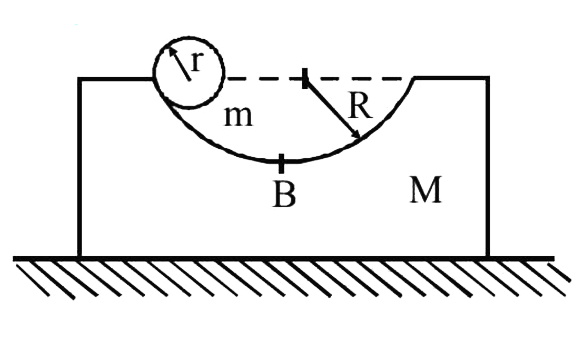
A block of mass M with a semicircualr of radius R, rests on a horizontal frictionless surface. A uniform cylinder of radius r and mass m is released from rest the top point A The cylinder slips on the semicircular frictionless track. How far has the block moved when the cylinder reaches the bottom (point B) of the track ? How fast is the block moving when the cylinder reaches the bottom of the track?

Text Solution

Verified by Experts

The correct Answer is:
B

C.M. of the system of two bodies in situation (i) in
x-coordinate
`x_C = (Mxx 0 +mx_1)/(M+m)` = (mx_1)/(M+m) …..(i)`
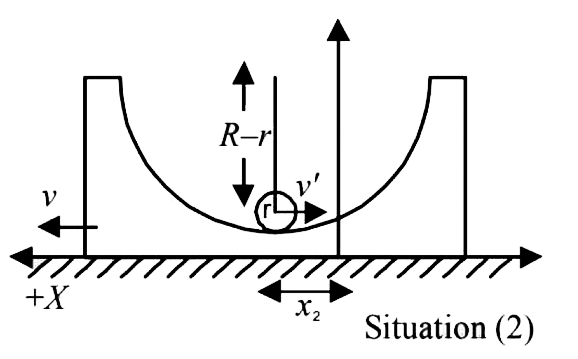
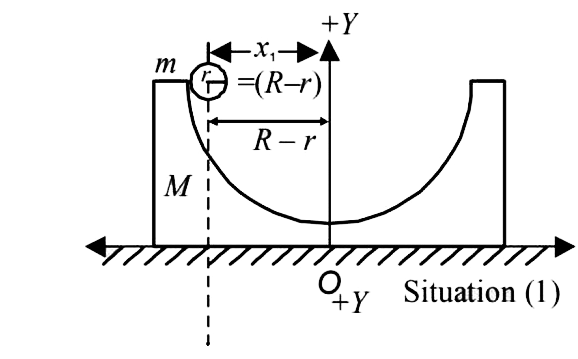
C.M. of the system in situation (ii) in x-coordinate is
`x'_C = (Mxx x_2+mxx x_2)/(M+m) = x_2 ....(ii)`
Since no external force is in x-direction
`:. x_C = x'_C `
`:. x_2 = (mx_1 )/(M + m) = (m(R-r)/(M +m)`
Applying conservation of linear momentum,
Initial Momentum = Final Momentum
`0 = MV - mv`
`:. v = (MV)/(m) ......(iii)`
Applying the concept of conservation of energy, we get
Loss in P.E. of mass m= Gain in K.E. of mass M and Gain in
K.E. of mass m
`rArr mg(R - r) =(1)/(2)MV^2 + (1)/(2)mv^2`
`rArr 2mg (R-r) = MV^2 + m(M^2V^2)/(m^2)` [from (iii)]`
`rArr 2mg (R - r) = MV^2 + (M^2GV^2)/(m)`
2mg(R -r)=MV^2 [(1+(M)/(m)] = MV^2 [(m+M)/(m)]`
`rARr (2m^2g(R -r)/(M(m+M) = v^2 rArr V =m sqrt(2g(R -r )/(M(m+M))`
Promotional Banner

Topper's Solved these Questions

  • ROTATIONAL MOTION

    SUNIL BATRA (41 YEARS IITJEE PHYSICS)|Exercise MCQs with one correct answer|1 Videos
  • MOTION

    SUNIL BATRA (41 YEARS IITJEE PHYSICS)|Exercise JEE Main And Advanced|63 Videos
  • SIMPLE HARMONIC MOTION

    SUNIL BATRA (41 YEARS IITJEE PHYSICS)|Exercise JEE Main And Advanced|69 Videos

Similar Questions

Explore conceptually related problems

A block of mass M = 2 kg with a semicircular track of radius R = 1.1 m rests on a horizontal frictionless surface. A uniform cylinder of radius r = 10 cm and mass = 1.0 kg is released from rest from the top point A. the cylinder slips on the semicircular frictionless track. The speed of the block when the cylinder reaches the bottom of the track at B is (g =10ms^(-2))

A block of mass M with a semi - circular track of radius R rests on a smooth floor. A sphere of mass m and radius r is released from rest from A . Find the velocity of sphere and track , when the sphere reaches B .

A solid cylinder of radius 0.35 m is released from rest from a height of 1.8 m and rolls down the incline as shown in the figure. What is the angular speed of the cylinder when it reaches the horizontal surface?

A uniform cylinder of mass M and radius R is released from rest on a rough inclined surface of inclination theta with the horizontal as shown in figure. As the cylinder rolls down the inclined surface, the maximum elongation it the spring stiffness k is

Figure shows a block A of mass 6 m having a smooth semicircular groove of radius a placed on a smooth horizontal surface. A block B of mass m is released from a position in groove where its radius is horizontal. Find the speed of the bigger block when the smaller block reaches its bottom most position.

A uniform solid cylinder of mass 2 kg and radius 0.2 m is released from rest at the top of a semicircular track of radius 0.7 m cut in a block of mass M = 3 kg as shown in Fig. The block is resting on a smooth horizontal surface and the cylinder rolls down without slipping. Based on the above information, answer the following questions: The speed of the point of contact of the cylinder with the block w.r.t. ground, when the cylinder reaches the bottom of the track is

A block of mass m is released from rest at a height R above a horizontal surface. The acceleration due to gravity is g. The block slides along the inside of a frictionless circular hoop of radius R. What is the magnitude of the normal force exerted on the block by the hoop when the block has reached the bottom ?

A mass M is supported by a massless string wound round a uniform cylinder ofmass M and radius R. On releasing the mass from rest, it will fall with acceleration?

