Home
Class 11
PHYSICS
Two uniform thin rods A and B of length ...

Two uniform thin rods A and B of length 0.6 m each and of masses 0.01 kg and 0.02kg respectively are rigidly joined end to end. The combination is pivoted at the lighter end, P as shown in fig. Such that it can freely rotate about point P in a vertical plane. A small object of mass 0.05kg, moving horizontally, hits the lower end of the combination and sticks to it what should be the velocity of the object so that the system could just be reised to the horizontal position.

Text Solution

Verified by Experts

The correct Answer is:
C

During collision, the torque of the system about P will be
zero because the only force acting on the system is through
P(namely weight of rods/mass m/reaction at P)
`Given: l =0.6m`
m_A 0.01kg`
`m_B = 0.02kg`
`m= 0.05kg`
since `tau = (dt)/(dt) and tau = 0`
`rArr L is constant.`
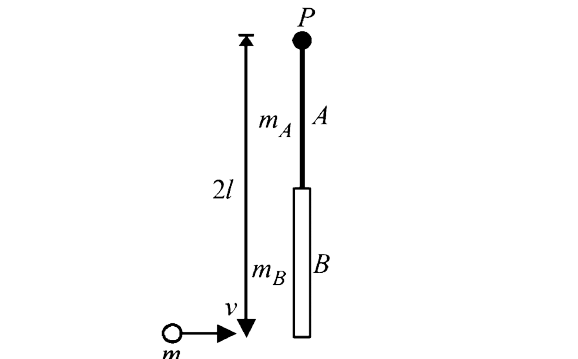
Angular momentum before collision `=mvxx2l ..(i)`
Angular momentum after collision `=iomega ..(ii)`
Where I is the moment of inertia of the system after collision
about P and `omega` is the angular velocity of the system. `M.I. about P:I_1 = M.I. of mass m`
`I_2 = M.I. of rod m_A`
`I_3 = M.I. of rod m_B`
`I=I_1+I_2+I_3`
`=[m(2l)^2 + {m_A((l^2)/(12)) + ((l)/(2))^2} + {m_B((l^2)/(12)) + ((l)/(2)+l)^2}]`
`=[4ml^2 + m_A((l^2)/(12)+(l^2)/(4)) + m_B ((l^2)/(12)+(9l^2)/(4))]`
`=[4ml^2 + (1)/(3)m_Al^2 +(7)/(3)mBl^2] = 0.09kgm^2`
Frm (i) and (ii)
`I oemga = mvxx2l`
`rArr omega = (mvxx2l)/(I) =(0.05xxvxx2xx0.6)/(0.09) = 0.67v`
Applying conservation of mechanical energy after collision.
(Using the concept of mass)
Loss of K.E. = Gain in P. E.
`(1)/(2)I omega^2 = mg(2l)+m_A((l)/(2))g +m_Bg((3l)/(2))`
`rArr (1)/(2)xx0.09xx(0.67v)^2`
`=[0.05xx2+0.01xx(1)/(2)xx(3)/(2)]xx9.8xx0.6`
`rArr v = 6.3m//s`
Promotional Banner

Topper's Solved these Questions

  • ROTATIONAL MOTION

    SUNIL BATRA (41 YEARS IITJEE PHYSICS)|Exercise MCQs with one correct answer|1 Videos
  • MOTION

    SUNIL BATRA (41 YEARS IITJEE PHYSICS)|Exercise JEE Main And Advanced|63 Videos
  • SIMPLE HARMONIC MOTION

    SUNIL BATRA (41 YEARS IITJEE PHYSICS)|Exercise JEE Main And Advanced|69 Videos

Similar Questions

Explore conceptually related problems

A slender rod is hinged at its top end and hanging freely in a vertical position. A tiny ball, moving horizontally, hits the lower end of the rod elastically and comes to rest. The ratio of the mass of rod to the mass of the ball must be

A thin uniform rod is free to rotate about a fixed smooth horizontal axis as shown. A point mass hits horizontally with velocity v_(0) to the one end B of the rod. When it hits, it sticks to the rod, then :

A thin rod of mass 0.9 kg and length 1 m is suspended , at rest form one end so that it can freely oscillate in the vertical plane. A particle of move 0.1 kg moving in a striaght line with velcoity 80 n/s hits the rod at is bottom most point and sticks to it (see figure) . The angluar speed ( in rad/s) of the rod immediately after the collision will be .

A uniform rod of mass 20 Kg and length 1.6 m is piovted at its end and swings freely in the vertical plane. Angular acceleration of the rod just after the rod is relased from rest in the horizontal position is

A uniform rod ofmass M and length L is hanging from its one end free to rotate in a veritcal plane.A small ball of equal mass is attached of the lowe end as shown. Time period of small oscillations of the rod is

A thin uniform rigid rod of length L is hinged at one end so that it can move in a vertical plane by rotating about a horizontal axis through upper end. The lower end is given a sharp blow and made to acquire a linear velocity v_(o) . Find the maximum height to which the lower end can rise.

A ligh rod of length 1 m is pivoted at its centre and two masses of 5 kg and 2 kg are hung from the ends as shown in the figure. Find the initial angular acceleration of the rod assuming that it was horizontal in the beginning.

A thin uniform rod of length l and mass m is freely pivoted about its end. The rod is initially held horizontally and released from rest. When the rod is vertical, an impulse J is applied to bring it to rest (this is in addition to any impulse provided by the pivot) What is the angular velocity of the rod at the moment it reaches the vertical position ?

