`I_c =1.2kg- m^2`
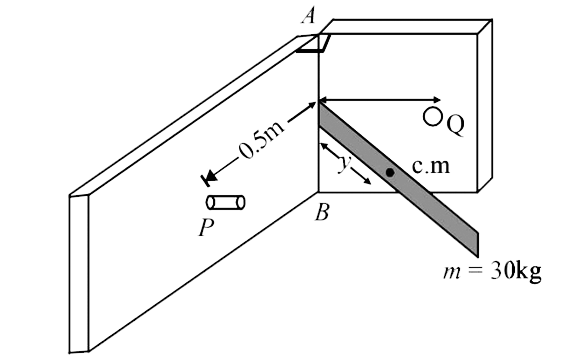
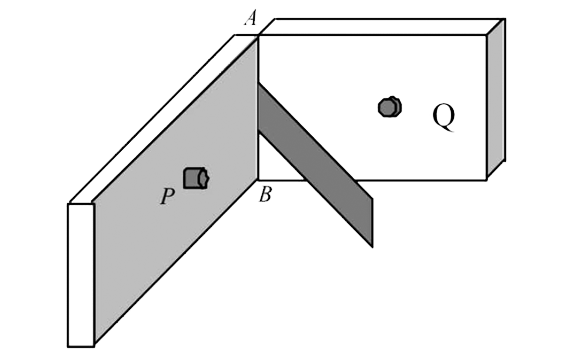
Let y be the distance of c.m. from line AB.
Applying parallel axis theorem of M.I. we get
M.I. of lamiar sheet about AB
`I_(AB) = I_(c.m.) +my^2`
`I_(AB)=12 + 30y^2 …..(i)`
The angular velocity of the laminar sheet will change after
impulse = Change in linear momentum
`6 =30(v_f - V_i)`
`6= 30 xxy(omega_f - omega_i)..(ii)`
Also, change in angular momentum = Moment of impulse
`:. I_(AB) omega_f - I_(AB)omega_i = impulse xx distance`
`I_(AB)(omega_f - omega_i) = 6xx0.5 = 3`
`:. omega_f = (3)/(I_(AB) + omega_i = (3)/(1.2 + 30y^2 + (-1) ...(iii)`
Note: Minus sign with `omega_i` because the direction of laminar
plate towards the obstacle is taaken as - ve (assumption).
From (ii) and (iii)`
`6 = 30 xxy [(3)/(1.2+30y^2)-1+1]`
`1 = 5y[(3)/(1.2 + 30y^2]`
`:. 1.2 +30y^2 = 5y[+3] = 15y`
`:. 30yk^2 - 15y - 1.2 = 0`
On solving we get y = 0.1 or 0.4
`:. omega_f = 1red/s if we puty y = 0.1 in eq. (ii)`
And `oemga_f = 0.5 rad/s if we put y = 0.4 in eq. (ii)`
(Not valid as per sign convention)
Now, since the lamina sheet comes back with same angular
speed as that of incident angular speed, the sheet will sming
in between P and Q infinitely.