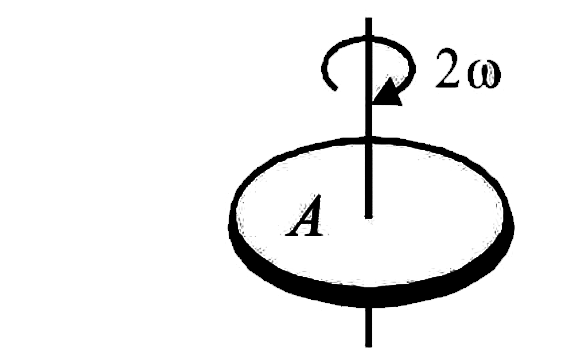
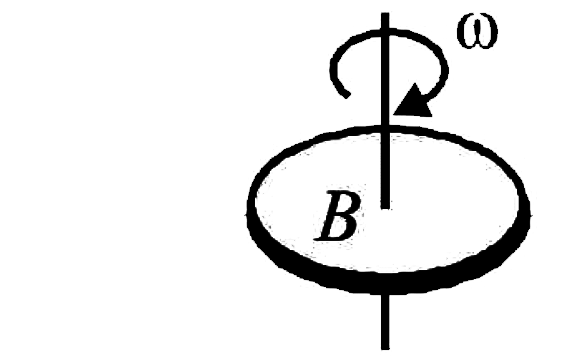
Two discs A and B are mounted coaxiallay on a vertical axle. The discs have moments of inertia I and 2 I respectively about the common axis. Disc A is imparted an initial angular velocity `2 omega` using the entire potential energy of a spring compressed by a distance `x_1` Disc B is imparted an angular velocity `omega` by a spring having the same spring constant and compressed by a distance `x_2` Both the discs rotate in the clockwise direction. The ratio `x_1//x_2` is
A
2
B
`(1)/(2)`
C
`sqrt2`
D
`(1)/(sqrt2)`
Text Solution
Verified by Experts
The correct Answer is:
C
(c ) For disc A `(1)/(2) kx_1^2 = (1)/(2)i(2omega)^2` `rArr kx_1^2 = 2I omega^2….(i)` For disc B `(1)/(2) kx_2^2 = (1)/(2)xx2Iomega^2` `rArr kx_2^2 = I omega^2 …..(ii)` On dividing (i) and (ii) we get `(kx_1^2)/(kx_2^2) = (2I omega^2)/(I omega^2) rArr (x_1)/(x_2) = sqrt2`
Topper's Solved these Questions
ROTATIONAL MOTION
SUNIL BATRA (41 YEARS IITJEE PHYSICS)|Exercise MCQs with one correct answer|1 Videos
MOTION
SUNIL BATRA (41 YEARS IITJEE PHYSICS)|Exercise JEE Main And Advanced|63 Videos
SIMPLE HARMONIC MOTION
SUNIL BATRA (41 YEARS IITJEE PHYSICS)|Exercise JEE Main And Advanced|69 Videos
Similar Questions
Explore conceptually related problems
Two discs A and B are mounted coaxiallay on a vertical axle. The discs have moments of inertia I and 2 I respectively about the common axis. Disc A is imparted an initial angular velocity 2 omega using the entire potential energy of a spring compressed by a distance x_1 Disc B is imparted an angular velocity omega by a spring having the same spring constant and compressed by a distance x_2 Both the discs rotate in the clockwise direction. The loss of kinetic energy in the above process is
Two discs A and B are mounted coaxiallay on a vertical axle. The discs have moments of inertia I and 2 I respectively about the common axis. Disc A is imparted an initial angular velocity 2 omega using the entire potential energy of a spring compressed by a distance x_1 Disc B is imparted an angular velocity omega by a spring having the same spring constant and compressed by a distance x_2 Both the discs rotate in the clockwise direction. When disc B is brought in contact with disc A, they acquire a common angular velocity in time t. The average frictional torque on one disc by the other during this period is
Two discs A and B are mounted coaxially ona vertical axle. The discs have moments of inertia l and 2l respectively about the common axis. Disc A is imparted an initial angular velocity 2 omega using the centre potential energy of a spring compressed by a distance x_(1) . Disc B is imparted angular velocity omega by a spring having the same spring constant and compressed by a distance x_(2) . Both the disc rotate in the clockwise direction. The rotation x_(1)//(x_(2) is.
Two discs A and B are mounted coaxially ona vertical axle. The discs have moments of inertia l and 2l respectively about the common axis. Disc A is imparted an initial angular velocity 2 omega using the centre potential energy of a spring compressed by a distance x_(1) . Disc B is imparted angular velocity omega by a spring having the same spring constant and compressed by a distance x_(2) . Both the disc rotate in the clockwise direction. The loss of kinetic energy the above process is -
Two discs A and B are mounted coaxially ona vertical axle. The discs have moments of inertia l and 2l respectively about the common axis. Disc A is imparted an initial angular velocity 2 omega using the centre potential energy of a spring compressed by a distance x_(1) . Disc B is imparted angular velocity omega by a spring having the same spring constant and compressed by a distance x_(2) . Both the disc rotate in the clockwise direction. When disc B is brought in contact with disc A , they acquirea common angularvelocity in time t . The average frictional torque on one disc by the other during this period is -
A disc is rotating with angular velocity omega . If a child sits on it, what is conserved?
If I, alpha and tau are the moment of inertia, angular acceleration and torque respectively of a body rotating about an axis with angular velocity omega then,
A disc rotates with angular velocity omega and kinetic energy E . Then its angular momentum
A uniform circular disc of radius R is rotating about its own axis with moment of inertia I at an angular velocity omega if a denser particle of mass m is gently attached to the rim of disc than its angular velocity is
SUNIL BATRA (41 YEARS IITJEE PHYSICS)-ROTATIONAL MOTION-MCQs with one correct answer