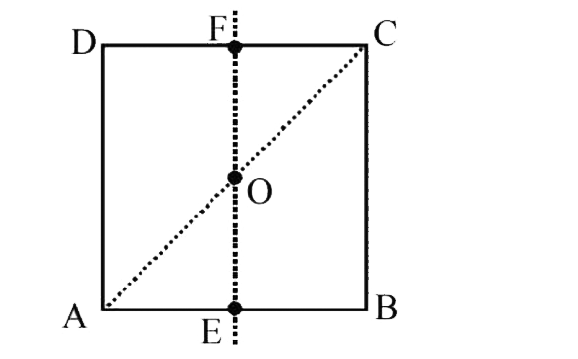
For the given uniform square lamina ABCD, whose centre is O,
A
`I_(AC) = sqrt2 I_(EF)`
B
`sqrt2I_(AC) = I_(EF)`
C
`I_(AD)= 3I_(EF)`
D
`I_(AC) = I_(EF)`
Text Solution
Verified by Experts
The correct Answer is:
D
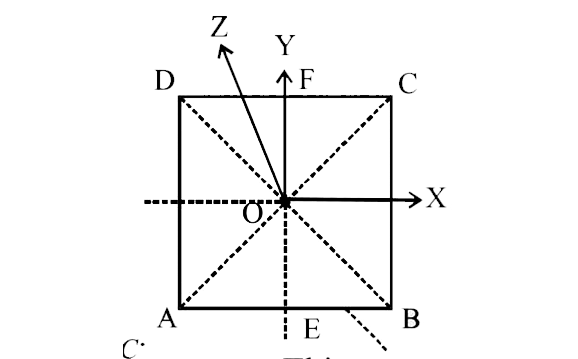
(d) By the theorem of perpendicular axes, `I_z = I_x + I_y or , I_z = 2I_y` (:. I_x = I_y by symmetry of the figure)` `:. I_(EF) = (I_z)/(2) …(i)` Again, by the same theorem `I_z = I_(AC) + I_(BD) = 2I_(AC)` (:. I_(AC) = I_(BD) by symmetry of the figure)` `:.I_(AC) =(I_z)/(2) ...(ii)` From (i) and (ii), we get `I_(Ef) = I_(AC).
Topper's Solved these Questions
ROTATIONAL MOTION
SUNIL BATRA (41 YEARS IITJEE PHYSICS)|Exercise MCQs with one correct answer|1 Videos
MOTION
SUNIL BATRA (41 YEARS IITJEE PHYSICS)|Exercise JEE Main And Advanced|63 Videos
SIMPLE HARMONIC MOTION
SUNIL BATRA (41 YEARS IITJEE PHYSICS)|Exercise JEE Main And Advanced|69 Videos
Similar Questions
Explore conceptually related problems
For the given uniform square lamina ABCD , where centre is O . Its moment of inertia about an axis AD is equal to how many times its moment of inertia about an axis EF ? 1 sqrt(2) I_(AC)=I_(EF) " " 2. I_(AD)=3I_(EF) 3.I_(AC)=4I_(EF). " " 4. I_(AC)=sqrt(2)I_(EF)
There is a pentagon ABCDE, whose centre is O. Five identical charges Q are placed at the corners of pentagon. (a)What will be the net electric field intensity at the centre of pentagon ? (b)If charge at corner A is moved to centre O of pentagon, then what will be the net force experienced by it ? Distance of any vertex of pentagon from its centre is d.
In the given figure, side of square ABCD is 7 cm. With centre D and radius DA, sector D-AXC is drawn. find out the area of the shaded ragion.
In the given figure,OPOR is a square.A circle drawn with centre O,cuts the square X and Y . Prove that QX=QY
Find the area of the shaded region in the given figure, if ABCD is a rectangle with sides 8 cm and 6 cm and O is the centre of the circle.
In the given figure, ABCD is a square whose side is 4 cm. P is a point on the side AD. What is the minimum value (in cm) of BP+CP ?
In the figure given above, the side of square ABCD is 7 cm. What is the area of the shaded portion, formed by the arcs oversetfrown(AB) of the circles with centre at C and A?
SUNIL BATRA (41 YEARS IITJEE PHYSICS)-ROTATIONAL MOTION-MCQs with one correct answer