Home
Class 11
PHYSICS
A spherical body of radius R consists of...

A spherical body of radius R consists of a fluid of constant density and is in equilibrium under its own gravity. If P(r) is the pressure at r(rltR), then the correct option(s) is (are)

A

(a) `P(r=0)=0`

B

(b) `(P(r=3R//4))/(P(r=2R//3))=63/80`

C

(c) `(P(r=3R//5))/(P(r=2R//5))=16/21`

D

(d) `(P(r=R//2))/(P(r=R//3))=20/27`

Text Solution

Verified by Experts

The correct Answer is:
A, B

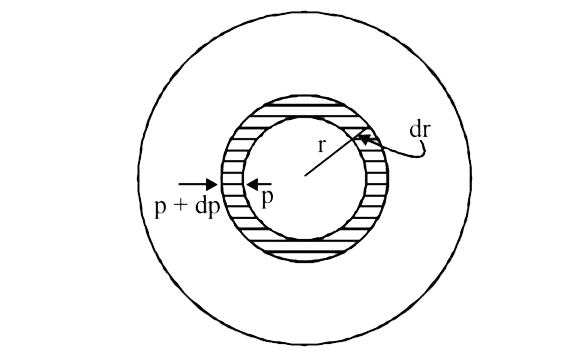
Let us consider an elemental mass dm shown in the shaded portion.
Here
`P4pir^2-(P+dP)4pir^2`
`=(GMr)/(R^3)rho(4pir^2)dr`
`:. -int_0^Pdp=(GMrho)/(R^3)int_R^rrdr`
`: P=(GMrho)/(2R^3)[R^2-r^2]`
`:. (P(r=3R//4))/(P(r=2R//3))=[(R^2-(9R^2)/(16))/(R^2-(4R^2)/(9))]=((7R^2)/(16))/((5R^2)/(9))=63/80`
and `(P(r=3R//5))/(P(r=2R//5))=[(R^2-(9R^2)/(25))/(R^2-(4R^2)/(25))]=16/21`
B and C are correct options.
Promotional Banner

Topper's Solved these Questions

  • MECHANICAL PROPERTIES OF MATTER AND FLUIDS

    SUNIL BATRA (41 YEARS IITJEE PHYSICS)|Exercise Subjective Problems|1 Videos
  • LAWS OF MOTION

    SUNIL BATRA (41 YEARS IITJEE PHYSICS)|Exercise JEE Main And Advanced|79 Videos
  • MOMENTUM & IMPULSE

    SUNIL BATRA (41 YEARS IITJEE PHYSICS)|Exercise JEE Main And Advanced|30 Videos

Similar Questions

Explore conceptually related problems

A spherical black body of radius n radiates power p and its rate of cooling is R. then.

A cylinder of radius R full of liquid of density p is rotated about its axis at w rad/s. The increase in pressure at the centre of the cylinder will be

A spherical marble of radius r is made to oscillate in a bowl of radius R. What is its period of oscillation ?

A body is in equilibrium under the action of three coplanar forces P,Q and R as shown in figure. Select the correct statement.

A star can be considered as spherical ball of hot gas of radius R . Inside the star, the density of the gas is rho_(r) at radius r and mass of the gas within this region is M_(r) . The correct differential equation for variation of mass with respect to radius is (refer to the adjacent figure)

A small spherical body of radius r is falling under gravity in a viscous medium. Due to friction the meduim gets heated. How does the rate of heating depends on radius of body when it attains terminal velocity?

Assuming the Sun to be a spherical body of radius R at a temperature of TK, evalute the total radiant powerd incident of Earth at a distance r from the sun where r_0 is the radius of the Earth and sigma is Stefan's constant.

