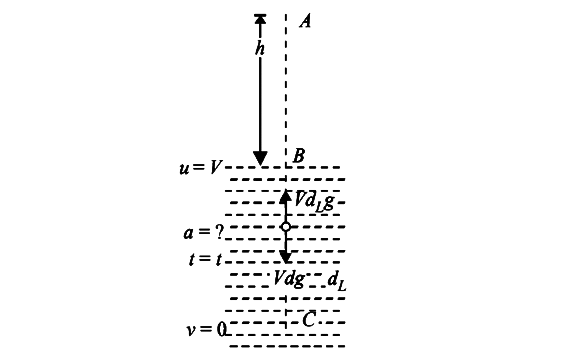
Let the ball be dropped from a height h. During fall `V=ut+at=0+gt_1/2impliest_1=(2v)/(g)`
In the second case the ball is made to fall through the same height and then the ball strikes the surface of liquid of density `d_L`. When the ball reaches inside the liquid, it is under the influence of two force (i) `Vdg`, the weight of ball in downward direction (ii) `Vd_Lg`, the upthrust in upward direction.
The viscous forces are absent. (given)
Since, `d_Lgtd`
the upward force is greater and the ball starts retarding.
For motion B to C
`u=V`, `v=0`, `t=t`, `a=-a`
`v=u+at=0=v+(-a)t`
`impliest=v/a`
Now, `a=F_(n et)/(m)`
`=(Vd_Lg-Vdg)/(Vd)=((d_L-d)g)/(d)`
`impliest=(vd)/((d_L-d)g)` ...(iii)
Therefore,
`t_2=t_1+2t=t_1+(2dv)/((d_L-d)g)`
`=t_1+(2d)/((d_L-d)g)(t_1g)/(2)=t_1[1+(d)/(d_L-d)]`
`impliest_2=(d_Lt_1)/(d_L-d)`
(b) Since the retardation is not proportional to displacement, the motion of the ball is not simple harmonic.
(c) If `d=d_L` then the retardation `a=0`. Since the ball strikes the water surface with some velocity, it will continue with same velocity in downward direction(until it is interrupted by some other force).