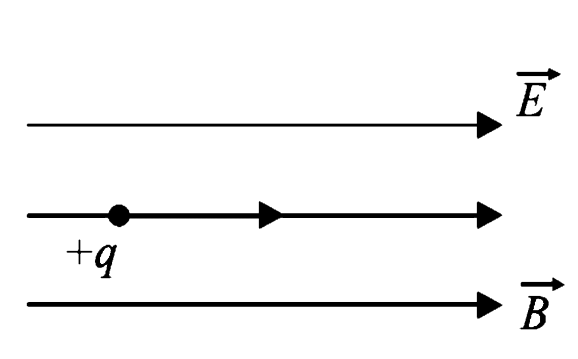
A charged particle is released from rest in a region of steady and uniform electric and magnetic fields which are parallel to each other . The particle will remove in a
A
straight line
B
circle
C
helix
D
helix
Text Solution
Verified by Experts
The correct Answer is:
A
` F_(E) = q^(E)` ( force due to electric field) ` F_(B) = evB sin theta = q vB sin 0 = 0` ( force due to magnetic field ) Force due to electric field will make the charged particle released from rest to move in the straight line ( that of eletric field ) . Since the force due to magnetic field is zero , therefore , the charged particle will move in a straight line.
Topper's Solved these Questions
MOVING CHARGES AND MAGNETISM
SUNIL BATRA (41 YEARS IITJEE PHYSICS)|Exercise MCQs(d )|1 Videos
SUNIL BATRA (41 YEARS IITJEE PHYSICS)|Exercise JEE Main And Advanced|209 Videos
Similar Questions
Explore conceptually related problems
an electron is released from rest in a region of uniform electric and magnetic field acting parallel to each other. The electron will (A) move in a straight line (B) move in a circle (C) remain stationary (D) move in a helical path
If a charged particle goes unaccelerated in a region containing electric and magnetic fields,
In a region, steady and uniform electric and magnetic fields are present . These two fields are parallel to each other. A charged particle is released from rest in this region . The path of the particle will be a
In a region where both non-zero uniform electric field and magnetic field coexist, the path of a charged particle
What is the magnetic force experienced by a charged particle if velocity and magnetic field are parallel to each other?
Describe qualitatively the path of a charged particle moving in a region with uniform electrosatic and magnetic fields parallel to each other, with initial velocity (i) parallel (ii) perpendicular (iii) at an arbitrary angle with common direction of the fields.
SUNIL BATRA (41 YEARS IITJEE PHYSICS)-MOVING CHARGES AND MAGNETISM-MCQs(d )