Home
Class 12
PHYSICS
A particle of charge +q and mass m movi...

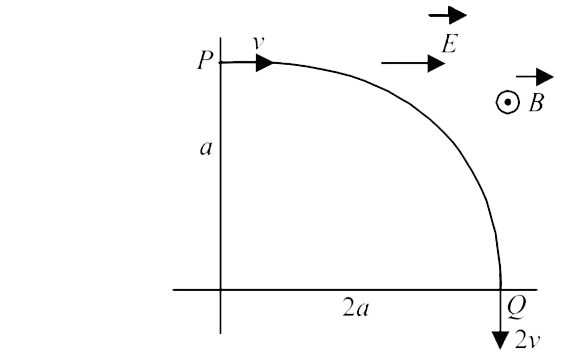
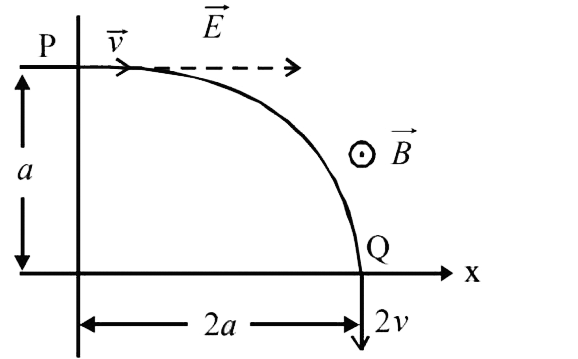
A particle of charge ` +q` and mass `m` moving under the influence of a uniform electric field ` E hat(i)` and uniform magnetic field ` B hat(k)` follows a trajectory from ` P to Q` as shown in fig. The velocities at `P and Q` are ` v hat(i)` and ` - 2v hat(j)` . which of the following statement(s) is/are correct ?

A

` E = (3)/(4) [ (mv^(2))/(qa)]`

B

Rate of work done by the electric field at `P` is ` 3/4[ (mv^(3))/(a)]`

C

Rate of work done by the electric field at `p` is zero

D

Rate of work done by the electric field at `Q` is zero

Text Solution

Verified by Experts

The correct Answer is:
A, B, D

Considering the activity from `P to Q` ( Horizontal)
` u_(1) = v, v_(1) = 2v, s_(1) = 2a , Acc = A`
rArr ` 4v^(2)- v^(2) = 2A(2a)`
rArr `A = (3v^(2))/(4a)`
Force acting in the horizontal direction is
` F = q ^(E) = mA`
rArr `E = (mA)/(q) = 3/4[ (mv^(2))/(qa)]`
Rate of doing work A `P`
power ` = Fxxv = mAxxv = 3/4[(mv^(3)/(a)]`
Rate of doing work by the magnetic field is throughout zero. The rate of doing work by eletric field is zero at `Q` . Because at `Q` , the angle between force due to electric field and displacement is zero .
Promotional Banner

Topper's Solved these Questions

  • MOVING CHARGES AND MAGNETISM

    SUNIL BATRA (41 YEARS IITJEE PHYSICS)|Exercise MCQs(d )|1 Videos
  • MODERN PHYSICS

    SUNIL BATRA (41 YEARS IITJEE PHYSICS)|Exercise MCQ (One Correct Answer|1 Videos
  • RAY AND WAVE OPTICS

    SUNIL BATRA (41 YEARS IITJEE PHYSICS)|Exercise JEE Main And Advanced|209 Videos

Similar Questions

Explore conceptually related problems

A particle of charge +q and mass m moving under the influnce of a uniform electric field E hati and a uniform magnetic field Bhatk follows trajectory from P to Q as shown in figure. The velocities at P and Q vhati and -2vhatj respectively. Which of the following statement(s) is/are correct

A particle of charge q and mass m starts moving from the origin under the action of an electric field vec E = E_0 hat i and vec B = B_0 hat i with a velocity vec v = v_0 hat j . The speed of the particle will become 2v_0 after a time.

A particle of charge q and mass m starts moving from the origin under the action of an electric field vecE=E_0 hat i and vec B=B_0 hat i with velocity vec v=v_0 hat j . The speed of the particle will become 2v_0 after a time

A particle ( mass = m and charge = q ) is moving in a region in which there exists a uniform electric field E vec( i ) and a uniform magnetic field B hat (k) . At t = 0 , the particle is at ( 0,a ) and is moving with v hat(i) . After some time, the particle is located at ( 2a, 0 ) and has a velocity - 2 v hat( j ) , then which of the following is true ?

An alpha particle moving with the velocity vec v = u hat i + hat j ,in a uniform magnetic field vec B = B hat k . Magnetic force on alpha particle is

An electron of charge -e , mass m, enters a uniform magnetic field vec(B)= B hat(i) with an initial velocity vec(v) = v_(x) hat(i) + v_(y) hat(j) . What is the velocity of the electron after a time interval of t seconds?

A particle of charge -q and mass m enters a uniform magnetic field vecB (perpendicular to paper inward) at P with a velocity v_0 at an angle alpha and leaves the field at Q with velocity v at angle beta as shown in fig.

A particle of charge q and mass m released from origin with velocity vec(v) = v_(0) hat(i) into a region of uniform electric and magnetic fields parallel to y-axis. i.e., vec(E) = E_(0) hat(j) and vec(B) = B_(0) hat(j) . Find out the position of the particle as a functions of time Strategy : Here vec(E) || vec(B) The electric field accelerates the particle in y-direction i.e., component of velocity goes on increasing with acceleration a_(y) = (F_(y))/(m) = (F_(e))/(m) = (qE_(0))/(m) The magnetic field rotates the particle in a circle in x-z plane (perpendicular to magnetic field) The resultant path of the particle is a helix with increasing pitch. Velocity of the particle at time t would be vec(v) (t) = v_(x) hat(i) + v_(y) hat(j) + v_(z) hat(k)

If the vectors 2 hat(i) - q hat(j) + 3 hat(k) and 4 hat(i) - 5 hat(j) + 6 hat(k) are collinear then find the value of q.

Figure 2 (EP). 13 shows the orientatione of two vectors vec u and vec v in the (XY) plane. If vec u = a hat I + b hat j and vec v = p hat + q hat j which of the following is correct ? .

