Consider the motion of a positive point charge in a region where area simultaneous uniform electric and magnetic fields ` vec(E) = E_(0) hat(j)` and ` vec(B) = B_(0) hat(j)`. At time ` t = 0` , this charge has velocity ` vec(v)` in the ` x-y `plane , making an angle ` theta` with the ` x-axis `. Which of the following option(s) is (are) correct for time ` t gt 0`?
Consider the motion of a positive point charge in a region where area simultaneous uniform electric and magnetic fields ` vec(E) = E_(0) hat(j)` and ` vec(B) = B_(0) hat(j)`. At time ` t = 0` , this charge has velocity ` vec(v)` in the ` x-y `plane , making an angle ` theta` with the ` x-axis `. Which of the following option(s) is (are) correct for time ` t gt 0`?
A
If ` theta = 0@` , the charge moves in a circular path in the ` x-z` plane.
B
If ` theta = 0@`, the charge undergoes helical path motion with constant pitch along the `y - axis`.
C
If ` theta = 10@, the charge undergoes helical motion with its pitch increasing with time, along the ` y - axis.
D
If ` theta = 90@` the charge undergoes linear but accelerated motion along the ` y-axis`.
Text Solution
Verified by Experts
The correct Answer is:
C, D
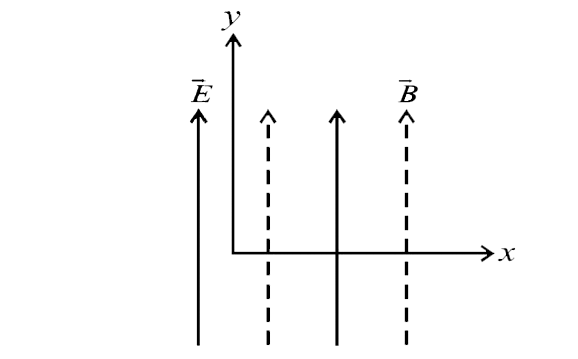
When ` theta = 0^(@), the charged particle is projected along ` x - axis` , due to `vec(B)` the charged particle will tend to move in a circular path in ` y -z `plane but due to force of electric field , the particle will move in a helical path with increasing pitch. Therfore options `(A) and (B)` are incorrect.
When ` theta = 10^(@)`, we can resolve velocity into two rectangular components. One al,ong ` x- axis(v cos 10^(@))` and one along ` y - axis (v sin 10^(@))`. Due to ` v cos 10@` , the particle will move in circular path and due to ` v sin 10^(@)` plus the force due to electric field, the particle will undergo helical motion with its pitch increasing.
If ` theta = 90^(@)`, the charge is moving along the magnetic field. Therefore the force due to magnetic field is zero . But the force due to electric field will accelerate the particle along ` y - axis`.
When ` theta = 10^(@)`, we can resolve velocity into two rectangular components. One al,ong ` x- axis(v cos 10^(@))` and one along ` y - axis (v sin 10^(@))`. Due to ` v cos 10@` , the particle will move in circular path and due to ` v sin 10^(@)` plus the force due to electric field, the particle will undergo helical motion with its pitch increasing.
If ` theta = 90^(@)`, the charge is moving along the magnetic field. Therefore the force due to magnetic field is zero . But the force due to electric field will accelerate the particle along ` y - axis`.



Topper's Solved these Questions
Similar Questions
Explore conceptually related problems
Consider the motion of a positive point charge in a region where there are simultaneous uniform electric and magnetic fields vecE=E_(0)hatj and vecB=B_(0)hatj . At time t-0 , this charge has velocity v in the x-y plane, making an angle theta with the x- axis. Which of the following option (s) is (are) correct for time tgt0 ?
Consider the motion of a positive point charge in a region where there are simultaneous uniform electic and magnetic field E=E_0hatj and B=B_0hatj . At time t=0 , this charge has velocity v inn the xy-plane making an angle theta with the x-axis. Which of the following option(s) is (are) correct for time tgt0? If theta=0^0 the charge moves in a circular path in the xy-plane. b. If theta=0^0 the charge undergoes helical motion with constant pitch along the y-axis. c. If theta=10^0 the charge undergoes helicalmotion with its pitch increasing with time along the y -axis. d If theta=90^@ the charge undergoes linear but accelerated motion along the y -axis.
The potential field of an electric field vec(E)=(y hat(i)+x hat(j)) is
In a region of space , suppose there exists a uniform electric field vec(E ) = 10 hat(i) ( V /m) . If a positive charge moves with a velocity vec(v ) = -2 hat(j) , its potential energy
A particle having mass m and charge q is released from the origin in a region in which electric field and megnetic field are given by vec(B) = -B_(0)hat(j) and vec(E) = vec(E)_(0)hat(k) . Find the speed of the particle as a function of its z -coordinate.
A particle of charge q and mass m released from origin with velocity vec(v) = v_(0) hat(i) into a region of uniform electric and magnetic fields parallel to y-axis. i.e., vec(E) = E_(0) hat(j) and vec(B) = B_(0) hat(j) . Find out the position of the particle as a functions of time Strategy : Here vec(E) || vec(B) The electric field accelerates the particle in y-direction i.e., component of velocity goes on increasing with acceleration a_(y) = (F_(y))/(m) = (F_(e))/(m) = (qE_(0))/(m) The magnetic field rotates the particle in a circle in x-z plane (perpendicular to magnetic field) The resultant path of the particle is a helix with increasing pitch. Velocity of the particle at time t would be vec(v) (t) = v_(x) hat(i) + v_(y) hat(j) + v_(z) hat(k)
A particle of charge q and mass m starts moving from the origin under the action of an electric field vec E = E_0 hat i and vec B = B_0 hat i with a velocity vec v = v_0 hat j . The speed of the particle will become 2v_0 after a time.
Electric field strength bar(E)=E_(0)hat(i) and bar(B)=B_(0)hat(i) exists in a region. A charge is projected with a velocity bar(v)=v_(0)hat(j) at origin , then
A charge particles q enters in a magnetic field vec(B)=y hat(i) + x hat (j) with the velocity vec(v)= x hat (i) y hat (j) . Neglect any force other than magnetic force. Now answer the following question. Which of the following is true for the direction of magnetic force ?
An electron of charge -e , mass m, enters a uniform magnetic field vec(B)= B hat(i) with an initial velocity vec(v) = v_(x) hat(i) + v_(y) hat(j) . What is the velocity of the electron after a time interval of t seconds?