

Home
Class 12
PHYSICS
A ray of light from a denser medium stri...


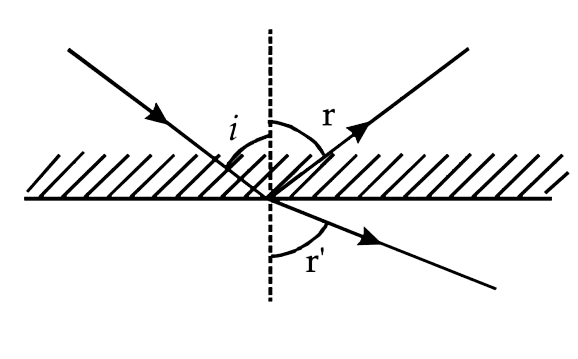
A ray of light from a denser medium strike a rarer medium at an angle of incidence I (see Fig). The reflected and refracted rays make as angle of 90degrees with each other. The angles of reflection and refraction are r and `r` The critical angle is

A

`sin^-1(tanr)`

B

`sin^-1(tani)`

C

`sin^-1(tanr`)`

D

`tan^-1(sini)`

Text Solution

Verified by Experts

The correct Answer is:
A

`C=Sin^-1((1)/(_2^1mu))` .....(i)
Applying Snell's law at P, we get `_2^1mu=(sinr`)/(sini)=sin(90-r)/(9sinr)` `[:' i=r^.,r^`+r=90degree]`
:' ` _2^1mu=(cosr)/(sinr)` ….(ii)
From (i) and (ii)
`C=sin^-1 (tanr)`
Promotional Banner

Topper's Solved these Questions

  • MOVING CHARGES AND MAGNETISM

    SUNIL BATRA (41 YEARS IITJEE PHYSICS)|Exercise MCQs(d )|1 Videos

Similar Questions

Explore conceptually related problems

A ray of light from a denser medium strikes a rarer medium at an angle of incidence I (see figure ). The reflected and refracted rays make an angle of 90^(@) with each other. The angles of reflection and refraction are r and r^() . The critical angle is

A ray of light from a denser medium strikes a rarer medium at angle of incidence i . The refrected and the refracted rays make an angle of 90^@ with each other. The angles of reflection and refraction are r and r^' respectively. The critical angle is (i) sin^-1(tanr) (ii) sin^-1(tani) (iii) sin^-1(tanr) (iv) tan^-1(tani)

A ray of light passes from a denser medium to a rarer medium at an angle of incidence i. The reflected and refracted rays make an angle of 90^@ with each other. The angle of reflection and refraction are resepectively r and r'. The critical angle is given by :

A ray of light from a denser medium strikes a rarer medium at an angle of incidenc i. The reflected and refracted rays make an angle of pi//2 with each other. If the angles of reflection and refraction are r and r^(') , then the criticall angle will be

A ray of light from a denser medium strikes a rarer medium at an angle of incidence i. if the reflected and the refracted rays are mutually perpendicular to each other, what is the value of the critical angle ?

If a ray of light in a denser medium strikes a rarer medium at an angle of incidence i, the angles of reflection and refraction are respectively, r and r' If the reflected and refraction rays are at right angles to each other, the critical angle for the given pair of media is

A ray of light from a denser medium strikes a rarer medium at an angle of incidence i = tan^( -1)(1//2) . If the reflected and the refracted rays are mutually perpendicular to each-other, what is the value of the critical angle in degree?

A ray of light from a rarer medium strikes a denser medium at angle of incidence 60°. The reflected and refracted rays are perpendicular to each other. The refractive index of denser medium and angle of deviation respectively are

A ray of light is incident at an angle i from denser to rare medium. The reflected and the refracted rays are mutually perpendicular. The angle of reflection and the angle of refraction are respectively r and r'. Then the critical angle will be:

SUNIL BATRA (41 YEARS IITJEE PHYSICS)-RAY AND WAVE OPTICS-JEE Main And Advanced
  1. A glass prism of refractive index 1.5 is immersed in water (refractive...

    Text Solution

    |

  2. In Young's double-slit experiment, the separation between the slits is...

    Text Solution

    |

  3. A ray of light from a denser medium strike a rarer medium at an angle ...

    Text Solution

    |

  4. Two coherent monochromatic light beams of intensities I and 4 I are su...

    Text Solution

    |

  5. Spherical aberration in a thin lens can be reduced by

    Text Solution

    |

  6. A beam of light of wave length 600 nm from a distance source fall on a...

    Text Solution

    |

  7. An isosceles prism of angle 120degree has a refractive index 1.44. Two...

    Text Solution

    |

  8. A diminished image of an object is to be obtained on a screen 1.0 m fr...

    Text Solution

    |

  9. The focal length of the objective and the eye piece of a compound micr...

    Text Solution

    |

  10. Consider Fraunhoffer diffraction pattern obtained with a single slit i...

    Text Solution

    |

  11. In an interference arrangement similar to Young's double-slit experime...

    Text Solution

    |

  12. A concave lens of glass, refractive index 1.5 has both surfaces of sam...

    Text Solution

    |

  13. Yellow light is used in a single slit diffraction experiment with slit...

    Text Solution

    |

  14. A thin slice is cut out of a glass cylinder along a plane parallel to ...

    Text Solution

    |

  15. A hollow double concave lens is made of very thin transparent material...

    Text Solution

    |

  16. A point source of light B is placed at a distance L in front of the ce...

    Text Solution

    |

  17. A diverging beam of light from a point source S having devergence angl...

    Text Solution

    |

  18. A rectengular glass slab ABCD of refractive index n1 is immersed in wa...

    Text Solution

    |

  19. In a double slit experiment instead of taking slits of equal widths, o...

    Text Solution

    |

  20. In a compound microscope, the intermediate image is

    Text Solution

    |