Home
Class 12
PHYSICS
In an interference arrangement similar t...

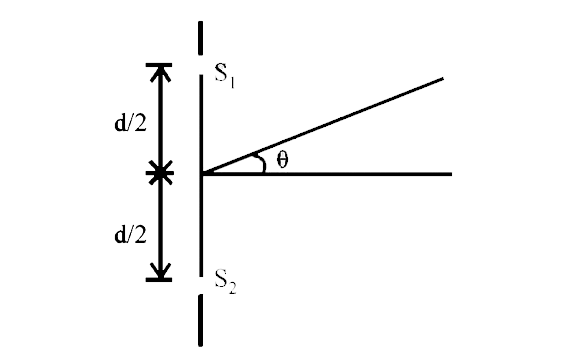
In an interference arrangement similar to Young's double-slit experiment, the slits S_1 and S_2 are illuminated with coherent microwave sources, each of frequency 10^6 Hz. The sources are synchronized to have zero phase difference. The slits are separated by a distance d=150.0 m. The intensity I (theta) is measured as a function of theta, where theta is defined as shown. If I_0 is the maximum intensity, then I (theta) for 0lethetale90degree is given by

A

`I(theta)=(i_0)/(2) for theta=30degree`

B

`i(theta)=(I_0)/(4) for theta=90degree`

C

`I(theta)=I_0 for theta=0degree`

D

`I(theta)` is constant for all

Text Solution

Verified by Experts

The correct Answer is:

C

Promotional Banner

Topper's Solved these Questions

  • MOVING CHARGES AND MAGNETISM

    SUNIL BATRA (41 YEARS IITJEE PHYSICS)|Exercise MCQs(d )|1 Videos

Similar Questions

Explore conceptually related problems

In an interference arrangement similar to young's double slit experiment the slits S_(1) and S_(2) are illuminated with coherent microwave sources each of frequency 10^(6)Hz the sources are synchronized to have zero phase difference. the slits are separated by a distance d=150.0m. The intensity I(theta) is measured as a funtion of theta , where theta is defined as shown. if I_(0) is the maximum intensity then I(theta) for 0lethetale90^(@) is given by:

In an interference arrangement similar to double-slit experiment, S_(1) and S_(2) are illuminated with coherent source microwave source each of frequency 1 MHz. the sources are synchronized to have zero phase difference . This slits are separated by distance d = 150.0m The intensity I (theta) is measured as a funciton of theta , where theta is defined as shown in figure. If I_(0) is maximum intensity, calculate I (theta) For : a. theta = 0 b. theta = 30^(@) c. theta = 90^(@)

Consider an interference arrangement similar to YDSE. Slits S_(1) and S_(2) are illuminated with coherent microwave sources each of frequency 2 MHz. The sources are synchronised to have zero phase difference. The slits are separated by distance d= 75m. The intensity I_((theta)) is measured as a function of theta where theta is defined as shown in figure. if I_(0) is maximum intensity then calculated I_((theta)) for (i) theta= 0^(@), (ii) theta=pi//6 and (iii) theta = pi//2

In a interference arrangement similar to Young's double-slit experiment ,the slits S_(1) and S_(2) are illuminated with coheremt microwave source ,each of frequencies 10^(6) Hz.The source are syhronized to have zero phase difference.The slits are separated by a distance from S_(1) and S_(2) where theta is defined as shown if I_(0) is the maximum intensity then

In Young's double slit experiment, if the two slits are illuminated with separate sources, no interference pattern is observed because

In a Young’s double slit experiment, the source illuminating the slits is changed from blue to violet. The width of the fringes

In Young's double slit experiment, the ratio of maximum and minimum intensities in the fringe system is 9:1 the ratio of amplitudes of coherent sources is

In Young's double slit experiment, the intensity of central maximum is I . What will be the intensity at the same place if one slit is closed ?

S_(1) and S_(2) are two coherent sources of sound of frequency 110Hz each they have no initial phase difference. The intensity at a point P due to S_(1) is I_0 and due to S_2 is 4I_0 . If the velocity of sound is 330m//s then the resultant intensity at P is

SUNIL BATRA (41 YEARS IITJEE PHYSICS)-RAY AND WAVE OPTICS-JEE Main And Advanced
  1. The focal length of the objective and the eye piece of a compound micr...

    Text Solution

    |

  2. Consider Fraunhoffer diffraction pattern obtained with a single slit i...

    Text Solution

    |

  3. In an interference arrangement similar to Young's double-slit experime...

    Text Solution

    |

  4. A concave lens of glass, refractive index 1.5 has both surfaces of sam...

    Text Solution

    |

  5. Yellow light is used in a single slit diffraction experiment with slit...

    Text Solution

    |

  6. A thin slice is cut out of a glass cylinder along a plane parallel to ...

    Text Solution

    |

  7. A hollow double concave lens is made of very thin transparent material...

    Text Solution

    |

  8. A point source of light B is placed at a distance L in front of the ce...

    Text Solution

    |

  9. A diverging beam of light from a point source S having devergence angl...

    Text Solution

    |

  10. A rectengular glass slab ABCD of refractive index n1 is immersed in wa...

    Text Solution

    |

  11. In a double slit experiment instead of taking slits of equal widths, o...

    Text Solution

    |

  12. In a compound microscope, the intermediate image is

    Text Solution

    |

  13. Two beams of ligth having intensities I and 4I interface to produce a ...

    Text Solution

    |

  14. In a Young's double slit experiment, 12 fringes are observed to be for...

    Text Solution

    |

  15. A ray of light passes through four transparent media with refractive i...

    Text Solution

    |

  16. A given ray of light suffers minimum deviation in an equilateral prism...

    Text Solution

    |

  17. An observer can see through a pin-hole the top end of a thin rod of he...

    Text Solution

    |

  18. Which one of the following spherical lenses does not exhibit dispersio...

    Text Solution

    |

  19. In the ideal double-slit experiment, when a glass-plate(refractive ind...

    Text Solution

    |

  20. Two plane mirrors A and B are aligned parallel to each other, as shown...

    Text Solution

    |
