Home
Class 12
PHYSICS
A thin slice is cut out of a glass cylin...

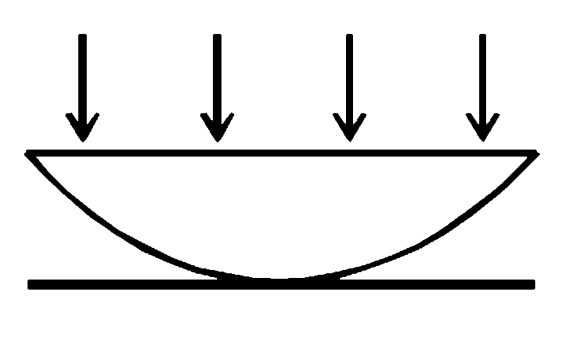
A thin slice is cut out of a glass cylinder along a plane parallel to its axis. The slice is placed on a flat glass plate as shown in Figure. The observed interference fringes from this combination shall be

A

straight

B

circular

C

equally spaced

D

having fringe spacing which increases as we go outwards

Text Solution

Verified by Experts

The correct Answer is:

A

Locus of equal path difference are lines runnning parallel to axis of the cylinder. Hence straight fringes will be observed.
Promotional Banner

Topper's Solved these Questions

  • MOVING CHARGES AND MAGNETISM

    SUNIL BATRA (41 YEARS IITJEE PHYSICS)|Exercise MCQs(d )|1 Videos

Similar Questions

Explore conceptually related problems

A thin slice is cut out of a glass cylinder along a plane parallel to its axis. The slice is placed on a flat glass plate with the curved surface downwards. Monochromatic light is incident normally from the top. The observed interference fringes from the combination do not follow on of the following statements.

Assertion: A glass hemisphere is placed on a flat plate as shown. The observed interference fringes from this combination shall be circular. Reason: In all cases fringes are circular.

The length of a magnet is large compared to its width and breadth. The time period of its oscillation in a vibration magnetometer is T. The magnet is cut along its length into six parts and these parts are then placed togather as shown in the figure. The time period of this combination will be

A point sources S emitting light of wavelength 600nm is placed at a very small height h above the flat reflecting surface AB (see figure).The intensity of the reflected light is 36% of the intensity.interference firnges are observed on a screen placed parallel to the reflecting surface a very large distance D from it. (A)What is the shape of the interference fringes on the screen? (B)Calculate the ratio of the minimum to the maximum to the maximum intensities in the interference fringes fromed near the point P (shown in the figure) (c) if the intenstities at point P corresponds to a maximum,calculate the minimum distance through which the reflecting surface AB should be shifted so that the intensity at P again becomes maximum.

A convex lens is cut in half along its principal axis and the two halves are separated by a distance of 12cm. An object is placed 6cm in front of the lens as shown in Figure., Two sharp images are formed on the screen placed 80cm from the oject. What is the focal length of the lens?

The two surfaces of a biconvex lens has same radii of curvatures . This lens is made of glass of refractive index 1.5 and has a focal length of 10 cm in air. The lens is cut into two equal halves along a plane perpendicular to its principal axis to yield two plane - convex lenses. The two pieces are glued such that the convex surfaces touch each other. If this combination lens is immersed in water (refractive index = 4/3 ), its focal length (in cm ) is

The concave surface of a thin concavo -convex lens of glass of refractive index 1.5 has a radius of curvature of 20cm .The concave surface has a radius of curvature of 60cm .The covnex side is silvered and placed on a horizontal surface as shown in the figure. A small object is placed on the principal axis of the combination,at a distance of 30cm in front of the mirror.The magnification of the image is

A certain transmission line (very long) is constructed from two thin metal plates (parallel to each other) of width b, which are separated by a very small distance ‘h’ lt lt ‘b’ . The current travels down one strip and back along the other, and it is distributed uniformly over the surface of the plates as shown in figure. Neglect fringing field at ends of plates. Capacitance per unit length of this combination is

SUNIL BATRA (41 YEARS IITJEE PHYSICS)-RAY AND WAVE OPTICS-JEE Main And Advanced
  1. A concave lens of glass, refractive index 1.5 has both surfaces of sam...

    Text Solution

    |

  2. Yellow light is used in a single slit diffraction experiment with slit...

    Text Solution

    |

  3. A thin slice is cut out of a glass cylinder along a plane parallel to ...

    Text Solution

    |

  4. A hollow double concave lens is made of very thin transparent material...

    Text Solution

    |

  5. A point source of light B is placed at a distance L in front of the ce...

    Text Solution

    |

  6. A diverging beam of light from a point source S having devergence angl...

    Text Solution

    |

  7. A rectengular glass slab ABCD of refractive index n1 is immersed in wa...

    Text Solution

    |

  8. In a double slit experiment instead of taking slits of equal widths, o...

    Text Solution

    |

  9. In a compound microscope, the intermediate image is

    Text Solution

    |

  10. Two beams of ligth having intensities I and 4I interface to produce a ...

    Text Solution

    |

  11. In a Young's double slit experiment, 12 fringes are observed to be for...

    Text Solution

    |

  12. A ray of light passes through four transparent media with refractive i...

    Text Solution

    |

  13. A given ray of light suffers minimum deviation in an equilateral prism...

    Text Solution

    |

  14. An observer can see through a pin-hole the top end of a thin rod of he...

    Text Solution

    |

  15. Which one of the following spherical lenses does not exhibit dispersio...

    Text Solution

    |

  16. In the ideal double-slit experiment, when a glass-plate(refractive ind...

    Text Solution

    |

  17. Two plane mirrors A and B are aligned parallel to each other, as shown...

    Text Solution

    |

  18. In the adjacent diagram, CP represents a wavefront and AO & BP, the co...

    Text Solution

    |

  19. The size of the image of an object, which is at infinity, as formed by...

    Text Solution

    |

  20. A ray of light is incident at the glass-water interface at an angle I,...

    Text Solution

    |
