Home
Class 12
PHYSICS
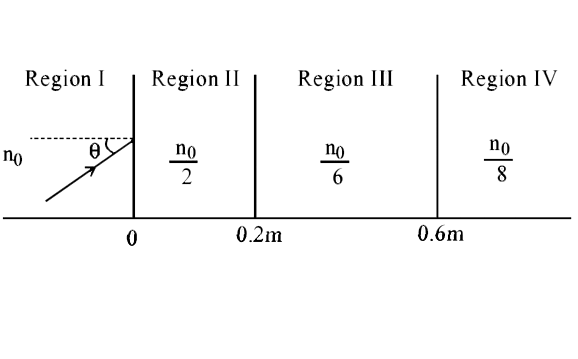
A light beam is travelling from Region I...

A light beam is travelling from Region `I` to `IV` (figure). The refractive index in regionals `I,II,III` and `IV` are `n_0=(n_0)/(2)`(n_0)/(6) and (n_0)/(8)` respectively. The angle of incidence `theta` for which the beam just misses entering region IV is- `

A

`sin^(-1)((3)/(4))`

B

`sin^(-1)((1)/(8))`

C

`sin^(-1)((1)/(4))`

D

`sin^(-1)((1)/(3))`

Text Solution

Verified by Experts

The correct Answer is:
B


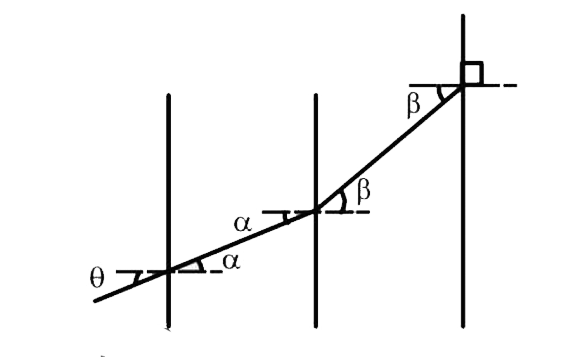
For refraction at parallel interfaces
`n_(0)sintheta=(n_(0))/(2)sinalpha=(n_(0))/(6)sinbeta=(n_(0))/(8)sin90degree`
`:'`sin theta=(1)/(8)
Promotional Banner

Topper's Solved these Questions

  • MOVING CHARGES AND MAGNETISM

    SUNIL BATRA (41 YEARS IITJEE PHYSICS)|Exercise MCQs(d )|1 Videos

Similar Questions

Explore conceptually related problems

A light beam is traveling from Region I to region IV (refer figure). The refractive indices in Region I, II, III, and IV are n_(0), n_(0)//2,n_(0)//6 and n_(0)//8 , respectively. The angle of incidence theta for which the beam just misses entering Region IV is

An intially parallel cyclindrical beam travels in a medium of refractive index mu (I) = mu_(0) + mu_(2) I , where mu_(0) and mu_(2) are positive constants and I is intensity of light beam. The intensity of the beam is decreasing with increasing radius. Answer the following questions : As the beam enters the medium, it will

An intially parallel cyclindrical beam travels in a medium of refractive index mu (I) = mu_(0) + mu_(2) I , where mu_(0) and mu_(2) are positive constants and I is intensity of light beam. The intensity of the beam is decreasing with increasing radius. Answer the following questions : The initial shape of the wavefront of the beam is

An intially parallel cyclindrical beam travels in a medium of refractive index mu (I) = mu_(0) + mu_(2) I , where mu_(0) and mu_(2) are positive constants and I is intensity of light beam. The intensity of the beam is decreasing with increasing radius. Answer the following questions : The speed of light in the medium is

A ray of light travels from a medium of refractive index n_(1) to a medium of refractive index n_(2) . If angle of incidence is i and angle of refraction is r, than (sin i)/(sin r) is equal to

Intensity of a light beam can be defined as amount of light energy incident in unit time on a unit area held normal to the direction of beam. A light beam of intensity I_(0) has a circular cross section of diameter d_(0) . This beam is travelling in a medium of refractive index mu = sqrt(2) and gets incident on the medium – air boundary at an angle of incidence i = 30° . Assume that entire light energy gets transmitted into air. Find the intensity (I) of transmitted light beam.

For a prism angle theta = 60^0 the refractive indices of the left half and right half are resp, n1 and n2 (n2gen1) as shown in figure. The angle of incidence i is chosen such that the incident light rays will have minimum deviation if n1 = n2 = n = 1.5. For case of unequal refractive indices n1 = n and n2 = n+ delat(n) the angle of emergence e = i + delta (e) . Which of the following statement is/are correct?

A light ray enters into a medium whose refractive index varies along the x-axis as n(x) = n_(0) sqrt(1+(x)/(4)) where n_(0)=1 . The medium is bounded by the plates x =0,x =1 & y =0 . It the ray enters at the origin at an angle 30^(@) with x-axis

SUNIL BATRA (41 YEARS IITJEE PHYSICS)-RAY AND WAVE OPTICS-JEE Main And Advanced
  1. A ray of light travelling in water is incident on its surface open to ...

    Text Solution

    |

  2. Two beams of red and violet colours are made to pass separately throug...

    Text Solution

    |

  3. A light beam is travelling from Region I to IV (figure). The refractiv...

    Text Solution

    |

  4. A ball is dropped from a height of 20 m above the surface of water in ...

    Text Solution

    |

  5. A biconvex lens of focal length 15 cm is in front of a plane mirror. T...

    Text Solution

    |

  6. A light ray travelling in glass medium is incident of glass- air inter...

    Text Solution

    |

  7. A bi-convex lens is formed with two thin plano-convex lenses as shown ...

    Text Solution

    |

  8. Young's double slit experiment is carried out by using green, red and ...

    Text Solution

    |

  9. A ray of light travelling in the direction (1)/(2)(hati,+sqrt3hatj) is...

    Text Solution

    |

  10. In the Young's double slit experiment using a monochromatic light of w...

    Text Solution

    |

  11. A point source S is placed at the bottom of a tranparent block of heig...

    Text Solution

    |

  12. A parallel beam of light is incident from air at an angle alpha on the...

    Text Solution

    |

  13. A small object is placed 50 cm to the left of a thin convex lens of fo...

    Text Solution

    |

  14. In the Young's double slit experiment, the interference pattern is fou...

    Text Solution

    |

  15. A convex lens of focal length 40 cm is in contact with a concave lens ...

    Text Solution

    |

  16. White light is used to illuminate the two slits in a Young's double sl...

    Text Solution

    |

  17. A converging lens is used to form an image on a screen. When the upper...

    Text Solution

    |

  18. A short linear object of length b lies along the axis of a concave mir...

    Text Solution

    |

  19. A beam of light consisting of red, green and blue colours is incident ...

    Text Solution

    |

  20. An astronomical telescope has an angular magnification of magnitude 5 ...

    Text Solution

    |

